
Penny Dreadfuls, 1890 · page 26 of 31
Old Cap. Collier Library No. 379: The Lawyer Detective — page 26: what you’re looking at
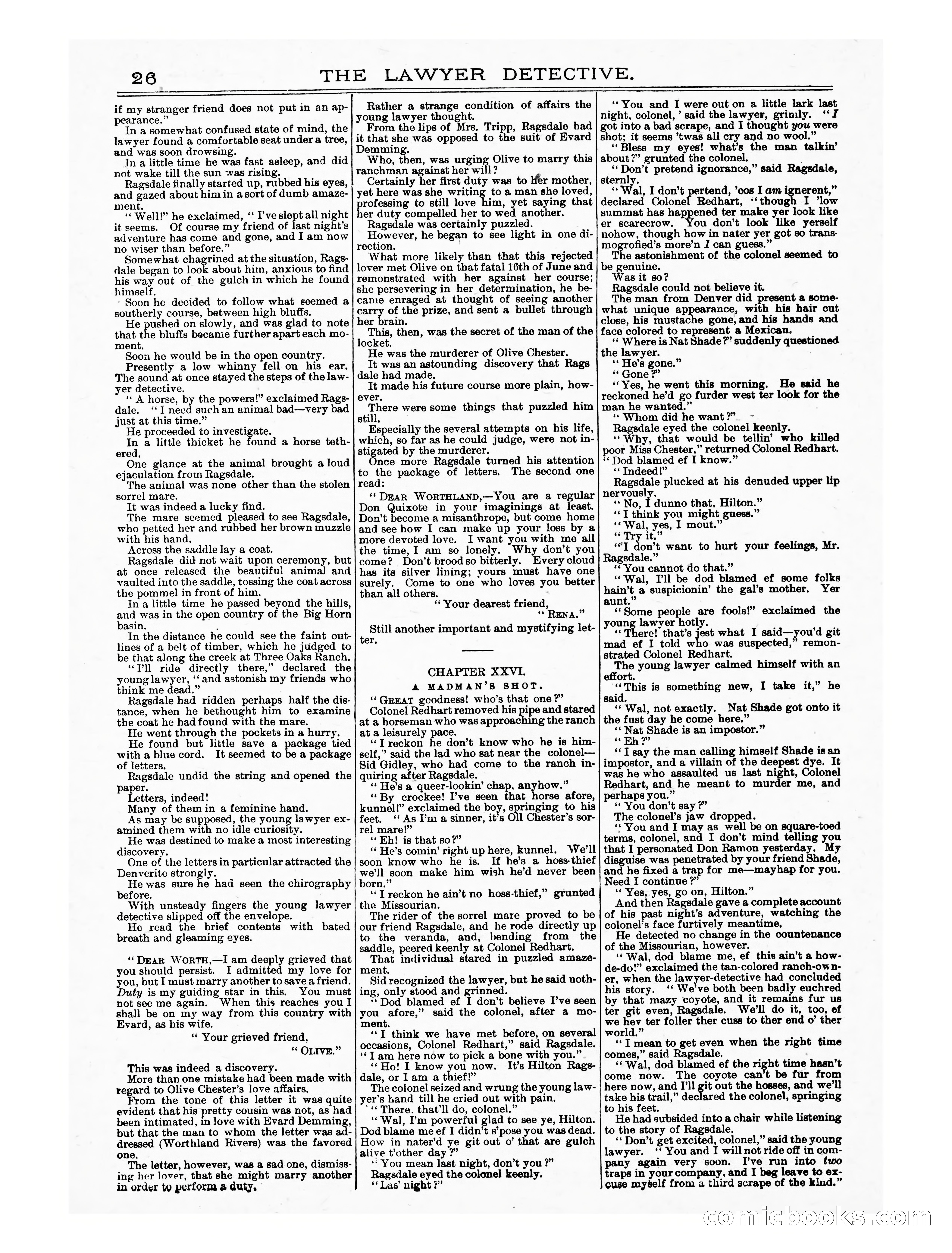
A restored page from Penny Dreadfuls, 1890. Page through the whole issue in the reader above.
📄 Transcribed text from this page (OCR, searchable)
Machine-transcribed from the original scan — historical spelling and the odd misread are preserved.
26 THE LAWYER DETECTIVE. ee eeeeoneag=00—0—0—0N0NNNNNNN SSS aware" if my stranger friend does not put in an ap- pearance.” In a somewhat confused state of mind, the lawyer found a comfortable seat under a tree, and was soon drowsing. In a little time he was fast asleep, and did not wake till the sun was rising. Ragsdale finally started up, rubbed his eyes, and gazed about him in a sort of dumb amaze- ment. “Well!” he exclaimed, ‘‘ I’veslept all night it seems. Of course my friend of last night’s adventure has come and gone, and I am now no wiser than before.” Somewhat chagrined at the situation, Rags- dale began to look about him, anxious to find his way out of the gulch in which he found himself. Soon he decided to follow what seemed a southerly course, between high bluffs. He pushed on slowly, and was glad to note that the bluffs became further apart each mo- ment, Soon he would be in the open country. Presently a low whinny fell on his ear. The sound at once stayed the steps of the law- yer detective. ‘‘ A horse, by the powers!” exclaimed Rags- dale. ‘I need suchan animal bad—very bad just at this time.” He proceeded to investigate. In a little thicket he found a horse teth- ered, One glance at the animal brought a loud ejaculation from Ragsdale. The animal was none other than the stolen sorrel mare. It was indeed a lucky find. The mare seemed pleased to see Ragsdale, who petted her and rubbed her brown muzzle with his hand. Across the saddle lay a coat. Ragsdale did not wait upon ceremony, but at once released the beautiful animal and vaulted into the saddle, tossing the coat across the pommel in front of him. In a little time he passed beyond the hills, and was in the open country of the Big Horn asin. ; In the distance he could see the faint out- lines of a belt of timber, which he judged to be that along the creek at Three Oaks Ranch. “lll ride directly there,” declared the young lawyer, ‘‘and astonish my friends who think me dead.” Ragsdale had ridden perhaps half the dis- tance, when he bethought him to examine the coat he had found with the mare. He went through the pockets in a hurry. He found but Jittle save a package tied with a blue cord. It seemed to be a package of letters. Ragsdale undid the string and opened the paper. tters, indeed! Many of them in a feminine hand. As may be supposed, the young lawyer ex- amined them with no idle curiosity. He was destined to make a most interesting discovery. One of the letters in particular attracted the Denverite strongly. He was sure he had seen the chirography before. With unstead detective slippe He read the brief contents breath and gleaming eyes. fingers the young lawyer off the envelope. with bated ‘“DEAR WORTH,—I am deeply grieved that you should persist. I admitted my love for you, but I must marry another to save a friend. Duty is my guiding star in this. You must not see me again. When this reaches you I shall be on my way from this country with Evard, as his wife. ‘‘ Your grieved friend, ‘* OLIVE.” This was indeed a discovery. More than one mistake had been made with regard to Olive Chester’s love affairs. From the tone of this letter it was quite evident that his pretty cousin was not, as had been intimated, in love with Evard Demming, but that the man to whom the letter was ad- dressed (Worthland Rivers) was the favored one. The letter, however, was a sad one, dismiss- ing her lover, that she might marry another in order to perform a duty, Rather a strange condition of affairs the young lawyer thought. From the lips of Mrs, Tripp, Ragsdale had it that she was opposed to the suit of Evard Demming. Who, then, was urging Olive to marry this ranchman against her will? Certainly her first duty was to Her mother, yet here was she writing to a man she loved, protessne to still love him, ze saying that er duty compelled her to wed another. Ragsdale was certainly puzzled. However, he began to see light in one di- rection. | What more likely than that this rejected lover met Olive on that fatal 16th of June and remonstrated with her against her course; she persevering in her determination, he be- came enraged at thought of seeing another carry of the prize, and sent a bullet through her brain. This, then, was the secret of the man of the locket. He was the murderer of Olive Chester. It was an astounding discovery that Rags dale had made. It made his future course more plain, how- ever. pero were some things that puzzled him still. Especially the several attempts on his life, which, so far as he could judge, were not in- poigated by the murderer. nce more Ragsdale turned his attention to we package of letters. The second one read: ‘¢DrarR WORTHLAND,—You are a regular Don Quixote in your imaginings at least. Don’t become a misanthrope, but come home and see how I can make up your loss by a more devoted love. I want you with me all the time, I am so lonely. Why don’t you come? Don’t broodso bitterly. Every cloud has its silver lining; yours must have one surely. Come to one who loves you better than all others. ‘Your dearest friend, ‘“RENA.” Still another important and mystifying let- ter, CHAPTER XXVI. A MADMAN’S SHOT. ‘‘GREAT goodness! who’s that one?” Colonel Redhart removed his pipe and stared at a horseman who was approaching the ranch at a leisurely pace. ‘‘T reckon he don’t know who he is him- self,” said the lad who sat near the colonel— Sid Gidley, who had come to the ranch in- quiring after Ragsdale. ‘‘ He’s a queer-lookin’ chap, anyhow.” ‘‘By crockee! I’ve seen that horse afore, kunnel!” exclaimed the boy, springing to his feet. ‘‘ As I’m a sinner, it’s Oll Chester’s sor- rel mare!” ‘‘Eh! is that so?” ‘‘ He’s comin’ right up here, kunnel. We'll soon know who he is. If he’s a hoss-thief we'll soon make him wish he’d never been born.” ‘‘ T reckon he ain’t no hoss-thief,” grunted the Missourian. The rider of the sorrel mare proved to be our friend Ragsdale, and he rode directly up to the veranda, and, bending from the saddle, peered keenly at Colonel Redhart. That individual stared in puzzled amaze- ment. Sid recognized the lawyer, but he said noth- ing, only stood and grinned. ‘Dod blamed ef I don’t believe I’ve seen you afore,” said the colonel, after a mo- ment. ‘‘T think we have met before, on several occasions, Colonel Redhart,” said Ragsdale. ‘¢T am here now to pick a bone with you.” ‘‘Ho! I know you now. It’s Hilton Rags- dale, or Iam a thief!” The colonel seized and wrung the young law- yer’s hand till he cried out with pain. ‘There, that'll do, colonel.” ‘« Wal, I’m powerful glad to see ye, Hilton. Dod blame me ef I didn’t s’pose you was dead. How in nater’d ye git out o’ that are gulch alive tother day ?” ‘You mean last night, don’t you ?” Ragsdale eyed the colonel keenly. ‘* Las’ night ?” ‘“You and I were out on a little lark last night, colonel, ’ said the lawyer, grimly. ‘I got into a bad scrape, and I thought you were shot; it seems ’twas all cry and no wool.” ‘‘Bless my eyes! what’s the man talkin’ about?” grunted the colonel. ‘‘Don’t pretend ignorance,” said Ragsdale, sternly. ‘‘Wal, I don’t pertend, ’cos I am ignerent,” declared Colonel Redhart, ‘‘though I ‘low summat has happened ter make yer look like er scarecrow. You don’t look like yerself nohow, though how in nater yer got so trans- mogrofied’s more’n J can guess.” The astonishment of the colonel seemed to be genuine. Was it so? Ragsdale could not believe it. The man from Denver did present a some- what unique appearance, with his hair cut close, his mustache gone, and his hands and face colored to represent a Mexican. ‘‘ Where is Nat Shade?” suddenly questioned the lawyer. ; ‘* He’s gone.” ‘* Gone ?” ‘“Yes, he went this morning. He said he reckoned he’d go furder west ter look for the man he wanted.” ‘““ Whom did he want?” - Ragsdale eyed the colonel keenly. ‘¢ Why, that would be tellin’ who killed poor Miss Chester,” returned Colonel Redhart. ‘¢ Dod blamed ef I know.” ‘* Indeed!” Ragsdale plucked at his denuded upper lip nervously, ‘¢No, I dunno that, Hilton.” ‘“‘T think you might guess.” ‘© Wal, yes, I mout.” ‘Try it.” ‘°T don’t want to hurt your feelings, Mr. Ragsdale.” “You cannot do that.” ‘Wal, I'll be dod blamed ef some folks hain’t a suspicionin’ the gal’s mother. Yer aunt.” ‘‘Some people are fools!” exclaimed the young lawyer hotly. ‘There! that’s jest what I said—you'd git mad ef I told who was suspected,” remon- strated Colonel Redhart. The young lawyer calmed himself with an effort. “This is something new, I take it,” he said, ‘‘ Wal, not exactly. Nat Shade got onto it the fust day he come here.” ‘‘ Nat Shade is an impostor.” “Eh?” ‘‘T say the man calling himself Shade is an impostor, and a villain of the deepest dye. It was he who assaulted us last night, Colonel Redhart, and he meant to murder me, and perhaps you.” ‘¢ You don’t say ?” The colonel’s jaw dropped. ‘‘ You and I may as well be on square-toed terms, colonel, and I don’t mind telling you that I personated Don Ramon yesterday. My disguise was penetrated by your friend Shade, and he fixed a trap for me—mayhap for you. Need I continue ?” ‘¢ Yes, yes, go on, Hilton.” And then Ragsdale gave a complete account of his past night’s adventure, watching the colonel’s face furtively meantime, He detected no change in the countenance of the Missourian, however. ‘‘ Wal, dod blame me, ef this ain’t a how- de-do!” exclaimed the tan-colored ranch-own- er, when the lawyer-detective had concluded his story. ‘‘ We've both been badly euchred by that mazy coyote, and it remains fur us ter git even, Ragsdale. We'll do it, too, ef we hev ter foller ther cuss to ther end o’ ther world.” ‘‘T mean to get even when the right time comes,” said Ragsdale. ‘‘Wal, dod blamed ef the right time hasn’t come now. The coyote can’t be fur from here now, and I’ll git out the hosses, and we'll take his trail,” declared the colonel, springing to his feet. He had subsided into a chair while listening to the story of Ragsdale. ‘Don’t get excited, colonel,” said the young lawyer. ‘‘ You and I will not ride off in com- pany again very soon. I’ve run into two traps in your company, and I beg leave to ex- cuse myself from a third scrape of the kind.” C MICLOO© (CO) SS (C(O)