
Penny Dreadfuls, 1894 · page 6 of 16
Yale Murphy, the Great Short-Stop — page 6: what you’re looking at
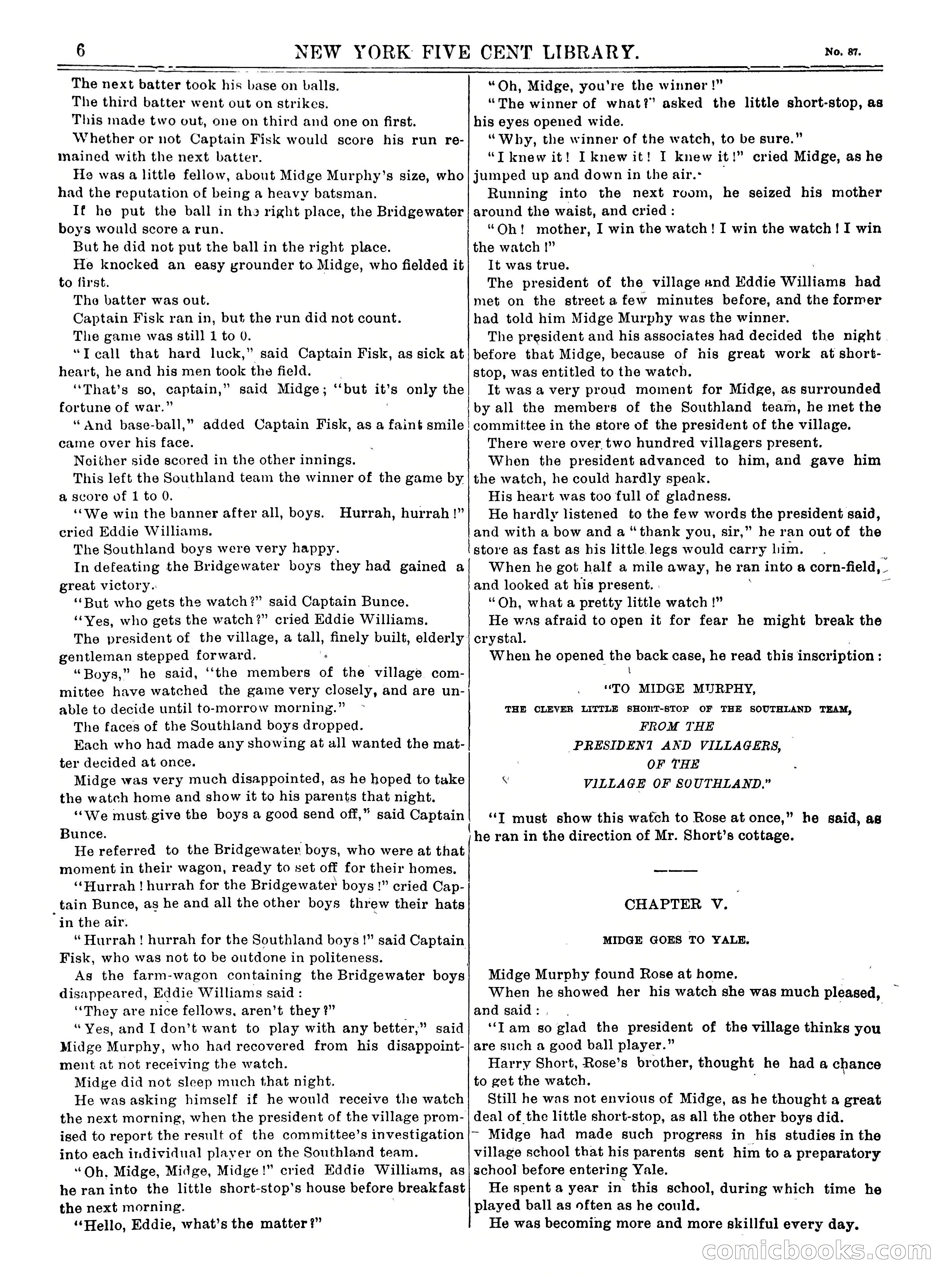
A restored page from Penny Dreadfuls, 1894. Page through the whole issue in the reader above.
📄 Transcribed text from this page (OCR, searchable)
Machine-transcribed from the original scan — historical spelling and the odd misread are preserved.
6 NEW YORK FIVE CENT LIBRARY. —y oe The next batter took his Lage on balls. The third batter went out on strikes. This made two out, one on third and one on first. Whether or not Captain Fisk would score his run re- mained with the next batter. He was a little fellow, about Midge Murphy’s size, who had the reputation of being a heavy batsman. If he put the ball in the right place, the Bridgewater boys would score a run. But he did not put the ball in the right place. He knocked an easy grounder to Midge, who fielded it to first. ] The batter was out. Captain Fisk ran in, but the run did not count. The game was still 1 to 0. “T call that hard luck,” said Captain Fisk, as sick at heart, he and his men took the field. “That’s so, captain,” said Midge; fortune of war.” “And base-ball,” added Captain Fisk, as a faint smile came over his face. Neoither side scored in the other innings. This left the Southland team the winner of the game by. a score of 1 to 0. © ‘‘We win the banner after all, boys. cried Eddie Williams. The Southland boys were very happy. | In defeating the Bridgewater boys they had gained a great victory. ‘‘But who gets the watch?” said Captain Bunce. ‘Ves, who gets the watch?” cried Eddie Williams. The president of the village, a tall, finely built, elderly gentleman stepped forward. ts “Boys,” he said, ‘‘the members of the village com- mittee have watched the game very closely, and are un- able to decide until to-morrow morning.” ~ The faces of the Southland boys dropped. Each who had made any showing at all wanted the mat- ter decided at once. 7 ( “but it’s only the Hurrah, hurrah !” Midge was very much disappointed, as he hoped to take the watch home and show it to his parents that night. ‘““We must.give the boys a good send off,” said Captain Bunce. He referred to the Bridgewater boys, who were at that moment in their wagon, ready to set off for their homes. ‘Hurrah ! hurrah for the Bridgewater boys!” cried Cap- tain Bunce, as he and all the other boys threw their hats “in the air. . “Hurrah! hurrah for the Southland boys!” said Captain Fisk, who was not to be outdone in politeness. | As the farm-wagon containing the Bridgewater boys disappeared, Eddie Williams said : “They are nice fellows, aren’t they ?” “Yes, and I don’t want to play with any better,” said Midge Murphy, who had recovered from his disappoint- ment at not receiving the watch. Midge did not sleep much that night. He was asking himself if he would receive the watch the next morning, when the president of the village prom- —Seee ee, “Oh, Midge, you’re the winner !” “The winner of what?’ asked the little short-stop, as his eyes opened wide. “Why, the winner of the watch, to be sure.” “T knew it! Iknewit! I knew it!” cried Midge, as he jumped up and down in the air.- Running into the next room, he seized his mother around the waist, and cried : “Oh! mother, I win the watch! I win the watch! I win the watch !” It was true. The president of the village and Eddie Williams had met on the street a few minutes before, and the former had told him Midge Murphy was the winner. The president and his associates had decided the night. betore that Midge, because of his great work at short- stop, was entitled to the watch. It was a very proud moment for Midge, as surrounded by all the members of the Southland team, he met the committee in the store of the president of the village. There were over two hundred villagers present. When the president advanced to him, and gave him the watch, he could hardly speak. His heart was too full of gladness. He hardly listened to the few words the president said, and with a bow and a “thank you, sir,” he ran out of the store as fast as his little legs would carry him. When he got half a mile away, he ran into a corn- -field,_ and looked at his present. . “Oh, what a pretty little watch !” He was afraid to open it for fear he might break the crystal. When he opened ie back case, he read this inscription ; : “TO MIDGE MURPHY, THE CLEVER LITTLE SHORT-8STOP OF THE SOUTHLAND TEAM, FROM THE PRESIDENT AND VILLAGERS, OF THE VILLAGE OF SOUTHLAND.” ‘“‘T must show this watch to Rose at once,” he said, as he ran in the direction of Mr. Short’s cottage. CHAPTER V. MIDGE GOES TO YALE, Midge Murphy found Rose at home. When he showed her his watch she was much pleased, and said : | ‘“‘Tam so vied the president of the village thinks you are such a good ball player.” Harry Short, Rose’s brother, thought he had a chance to get the watch. Still he was not envious of Midge, as he thought a great deal of the little short-stop, as all the other boys did. ised to report the result of the committee’s investigation|— Midge had made such progress in his studies in the into each individual plaver on the Southland team. “Oh. Midge, Midge, Midge!” cried Eddie Williams, as he ran into the little short-stop’s house before breakfast the next morning. ‘‘Hello, Eddie, what’s the matter?” village school that his parents sent him toa preparatory school before entering Yale. He spent a year in this school, during which time he played ball as often as he could. He was becoming more and more skillful every day. COMME OOOKS (SO)