
Penny Dreadfuls, 1894 · page 4 of 16
Yale Murphy, the Great Short-Stop — page 4: what you’re looking at
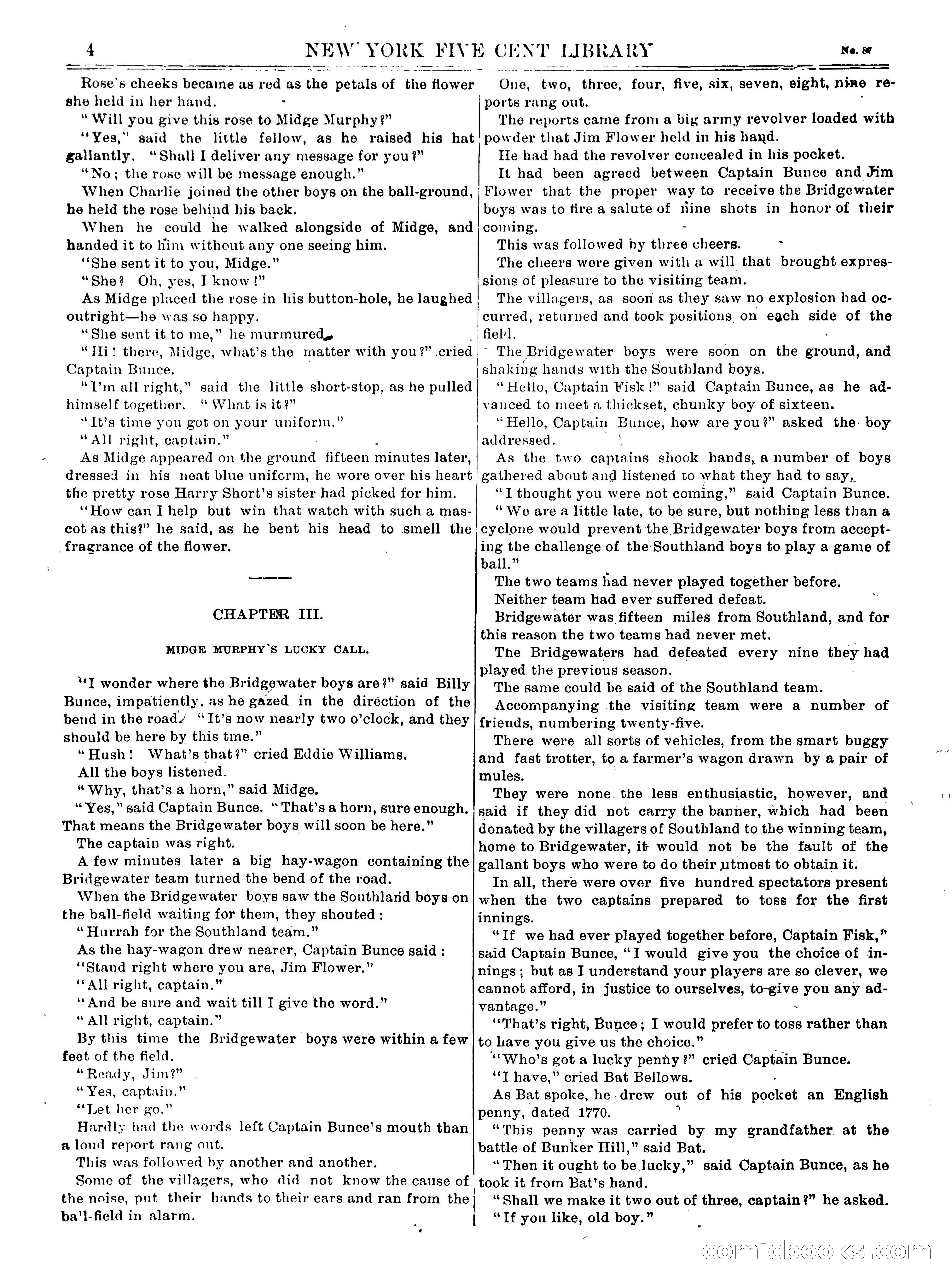
A restored page from Penny Dreadfuls, 1894. Page through the whole issue in the reader above.
📄 Transcribed text from this page (OCR, searchable)
Machine-transcribed from the original scan — historical spelling and the odd misread are preserved.
— — A, a = me i er ee eee ee she held in her hand. . “Will you give this rose to Midge Murphy?” ‘‘Yes,” gallantly. “Shall I deliver any message for you?” “No; the rose will be message enough.” When Charlie joined the other boys on the ball-ground, he held the rose behind his back. When he could he walked alongside of Midge, and handed it to him withcut any one seeing him. ‘‘She sent it to you, Midge.” “She? Oh, yes, I know !” As Midge placed the rose in his button-hole, he laughed outright—he was so happy. “She sent it to me,” he murmured, “Hi! there, Midge, what’s the matter with you?” cried Captain Bunee. | “Tm all right,” said the little short-stop, as he pulled | himself together. ‘“ What is it?” “It’s time you got on your uniform.” “All right, captain.’ As Midge appeared on the gr ound fifteen — later, s | NEW YORK FIV E CEN Tr LIBRAR Y Rose's cheeks became as red as the petals of the flower suid the little fellow, as he raised his hat Ne. & ae Ona, two, three, four, five, six, seven, eight, nine re- | ports rang out. The reports came from a big army revolver loaded with powder that Jim Flower held in his hand. He had had the revolver concealed in his pocket. It had been agreed between Captain Bunce and Jim Flower that the proper way to receive the Bridgewater boys was to fire a salute of nine shots in honor of their coming. : This was followed by three cheers. ‘ The cheers were given with a will that brought expres- -_—- of pleasure to the visiting team. The villagers, as soon as they saw no explosion had oc- |curred, returned and took positions, on egch side of the 7 ‘field. - The Bridgewater boys were soon on the pecan, and shaking hands with the Southland boys. “ Hello, Captain Fisk!” said Captain Bunce, as he ad- vanced to meet a thickset, chunky boy of sixteen. “ Hello, Captain Bunce, how are you?” asked the boy addressed. As the two captains shook hands, a number of boys dressed in his neat blue uniform, he wore over his heart} gathered about and listened to what they had to say, the pretty rose Harry Short’s sister had picked for him. ‘How can I help but win that watch with such a mas- cot as this?” he said, as he bent his head to smell the fragrance of the flower. CHAPTER III. MIDGE MURPHY'S LUCKY CALL. “I wonder where the Bridgewater boys are?” said Billy Bunce, impatiently. as he gazed in the diréction of the bend in the road’ “It’s now nearly two o’clock, and they should be here by this tme.”’ “Hush! What’s that?” cried Eddie Williams. All the boys listened. “Why, that’s a horn,” said Midge. “Yes,” said Captain Bunce. “ That’s a horn, sure enough. That means the Bridgewater boys will soon be here.” The captain was right. A few minutes later a big hay-wagon containing the Bridgewater team turned the bend of the road. When the Bridgewater boys saw the Southlarid boys on the ball-field waiting for them, they shouted: “Hurrah for the Southland team.” As the hay-wagon drew nearer, Captain Bunce said: “Stand right where you are, Jim Flower.” “All right, captain.” ‘‘And be sure and wait till I give the word.” “All right, captain.” By this. time the Bridgewater boys were within a few feet of the field. “Ready, Jim?” “Yes, captain.” ‘‘Let her go.” Hardly nad the words left Captain Bunce’s mouth than a loud report rang out. This was followed by another and another. “I thought you were not coming,” said Captain Bunce, “We are a little late, to he sure, but nothing less than a ‘cyclone would prevent the Bridgewater boys from accept- ing the challenge of the Southland boys to play a game of ball.” The two teams had never played together before. Neither team had ever suffered defeat. Bridgewater was fifteen miles from Southland, and for this reason the two teams had never met. The Bridgewaters had defeated every nine they had played the previous season. The same could be said of the Southland team. Accompanying the visiting team were a number of friends, numbering twenty-five. There were all sorts of vehicles, from the smart, buggy and fast trotter, to a farmer’s wagon drawn by a pair of mules. . They were none the less enthusiastic, however, and said if they did not carry the banner, which had been donated by the villagers of Southland to the winning team, home to Bridgewater, it would not be the fault of the gallant boys who were to do their utmost to obtain it: In all, there were over five hundred spectators present when the two captains prepared to toss for the first innings. “If we had ever played together before, Captain Fisk,” said Captain Bunce, “I would give you the choice of in- nings; but as I understand your players are so clever, we cannot afford, in justice to ourselves, to-give you any ad- vantage.” ~ “That’s right, Bunce; I would prefer to toss rather than to have you give us the choice.” - “‘Who’s got a lucky penny?” cried Captain Bunce. ‘‘T have,” cried Bat Bellows. As Bat spoke, he drew out of his Godel an English penny, dated 1770. . “This penny was carried by my grandfather. at the battle of Bunker Hill,” said Bat. “Then it ought to be lucky,” said Captain Bunce, as he Some of the villagers, who did not know the cause of took it from Bat’s hand. the noise, put their hands to their ears and ran from the ba'l-field in alarm. «€ “Shall we make it two out of three, captain?” he asked. “Tf you like, old boy.” . a S CGOMIGOOO (C(O)