
Penny Dreadfuls, 1894 · page 2 of 16
Yale Murphy, the Great Short-Stop — page 2: what you’re looking at
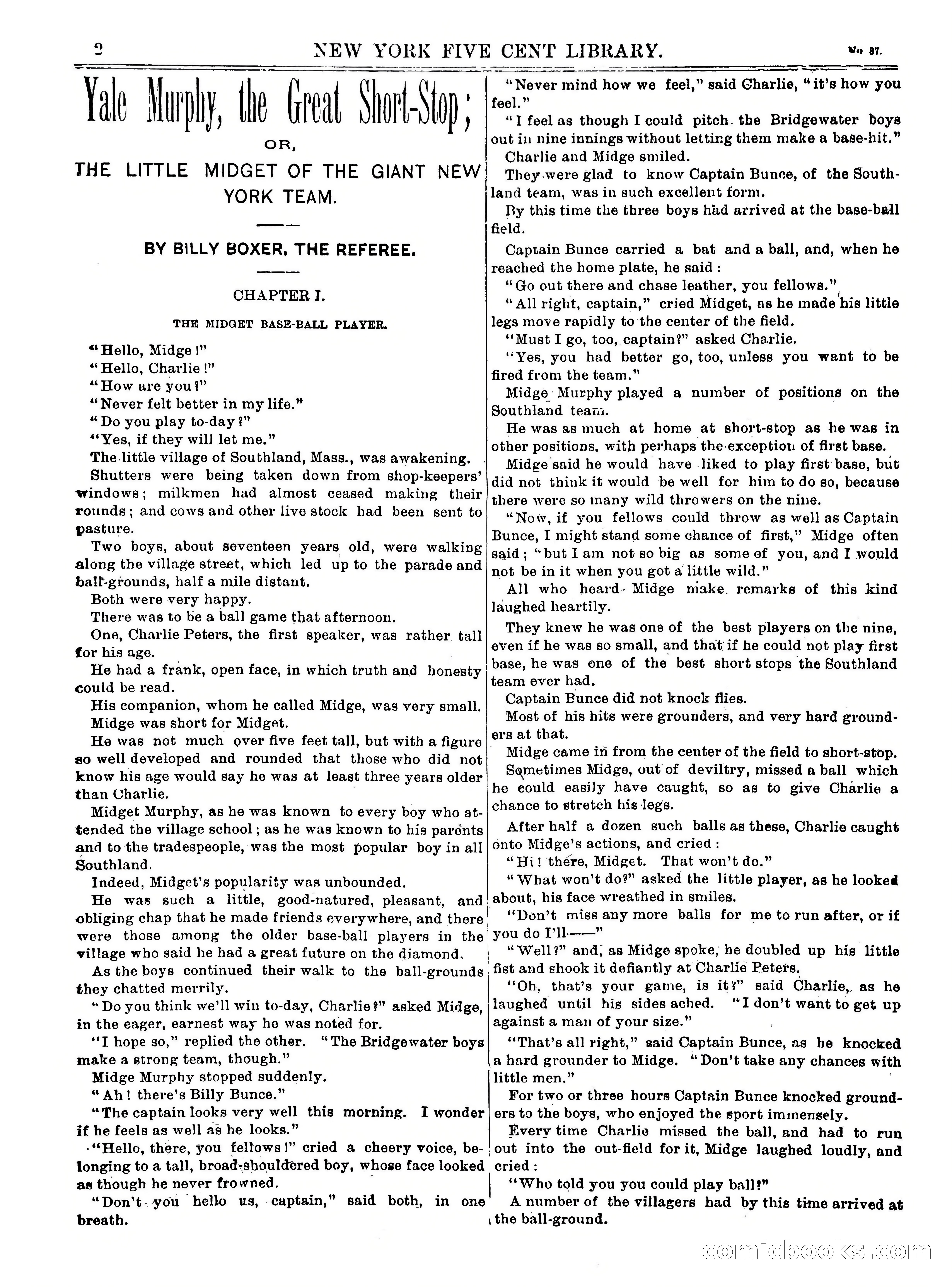
A restored page from Penny Dreadfuls, 1894. Page through the whole issue in the reader above.
📄 Transcribed text from this page (OCR, searchable)
Machine-transcribed from the original scan — historical spelling and the odd misread are preserved.
2) rr tre a THE LITTLE — or THE GIANT NEW YORK TEAM. SS BY BILLY BOXER, THE REFEREE. CHAPTER I. THE MIDGET BASH-BALL PLAYER. “Hello, Midge !” “Hello, Charlie !” ““How ure you!” ““Never felt better in my life.” “Do you play to-day ?” “Yes, if they will let me.” The. little village of Southland, Mass., was awakening. Shutters were being taken down from shop-keepers’ windows; milkmen had almost ceased making their rounds; and cows and other live stock had been sent to pasture. Two boys, about seventeen years old, were walking along the village street, which led up to the parade and ball-grounds, half a mile distant. Both were very happy. There was to be a ball game that afternoon. One, Charlie Peters, the first speaker, was rather tall for his age. He had a frank, open face, in which truth and honesty | could be read. His companion, whom he called Midge, was very small. Midge was short for Midget. He was not much over five feet tall, but with a figure |. so well developed and rounded that those who did not know his age would say he was at least three years older than Charlie. Midget Murphy, as he was known to every boy who at- tended the village school ; as he was known to his parents and to the tradespeople, was the most popular boy in all Southland. Indeed, Midget’s popularity was unbounded. He was such a little, good-natured, pleasant, and obliging chap that he made friends everywhere, and there were those among the older base-ball players in the village who said he had a great future on the diamond. As the boys continued their walk to the ball-grounds they chatted merrily. . “Do you think we’ll win to-day, Charlie?” asked Midge, in the eager, earnest way he was noted for. ‘‘I hope so,” replied the other. “The Bridgewater boys make a strong team, though.” Midge Murphy stopped suddenly. “Ah! there’s Billy Bunce.” “The captain looks very well this morning. I wonder if he feels as well as he looks.” -“Hello, there, you fellows!” cried a cheery voice, be- | longing to a tall, broad- shouldered boy, whose face looked as though he never frowned. “Don’t--you hello us, captain,” breath. said both, in one NEW YORK FIVE CENT LIBRARY. te ee nt ee ree = Yale Murphy, he trea Mort-Stap — A A A Wo 87. matin ae “Never mind how we feel,” said Charlie, “it’s how you feel.” “T feel as though I could pitch. the Bridgewater boys out in nine innings without letting them make a base-hit.” Charlie and Midge smiled. They-were glad to know Captain Bunce, of the South- land team, was in such excellent form. Ry this time the three boys had arrived at the base-ball field. Captain Bunce carried a bat anda ball, and, when he reached the home plate, he said : “Go out there and chase leather, you fellows.” “Allright, captain,” cried Midget, as he made ‘his little legs move rapidly to the center of the field. ‘“‘Must I go, too, captain?” asked Charlie. “Yes, you had better go, too, unless you want to be fired from the team.” Midge Murphy played a number of positions on the Southland teamni. He was as much at home at short-stop as he was in other positions, with perhaps the-exception of first base. Midge said he would have liked to play first base, but did not think it would be well for him to do so, because there were so many wild throwers on the nine. “Now, if you fellows could throw as well as Captain Bunce, I might stand some chance of first,” Midge often said; “but lam not so big as some of you, and I would not be init when you gota little wild.” All who heard- Midge make. remarks of this kind laughed heartily. They knew he was one of the best players on the nine, even if he was so small, and that if he could not play first Ibase, he was one of the best short stops the Southland team ever had. Captain Bunce did not knock flies. Most of his hits were grounders, and very hard ground- ers at that. Midge came in from the center of the field to short-stop. Sametimes Midge, out of deviltry, missed a ball which he eould easily have caught, so as to give Charlie a chance to stretch his legs. After half a dozen such balls as these, Charlie caught onto Midge’s actions, and cried : “Hi! thére, Midget. That won’t do.” “What won’t do?” asked the little player, as he looked about, his face wreathed in smiles. “Don’t miss any more balls for me torun after, or if you do P’ll——” “Well?” and; as Midge spoke; he doubled up his little fist and chook it defiantly at Charlie Peters. ‘‘Oh, that’s your game, is it#” said Charlie, as he laughed until his sides ached. “I don’t want to get up against a man of your size.’ “That’s all right,” said Captain Bunce, as he knocked a hard grounder to Midge. “Don’t take any chances with little men.” For two or three hours Captain Bunce knocked ground- ers to the boys, who enjoyed the sport. immensely. Every time Charlie missed the ball, and had to run ‘out into the out-field for it, Midge laughed loudly, and cried : ‘Who told you you could play ball?” A number of the villagers had by this time arrived at | the ball-ground. NOOKS. EO (CCOMMUC