
Penny Dreadfuls, 1873 · page 16 of 20
The Duchess's Revenge or The Three Warnings — page 16: what you’re looking at
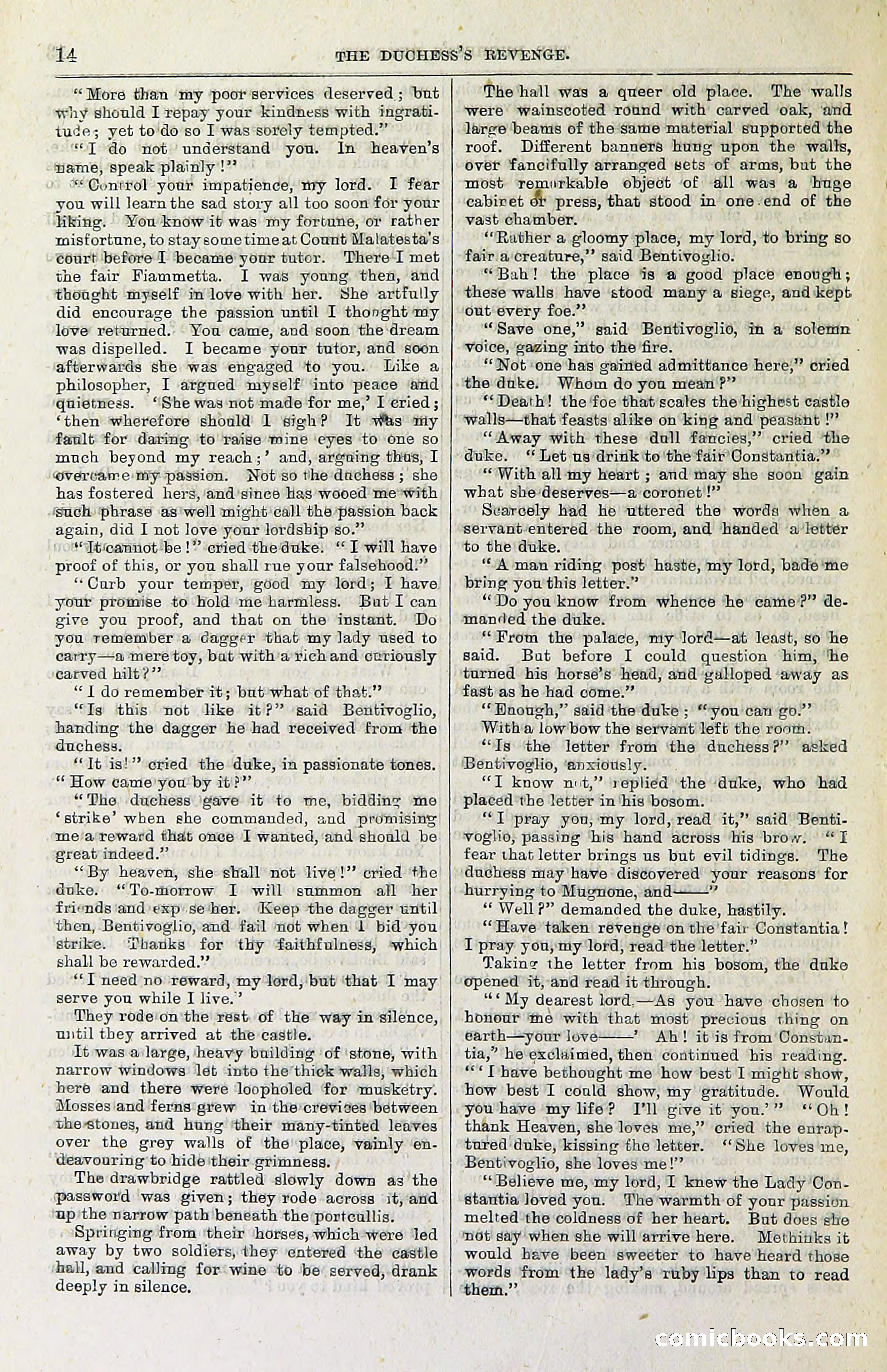
A restored page from Penny Dreadfuls, 1873. Page through the whole issue in the reader above.
📄 Transcribed text from this page (OCR, searchable)
Machine-transcribed from the original scan — historical spelling and the odd misread are preserved.
THE DUGHESS’S REVENGE. é ‘thee than my poor services deserved; but why should I repay your kindness with incrati- tude; yet to'do so I was ‘sorely tempted.” ““T do not understand you. In heaven’s -Hame, speak plainly!” “< Control your impatience, my lord. I fear you will learn the sad story all too soon for your liking. You know it was my fortune, or rather misfortune, to staysometimeat Count Malatesta’s court before I became your tutor. There I met the fair Fiammetta. I was young then, and thought myself m love with her. She artfully did encourage the passion until I thonght my love returned. You came, and soon the dream was dispelled. I became your tutor, and soon afterwards she was engaged to you. like a philosopher, I argued myself into peace anid quietness. ‘then wherefore should 1 sigh? It Was ay fault for daring to raise mine ‘eyes to one so’ much beyond my reach;’ and, ar¢ning thus, I overcame My passion. Not so the dachess; she “She was not made for me,’ I eried; has fostered hers, ‘and’sines Has wooed me with | such phrase as'well might'call the passion back again, did I not love your lordship so.” ‘“Tticannot be!” eried theduke. “ I will have proot of this, or you shall rue your falsehood.” “Curb your temper, good my lord; I have your promise to hold me harmless. give you proof, and that on the instant. ‘Do you remember a dagger that my lady used to carry—a mere toy, bat with’'a rich and cvriously carved hilt ?”’ “1 do remember it; but what of that.” ‘Ts this not lke it?” said Benttvoglio, handing the dagger he had received from the duchess. ‘It is!” eried the duke, in passionate tones. “ How came’you by it ?”’ “Phe duchess '#ave it to me, bidding me ‘strike’ when she commanded, and promising mea reward that once I wanted, ‘and shonld be great indeed.” ‘“By heaven, she shall not live!” cried the | duke. ‘To-morrow I will summon all her friends ‘and exp se ‘her. then, Bentivoglio, and fail not when 1 bid you strike. ‘hanks for thy faithfulness, vines shall be rewarded.” ““T need no ‘reward, my lord, but ‘that I may serve you while I live.” They rode'on'the rest. of the way in silence, aitil they arrived at the castle. It was a large, heavy building of ‘stone, with narrow windows let into the’thick walls, which ' here and there were loopholed ‘for muskétry. Mossesiand ferns'grew in the'creviges between the-stones, and hung ‘their many-tinted leaves — over the grey walls of the place, vainly en- deavouring to hide their ¢rimnesgs. The drawbridge rattled slowly down as the — password was given; they rode across it, and up the narrow path beneath the porteullis. Springing from ‘their horses, which were Jed away by two soldiers, they ‘entered ‘the castle hall, and callmg for wine to be served, drank deeply in silence, Bat I can | Keep the dagger until | ‘the duke. | tia,” The ‘hall was a queer old place. The walls were wainscoted round with carved oak, ‘and large beams of the same material supported the roof. Different banners hung upon the walls, over fancifully arranged sets of arms, but the most remiurkable object of all was a huge cabinet or press, that stood in one-end of the vast chamber. “Rather a gloomy place, my lord, to siti SO fair a‘creature,”’ said Bentivoclio. “Bah! the place 1s a good place enough; these walls have stood many a siege, and kept out every foe.” “Save one,” said Bentivoglio, in a solemn voice, gazing into the fire. “Not ‘one has gained admittance here,” cried Whom do you mean ?” | *“Death! the ‘foe that scales the highest castle walls—that feasts alike on king and peasizht !” “Away with these dull fancies,’’ cried the duke. “ Let us/drink ‘to 'the fair Constantia.” ‘With all my heart ; and may she soon gain what shedeserves—a_ coronet'! ie Svarcely had he uttered the words when a servant-entered the room, and handed Seve to the duke. ‘“A man riding post haste, my lord, pate me bring you this letter.” “Do you know from whence he came ?” de- mancded the duke. “From the palace, my lor@—at act so he said. But before I could question him, ‘he turned his horse’s head, and gehoped away as fast as he had come.” ‘““Wnough,” said the duke ; “you can go.”’ Witha low bow the servant left the room. ‘““Is the letter from ‘the duchess?” asked Bentivoglio, ‘anxiously. “TI know nt,” replied ‘the duke, who had placed the letter in ‘his bosom. “I ‘pray you, my lord, read it,” said Benti- vogho, passing his hand across his brow. “Tf fear that letter brings us but evil tidings. The duchess may ' have dis¢overed your reasons for hurrying to Muenone, and——” ‘* Well?” demanded the duke, hastily. ‘“Have taken revenge on the’'fair Constantia! _ I pray you, my lord, read’the letter.” Takine the lector from his bosom, the duke ‘opened it, and read it through. “< My dearest lord.—As you have chosen to honour ‘the with that most precious thing on ) Barth “your love * Ah! itis from’ Constan.. he exclaimed, then continued his reading. “« T have bethought me how best I might show, how best I could show, my oratitude. Would you have my life? Vl rive it you.” ‘Oh! thank Heaven, she loves me,” cried the enrap- tured duke, kissing the letter. “She loves me, Bentivoglio, she loves me!’’ “Believe me, my lord, I knew the Lady Con- stantia loved you. The warmth of your passion melted the coldness of her heart. But does she not say when she willarrive here. Methinks it would have been sweeter to have heard those sie from the lady’s ruby lips than to read em.”’ - (E(©) JOOKS AMIE Geom