
Penny Dreadfuls, 1850 · page 98 of 394
The Mysteries of London; or, Lights and Shadows of London Life — page 98: what you’re looking at
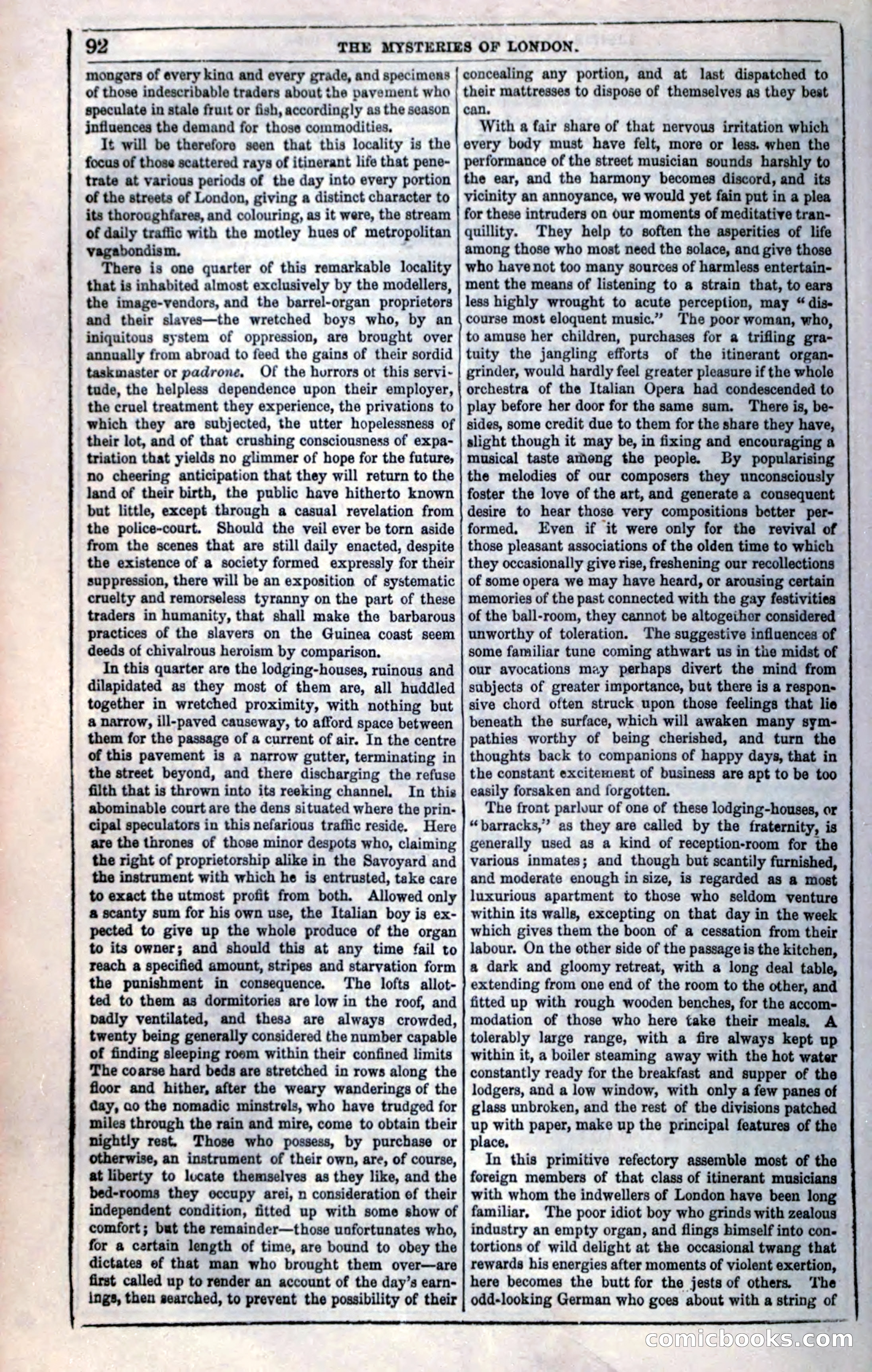
A restored page from Penny Dreadfuls, 1850. Page through the whole issue in the reader above.
📄 Transcribed text from this page (OCR, searchable)
Machine-transcribed from the original scan — historical spelling and the odd misread are preserved.
92 mongers of every kina and every grade, and specimens of those indescribable traders about the pavement who speculate in stale fruit or fish, accordingly as the season jnfluences the demand for those commodities, It will be therefore seen that this locality is the focus of those scattered rays of itinerant life that pene- trate at various periods of the day into every portion of the streets of London, giving a distinct character to its thoroughfares, and colouring, as it were, the stream of daily traffic with the motley hues of metropolitan vagabondism. | There is one quarter of this remarkable locality that is inhabited almost exclusively by the modellers, the image-vendors, and the barrel-organ proprietors and their slaves—the wretched boys who, by an iniquitous system of oppression, are brought over annually from abroad to feed the gains of their sordid taskmaster or padrone, Of the hurrors ot this servi- tude, the helpless dependence upon their employer, the cruel treatment they experience, the privations to which they are subjected, the utter hopelessness of their lot, and of that crushing consciousness of expa- triation that yields no glimmer of hope for the future, no cheering anticipation that they will return to the land of their birth, the public have hitherto known but little, except through a casual revelation from the police-court. Should the veil ever be torn aside from the scenes that are still daily enacted, despite the existence of a society formed expressly for their suppression, there will be an exposition of systematic cruelty and remorseless tyranny on the part of these traders in humanity, that shall make the barbarous practices of the slavers on the Guinea coast seem deeds of chivalrous heroism by comparison. In this quarter are the lodging-houses, ruinous and dilapidated as they most of them are, all huddled together in wretched proximity, with nothing but a narrow, ill-paved causeway, to afford space between them for the passage of a current of air. In the centre of this pavement is a narrow gutter, terminating in the street beyond, and there discharging the refuse filth that is thrown into its reeking channel. In this abominable court are the dens situated where the prin- cipal speculators in this nefarious traffic reside. Here are the thrones of those minor despots who, claiming the right of proprietorship alike in the Savoyard and the instrument with which he is entrusted, take care to exact the utmost profit from both. Allowed only a scanty sum for his own use, the Italian boy is ex- pected to give up the whole produce of the organ to its owner; and should this at any time fail to reach a specified amount, stripes and starvation form the punishment in consequence. The lofts allot- ted to them as dormitories are low in the roof, and badly ventilated, and these are always crowded, twenty being generally considered the number capable of finding sleeping room within their confined limits The coarse hard beds are stretched in rows along the floor and hither, after the weary wanderings of the day, ao the nomadic minstrels, who have trudged for miles through the rain and mire, come to obtain their nightly rest. Those who possess, by purchase or otherwise, an instrument of their own, are, of course, at liberty to locate themselves as they like, and the bed-rooms they occupy arei, n consideration of their independent condition, fitted up with some show of comfort; but the remainder—those unfortunates who, for a certain length of time, are bound to obey the dictates ef that man who brought them over—are first called up to render an account of the day’s earn- ings, then searched, to prevent the possibility of their LE LE CT THE MYSTERIES OF LONDON. ee concealing any portion, and at last dispatched to their mattresses to dispose of themselves as they best can. With a fair share of that nervous irritation which — every body must have felt, more or less. when the - performance of the street musician sounds harshly to the ear, and the harmony becomes discord, and its vicinity an annoyance, we would yet fain put in a plea for these intruders on Our moments of meditative tran- quillity. They help to soften the asperities of life among those who most need the solace, and give those who have not too many sources of harmless entertain- ment the means of listening to a strain that, to ears less highly wrought to acute perception, may “ dis- course most eloquent music.” The poor woman, who, to amuse her children, purchases for a trifling gra- tuity the jangling efforts of the itinerant organ- grinder, would hardly feel greater pleasure if the whole orchestra of the Italian Opera had condescended to play before her door for the same sum. There is, be- sides, some credit due to them for the share they have, slight though it may be, in fixing and encouraging a musical taste atheng the people. By popularising the melodies of our composers they unconsciously foster the love of the art, and generate a consequent desire to hear those very compositions better per- formed, Even if it were only for the revival of those pleasant associations of the olden time to which they occasionally give rise, freshening our recollections of some opera we may have heard, or arousing certain memories of the past connected with the gay festivities of the ball-room, they cannot be altogether considered unworthy of toleration. The suggestive influences of some familiar tune coming athwart us in the midst of our avyocations may perhaps divert the mind from subjects of greater importance, but there is a respon- sive chord often struck upon those feelings that lie beneath the surface, which will awaken many sym- pathies worthy of being cherished, and turn the thoughts back to companions of happy days, that in the constant excitement of business are apt to be too easily forsaken and forgotten. The front parlour of one of these lodging-houses, or “barracks,” as they are called by the fraternity, is generally used as a kind of reception-room for the various inmates; and though but scantily furnished, and moderate enough in size, is regarded as a miost luxurious apartment to those who seldom venture within its walls, excepting on that day in the week which gives them the boon of a cessation from their labour. On the other side of the passage is the kitchen, a dark and gloomy retreat, with a long deal table, extending from one end of the room to the other, and fitted up with rough wooden benches, for the accom- modation of those who here take their meals, A tolerably large range, with a fire always kept up within it, a boiler steaming away with the hot water constantly ready for the breakfast and supper of the lodgers, and a low window, with only a few panes of glass unbroken, and the rest of the divisions patched up with paper, make up the principal features of the place, In this primitive refectory assemble most of the foreign members of that class of itinerant musicians with whom the indwellers of London have been long familiar, The poor idiot boy who grinds with zealous industry an empty organ, and flings himself into con- tortions of wild delight at the occasional twang that rewards his energies after moments of violent exertion, here becomes the butt for the jests of others. ‘The odd-looking German who goes about with a string of A A CORNICE) <S;€O m