
Penny Dreadfuls, 1850 · page 91 of 394
The Mysteries of London; or, Lights and Shadows of London Life — page 91: what you’re looking at
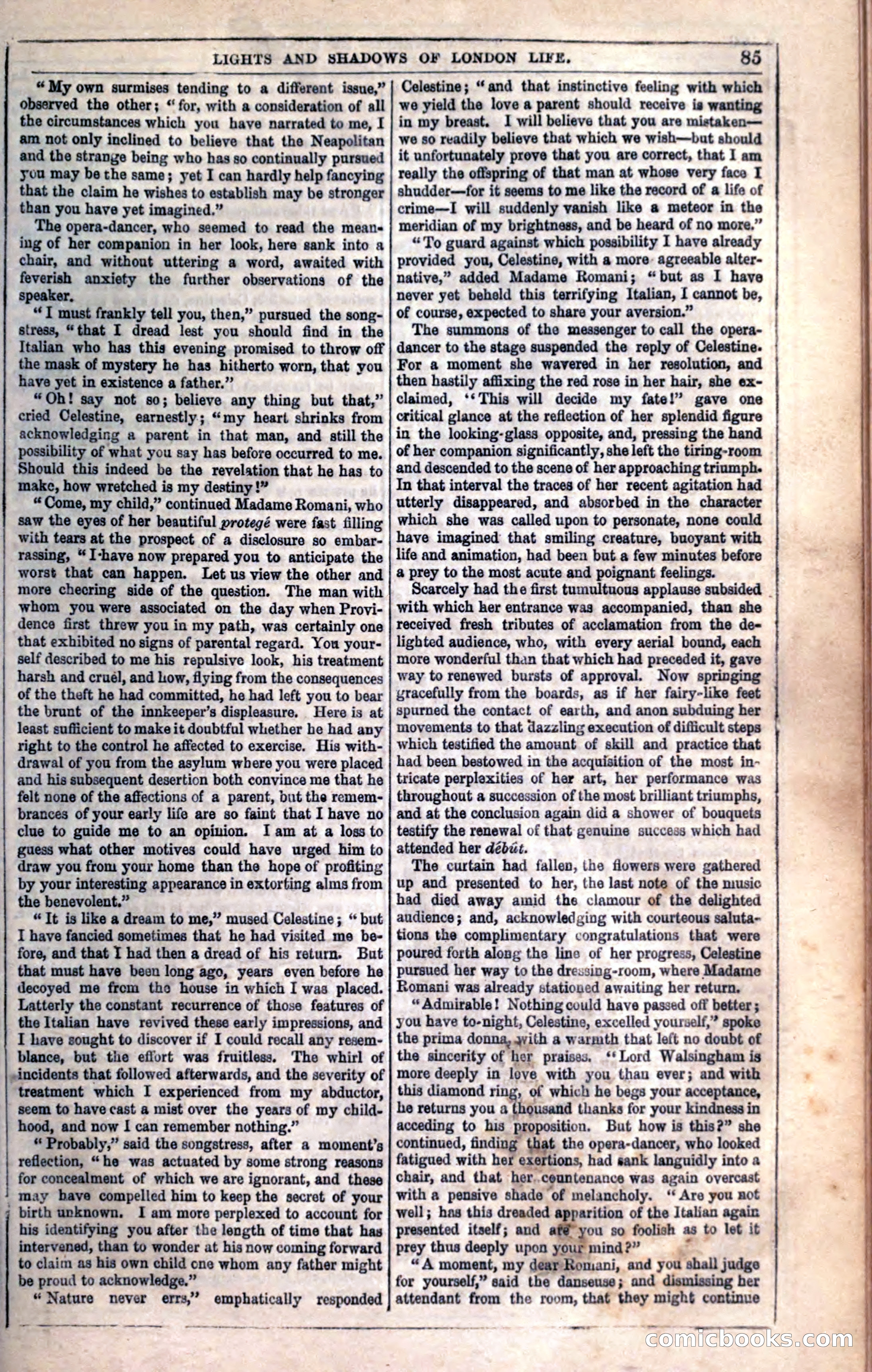
A restored page from Penny Dreadfuls, 1850. Page through the whole issue in the reader above.
📄 Transcribed text from this page (OCR, searchable)
Machine-transcribed from the original scan — historical spelling and the odd misread are preserved.
LIGHTS AND SHADOWS OF LONDON LIFE, “ My own surmises tending to a different issue,” observed the other; “ for, with a consideration of all the circumstances which you have narrated to me, I am not only inclined to believe that the Neapolitan and the strange being who has so continually pursued you may be the same; yet I can hardly help fancying that the claim he wishes to establish may be stronger than you have yet imagined.” opera-dancer, who seemed to read the mean- ing of her companion in her look, here sank into a chair, and without uttering a word, awaited with feverish anxiety the further observations of the “T must frankly tell you, then,” pursued the song- stress, “that I dread lest you should find in the Italian who has this evening promised to throw off the mask of mystery he has hitherto worn, that you have yet in existence a father.” “Oh! say not so; believe any thing but that,” cried Celestine, earnestly ; “my heart shrinks from acknowledging a parent in that man, and still the possibility of what you say has before occurred to me. Should this indeed be the revelation that he has to make, how wretched is my destiny !” “Come, my child,” continued Madame Romani, who saw the eyes sof her beautiful protegé were fast filling with tears at the prospect of a disclosure so embar- rassing, “ I-have now prepared you to anticipate the worst that can happen. Let us view the other and more cheering side of the question. The man with whom you were associated on the day when Provi- dence first threw you in my path, was certainly one that exhibited no signs of parental regard. You your- self described to me his repulsive look, his treatment harsh and cruél, and how, flying from the consequences of the theft he had committed, he had left you to bear the brunt of the innkeeper’s displeasure. Here is at least sufficient to make it doubtful whether he had any right to the control he affected to exercise. His with- drawal of you from the asylum where you were placed and his subsequent desertion both convince me that he felt none of the affections of a parent, but the remem- brances of your early life are so faint that I have no clue to guide me to an opinion. Iam at a loss to guess what other motives could have urged him to draw you from your home than the hope of profiting by your interesting appearance in extorting alms from the benevolent.” “Tt is like a dream to me,” mused Celestine; “ but I have fancied sometimes that he had visited me be- fore, and that I had then a dread of his return. But that must have been long ago, years even before he decoyed me from the house in which I was placed. Latterly the constant recurrence of those features of the Italian have revived these early impressions, and I have sought to discover if I could recall any resem- blance, but tlie effort was fruitless. The whirl of »incidents that followed afterwards, and the severity of ‘treatment which I experienced from my abductor, seem to have cast a mist over the years of my child- hood, and now I can remember nothing.” * Probably,” said the songstress, after a moment’s on, “he was actuated by some strong reasons for caaihatinant of which we are ignorant, and these | may have compelled him to keep the secret of your birth unknown. I am more perplexed to account for his bic ideneifyior Beg after the length of time that has intervened, than to wonder at his now coming forward to claim as his own child one whom any father might be proud to acknowledge.” “Nature never errs,’ emphatically responded —_— —— eee ee el ee -- — wore _-—— 85 Celestine; “and that instinctive feeling with which we yield the love a parent should receive is wanting in my breast. I will believe that you are mistaken— we so readily believe that which we wish—but should it unfortunately prove that you are correct, that I am really the offspring of that man at whose very face I shudder—for it seems to me like the record of a life of crime—I will suddenly vanish like a meteor in the meridian of my brightness, and be heard of no more,” “To guard against which possibility I have already provided you, Celestine, with a more- agreeable alter- native,” added Madame Romani; “but as 1 have never yet beheld this terrifying Italian, [ cannot be, of course, expected to share your aversion.” The summons of the messenger to call the opera- dancer to the stage suspended the reply of Celestine. For a moment she wavered in her resolution, and then hastily affixing the red rose in her hair, she ex- claimed, ‘* This will decide my fate!” gave one critical glance at the reflection of her splendid figure in the looking-glass opposite, and, pressing the hand of her companion significantly, she left the tiring-room and descended to the scene of her approaching triumph. In that interval the traces of her recent agitation had utterly disappeared, and absorbed in the character which she was called upon to personate, none could have imagined that smiling creature, buoyant with life and animation, had been but a few minutes before a prey to the most acute and poignant feelings. Scarcely had the first tumultuous applause subsided _ with which her entrance was accompanied, than she received fresh tributes of acclamation from the de- lighted audience, who, with every aerial bound, each more wonderful than that which had preceded it, gave way to renewed bursts of approval. Now springing gracefully from the boards, as if her fairy-like feet spurned the contact of earth, and anon subduing her movements to that dazzling execution of difficult steps which testified the amount of skill and practice that had been bestowed in the acquisition of the most in- tricate perplexities of her art, her performance was throughout a succession of the most brilliant triumphs, and at the conclusion again did a shower of bouquets testify the renewal of that genuine success which had attended her début. The curtain had fallen, the flowers were gathered up and presented to her, the last note of the music had died away amid the clamour of the delighted audience; and, acknowledging with courteous saluta- tions the complimentary congratulations that were poured forth along the line of her progress, Celestine pursued her way to the dressing-room, where Madame Romani was already stationed awaiting her return. “Admirable! Nothing could have passed off better; you have to-night, Celestine, excelled yourself,” spoke the prima donna, with a warmth that ‘left no doubt of the sincerity of her praises. ‘‘ Lord Walsingham is more deeply in love with you than ever; and with this diamond ri , of which he begs your acceptance, he returns you a thousand thanks for your kindness in acceding to his proposition. But how is this?” she continued, findi ; that the opera- es! who looked fatigued with her exertions, had sank languidly into a chair, and that her... countenance was again overcast with a pensive shade of melancholy. ‘“ Are you not well; has this dreaded apparition of the Italian again presented itself; and you so foolish as to let it prey thus deeply upon youl mind?” ‘ “A moment, my dear Romani, and you shall judge for yourself,” said the danseuse; and attendant from the room, that they might pm Sees -so—-< eo ea) SS (EO)