
Penny Dreadfuls, 1850 · page 72 of 394
The Mysteries of London; or, Lights and Shadows of London Life — page 72: what you’re looking at
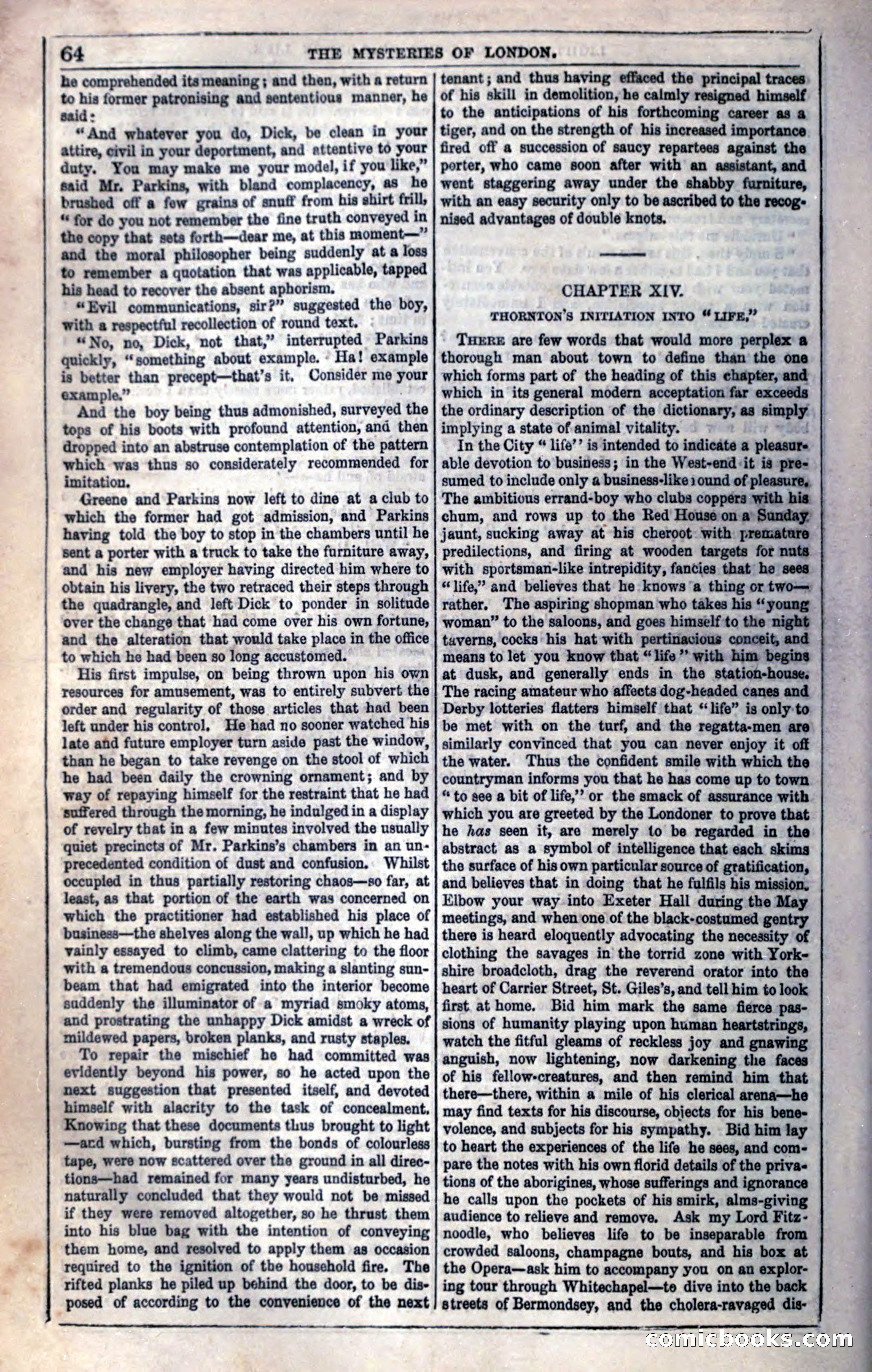
A restored page from Penny Dreadfuls, 1850. Page through the whole issue in the reader above.
📄 Transcribed text from this page (OCR, searchable)
Machine-transcribed from the original scan — historical spelling and the odd misread are preserved.
—_ EE TT —_—-_ —_— ————- ee —_— —_—— ~~ eee ————/ 64 THE MYSTERIES OF LONDON. + eae ee sce he comprehended its meaning ; and then, with a return to his former patronising and sententious manner, he said: “And whatever you do, Dick, be clean in your attire, civil in your deportment, and attentive to your duty. You may make me your model, if you like,” said Mr. Parkins, with bland complacency, as he brushed off a few grains of snuff from his shirt frill, “for do you not remember the fine truth conveyed in the copy that sets forth—dear me, at this moment—” and the moral philosopher being suddenly at a loss to remember a quotation that was applicable, tapped his head to recover the absent aphorism. “Evil communications, sir?” suggested the boy, with a respectful recollection of round text. “No, no, Dick, not that,’ interrupted Parkins quickly, “something about example. - Ha! example is better than precept—that’s it, Consider me your example.” . And the boy being thus admonished, surveyed the tops of his boots with profound attention, and then dropped into an abstruse contemplation of the pattern which was thus so considerately recommended for imitation. Greene and Parkins now left to dine at a club to which the former had got admission, and Parkins having told the boy to stop in the chambers until he sent a porter with a truck to take the furniture away, and his new employer having directed him where to obtain his livery, the two retraced their steps through the quadrangle, and left Dick to ponder in solitude over the change that had come over his own fortune, and the alteration that would take place in the office to which he had been so long accustomed. His first impulse, on being thrown upon his own resources for amusement, was to entirely subvert the order and regularity of those articles that had been left under his control, He had no sooner watched his late afd future employer turn aside past the window, than he began to take revenge on the stool of which he had been daily the crowning ornament; and by way of repaying himself for the restraint that he had suffered through the morning, he indulged in a display of revelry that in a few minutes involved the usually quiet precincts of Mr. Parkins’s chambers in an un- precedented condition of dust and confusion. Whilst occupied in thus partially restoring chaos—so far, at least, as that portion of the earth was concerned on which the practitioner had established his place of business—the shelves along the wall, up which he had vainly essayed to climb, came clattering to the floor with a tremendous concussion, making a slanting sun- beam that had emigrated into the interior become saddenly the illuminator of a myriad smoky atoms, and prostrating the unhappy Dick amidst a wreck of mildewed papers, broken planks, and rusty staples. To repair the mischief he had committed was evidently beyond his power, so he acted upon the next suggestion that presented itself, and devoted himself with alacrity to the task of concealment. Knowing that these documents thus brought to light —acd which, bursting from the bonds of colourless tape, were now scattered over the ground in all direc- tions—had remained for many years undisturbed, he naturally concluded that they would not be missed if they were removed altogether, so he thrust them into his blue bag with the intention of conveying them home, and resolved to apply them as occasion required to the ignition of the household fire. The rifted planks he piled up behind the door, to be dis- posed of according to the convenience of the next tenant; and thus having effaced the principal traces) | of his skill in demolition, he calmly resigned himself to the anticipations of his forth career as & tiger, and on the strength of his increased importance fired off a succession of saucy repartees against the porter, who came soon after with an assistant, and went staggering away under the shabby furniture, with an easy security only to be ascribed to the recog- nised advantages of double knots, CHAPTER XIV. THORNTON'S INITIATION INTO “ LIFE,” THERE are few words that would more perplex a thorough man about town to define than the one which forms part of the heading of this chapter, and | which in its general modern acceptation far exceeds | the ordinary description of the dictionary, as simply | implying a state of animal vitality. — © In the City “ life’’ is intended to indicate a able devotion to business; in the West-end:it is pre- sumed to include only a business-like) ound of pleasure, | The ambitious errand-boy who clubs coppérs with his chum, and rows up to the Red House on a» ‘iy. jaunt, sucking away at his cheroot with premature predilections, and firing at wooden targets for nuts with sportsman-like intrepidity, fancies that he sees. “ life,’ and believes that he knows’a thing or two— rather. The aspiring shopman who takes his “young woman” to the saloons, and goes himself to the night tuverns, cocks his hat with navious conceit, and means to let you know that “life” with him begins at dusk, and generally ends in the station-houses The racing amateur who affects dog-headed canes and Derby lotteries flatters himself that “life” is only to be met with on the turf, and the regatta-men are’ similarly convinced that you can never enjoy it off the water. Thus the confident smile with which the countryman informs you that he has come up to town “ to see a bit of life,” or the smack of assurance with. which you are greeted by the Londoner to prove that he has seen it, are merely to be regarded in the abstract as a symbol of intelligence that each skims the surface of his own particular source of gratification, and believes that in doing that he fulfils his mission, Elbow your way into Exeter Hall during the May meetings, and when one of the black-costumed gentry there is heard eloquently advocating the necessity of clothing the savages in the torrid zone with York- shire broadcloth, drag the reverend orator into the heart of Carrier Street, St. Giles’s, and tell him to look first at home. Bid him mark the same fierce pas- sions of humanity playing upon human heartstrings, watch the fitful gleams of reckless joy and gnawing anguish, now lightening, now darkening the faces of his fellow-creatures, and then remind him that there—there, within a mile of his clerical arena—he may find texts for his discourse, objects for his bene- volence, and subjects for his sympathy. Bid him lay to heart the experiences of the life he sees, and com- pare the notes with his own florid details of the priva- tions of the aborigines, whose sufferings and ignorance he calls upon the pockets of his smirk, alms-giving audience to relieve and remove. Ask my Lord Fitz- noodle, who believes life to be inseparable from crowded saloons, champagne bouts, and his box at the Opera—ask him to accompany you on an explor- ing tour through Whitechapel—te dive into the back streets of Bermondsey, and the cholera-ravaged dis- . Gomicbooks:.co ae | a — _