
Penny Dreadfuls, 1850 · page 66 of 394
The Mysteries of London; or, Lights and Shadows of London Life — page 66: what you’re looking at
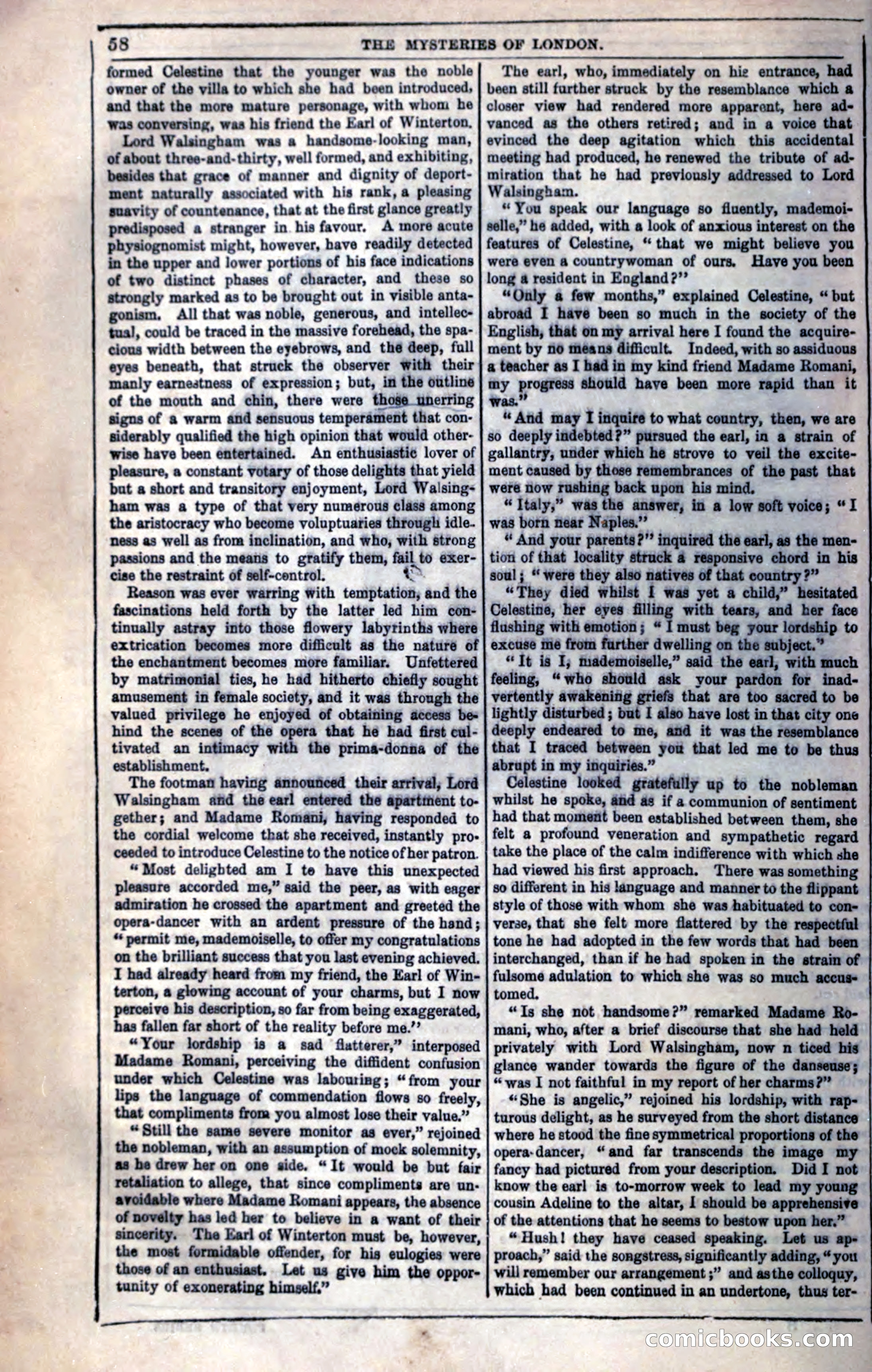
A restored page from Penny Dreadfuls, 1850. Page through the whole issue in the reader above.
📄 Transcribed text from this page (OCR, searchable)
Machine-transcribed from the original scan — historical spelling and the odd misread are preserved.
—_—_— ee | THE MYSTERIES OF LONDON. 58 ee ce me formed Celestine that the younger was the noble | ‘The earl, who, immediately on hie entrance, had owner of the villa to which she had been introduced, and that the more mature personage, with whom he was conversing, was his friend the Earl of Winterton, Lord Walsingham was a handsome-looking man, of about three-and-thirty, well formed, and exhibiting, besides that grace of manner and dignity of deport- ment naturally associated with his rank, a pleasing guavity of countenance, that at the first glance greatly predisposed a stranger in his favour. A more acute physiognomist might, however, have readily detected in the upper and lower portions of his face indications of two distinct phases of character, and these so strongly marked as to be brought out in visible anta- gonism., All that was noble, generous, and intellec- tual, could be traced in the massive forehead, the spa- cious width between the eyebrows, and thé deep, full eyes beneath, that struck the observer with their manly earnestness of expression; but, in the outline of the mouth and chin, there were those unerring signs of a warm and sensuous temperament that con- siderably qualified the high opinion that would other- wise have been entertained. An enthusiasti¢ lover of pleasure, a constant votary of those delights that yield but a short and transitory enjoyment, Lord Walsing- ham was a type of that very numerous class among the aristocracy who become voluptuaries through idle. ness as well as from inclination, and who, with strong passions and the means to gratify them, fail to exer- cise the restraint of self-centrol. =. Reason was ever warring with temptation, and the fascinations held forth by the latter led him con- tinually astray into those flowery labyrinths where extrication becomes more difficult as the nature of the enchantment becomes more familiar. Unfettered by matrimonial ties, he had hitherto chiefly sought amusement in female society, and it was through the valued privilege he enjoyed of obtaining access be« hind the scenes of the opera that he had first cul- tivated an intimacy with the prima-donia of the establishment. The footman having annouticed their arrival, Lord Walsingham afid the earl entered the apartttient to- gether; and Madame Romani, having responded to the cordial welcome that she received, instantly pro- ceeded to introduce Celestine to the notice of her patron. “Most delighted am I te have this unexpected pleasure accorded me,” said the peer, as with eager admiration he crossed the apartment and greeted the opera-dancer with an ardent pressure of the hand; “ permit me, mademoiselle, to offer my congratulations on the brilliant success that you last evening achieved. I had already heard from my friend, the Karl of Win- terton, a glowing account of your charms, but I now perceive his description, so far from being exaggerated, has fallen far short of the reality before me.’’ “Your lordship is a sad fiutterer,” interposed Madame Romani, perceiving the diffident confusion under which Celestine was labowing; “from your lips the language of commendation flows so freely, that compliments from you almost lose their value.” “Still the same severe monitor as ever,” rejoined the nobleman, with an assumption of mock solemnity, as he drew her on one side. “It would be but fair retaliation to allege, that since compliments are un- avoidable where Madame Romani appears, the absence of novelty has led her to believe in a want of their sincerity. The Earl of Winterton must be, however, the most formidable offender, for his eulogies were those of an enthusiast. Let us give him the oppor- tunity of exonerating himself,” been still further struck by the resemblance which a closer view had rendered more apparent, here ad- vanced as the others retired; and in a voice that evinced the deep agitation which this accidental meeting had produced, he renewed the tribute of ad- miration that he had previously addressed to Lord Walsingham. “You speak our language so fluently, mademoi- selle,” he added, with a look of anxious interest on the features of Celestine, “that we might believe you were even 4 countrywoman of ours. Have you been long 4 resident in England ?’’ “Only a few months,” explained Celestine, “ but abroad I have been so much in the society of the English, that on my arrival here I found the acquire- ment by no méans difficult. Indeed, with so assiduous a teacher as I had in my kind friend Madame Romani, my progress should have been more rapid than it was.’ “ And may I inquire to what country, then, we are so deeply indebted?” pursued the earl, in a strain of gallantry, under which he strove to veil the excite- ment caused by those remembrances of the past that were now rushing back upon his mind, “ Italy,” was the answer, in a low soft yoice; “I was born near Naples.” | “ And your parents?” inquired the earl, as the men- tion of that locality struck 4 responsive chord in his soul; “ were they also natives of that country?” “They died whilst | was yet a child,’ hesitated Celestine, her eyes et with tears, and her face flushing with emotion; “ I must beg your lordship to excuse me from further dwelling on the subject.” “It is I; mademoiselle,” said the earl, with much feeling, “who should ask your pardon for inad- vertently awakening griefs that are too sacred to be lightly disturbed ; but I also have lost in that city one deeply endeared to me, and it was the resemblance that I traced between you that led me to be thus abrupt in my inquiries.” Celestine looked gratefully up to the nobleman whilst he spoke, aid as if a communion of sentiment had that moment been established between them, she felt a profound veneration and sympathetic regard take the place of the calm indifference with which she had viewed his first approach. There was something so different in his language and manner to the flippant style of those with whom she was habituated to con- verse, that she felt more flattered by the respectful tone he had adopted in the few words that had been interchanged, than if he had spoken in the strain of fulsome adulation to which she was so much accus- tomed, “Is she not handsome?” remarked Madame Ro- mani, who, after a brief discourse that she had held privately with Lord Walsingham, now n ticed his glance wander towards the figure of the danseuse; “was I not faithful in my report of her charms?” “She is angelic,” rejoined his lordship, with rap- turous delight, as he surveyed from the short distance where he stood the fine symmetrical proportions of the opera-dancer, “and far transcends the image my fancy had pictured from your description. Did I not know the earl is to-morrow week to lead my young cousin Adeline to the altar, 1 should be apprehensive of the attentions that he seems to bestow upon her,” “Hush! they have ceased speaking. Let us ap- proach,” said the songstress, significantly adding, “ you will remember our arrangement ;” and asthe colloquy, which had been continued in an undertone, thus ter- Gomichbooks:com m