
Penny Dreadfuls, 1850 · page 62 of 394
The Mysteries of London; or, Lights and Shadows of London Life — page 62: what you’re looking at
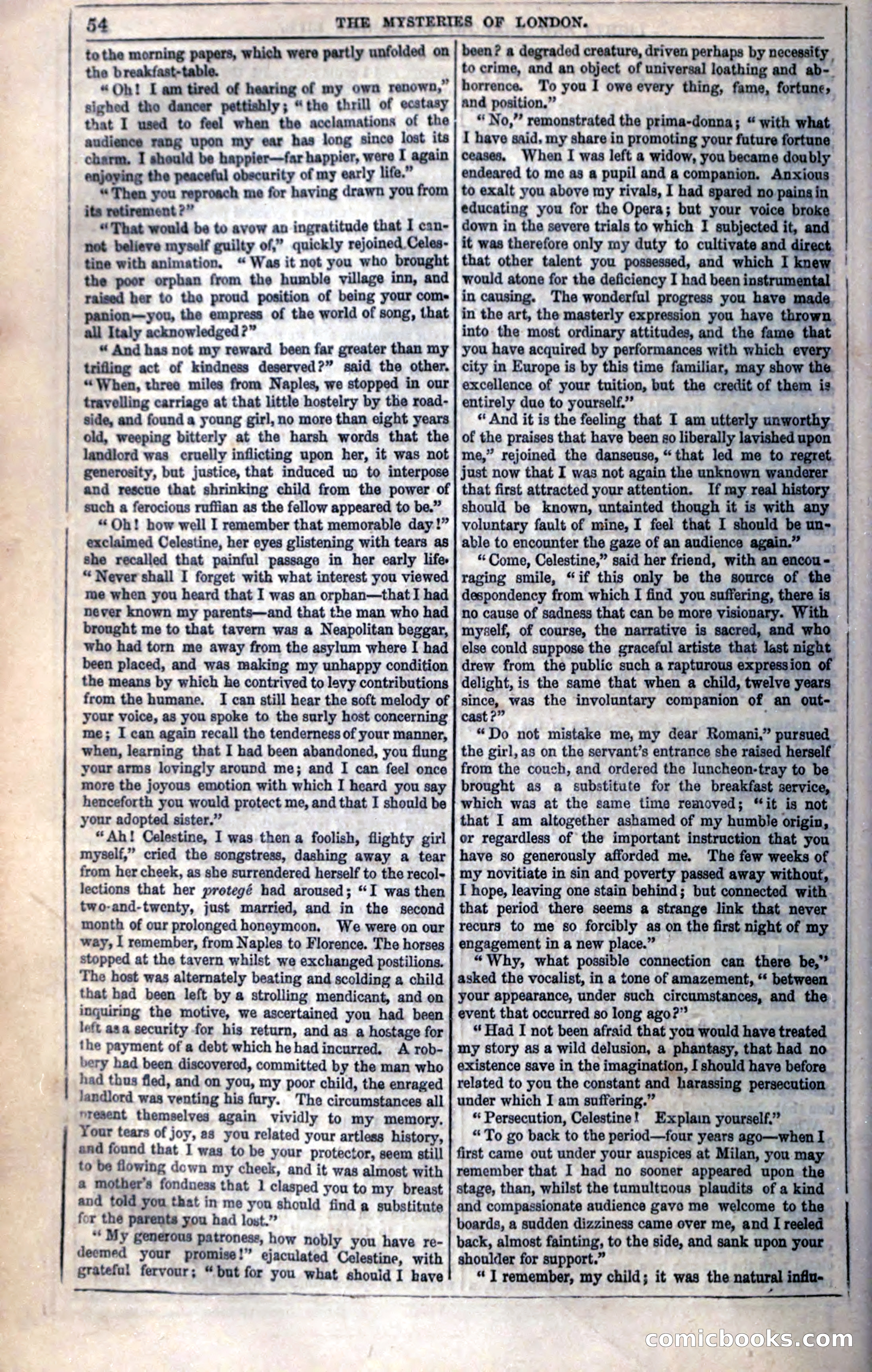
A restored page from Penny Dreadfuls, 1850. Page through the whole issue in the reader above.
📄 Transcribed text from this page (OCR, searchable)
Machine-transcribed from the original scan — historical spelling and the odd misread are preserved.
' / 54 to the morning papers, which were partly unfolded on the breakfast-table. e “Oh! Lam tired of hearing of my own renown, sighed tho dancer pettishly; “the thrill of ecstasy that I used to feel when the acclamations of the audience rang upon my ear has long since lost its charm. I should be happier—far rent vi I again enjoying the peaceful obscurity of my early life. “Then you reproach me for having drawn you from its retirement ?” “That would be to avow an ingratitude that I can- not believe myself guilty of,” quickly rejoined Celes- tine with animation. “Was it not you who brought the poor orphan from the humble village inn, and raised her to the proud position of being your come panion—you, the empress of the world of song, that all Italy acknowledged ?” * And has not my reward been far greater than my trifling act of kindness deserved?” said the other. “When, three miles from Naples, we stopped in our travelling carriage at that little hostelry by the road- side, and found a young girl, no more than eight years old, weeping bitterly at the harsh words that the landlord was cruelly inflicting upon her, it was not generosity, but justice, that induced uo to interpose and resctie that shrinking child from the power of such a ferocious ruffian as the fellow appeared to be.” “ Oh! how well I remember that memorable day!” exclaimed Celestine, her eyes glistening with tears as she recalled that painful passage in her early life “ Never shall I forget with what interest you viewed me when you heard that I was an orphan—that I had never known my parents—and that the man who had brought me to that tavern was a Neapolitan beggar, who had torn me away from the asylum where I had been placed, and was making my unhappy condition the means by which he contrived to levy contributions from the humane. I can still hear the soft melody of your voice, as you spoke to the surly host concerning me; I can again recall the tenderness of your manner, when, learning that I had been abandoned, you flung your arms lovingly around me; and I can feel once more the joyous emotion with which I heard you say henceforth you would protect me, and that I should be your adopted sister.” “Ah! Celestine, I was then a foolish, flighty girl myself,” cried the songstress, dashing away a tear from her cheek, as she surrendered herself to the recol- lections that her protegé had aroused; “I was then two-and-twenty, just married, and in the second month of our prolonged honeymoon, We were on our way, | remember, from Naples to Florence. The horses stopped at the tavern whilst we exchanged postilions. The host was alternately beating and scolding a child that had been left by a strolling mendicant, and on inquiring the motive, we ascertained you had been left asa security for his return, and as a hostage for the payment of a debt which he hadincurred. A rob- very had been discovered, committed by the man who had thus fled, and on you, my poor child, the enraged landlord was venting his fury. The circumstances all nresent themselves again vividly to my memory. Your tears of joy, as you related your artless history, and found that I was to be your protector, seem still to be flowing down my cheek, and it was almost with a mother’s fondness that 1 clasped you to my breast and told you that in me yon should find a substitute for the parents you had lost.” “‘ My generous patroness, how nobly you have re- deemed your promise!” ejaculated Celestine, with grateful fervour; “but for you what should I have ———— a ee " — = - a THE MYSTERIES OF LONDON. A —— ee ee been? a degraded creature, driven perhaps by necessi ‘ to crime, and an object of universal loathing and ab- horrence. To you I owe every thing, fame, fortune, and position.” | eo “No,” remonstrated the prima-donna; “ with what I have said, my share in promoting your future 1e ceases, When I was left a widow, you became doubly endeared to me as a pupil and a com Anxious to exalt you above my rivals, I had spared no pains in educating you for the Opera; but your voice broke down in the severe trials to which I subjected it, and it was therefore only my duty to cultivate and dire that other talent you possessed, and which I kn would atone for the deficiency I had been instrumental in causing. The wonderful progress you have made. in the art, the masterly expression you have throw into the most ordinary attitudes, and the fame tl you have acquired by performances with which every city in Europe is by this time familiar, may show the excellence of your tuition, but the credit of them is. entirely due to yTaling: thas : “ And it is the feeli am utterly unworthy. of the praises that have been so liberally lavished upon me,” rejoined the danseuse, “that led me to regret. just now that I was not again the unknown wanderer that first attracted your attention. If my real history should be known, untainted th it is with any voluntary fault of mine, I feel I should be un- able to encounter the gaze of an audience again.” “Come, Celestine,” said her friend, with an encou- raging smile, “if this only be the source of the despondency from which I find you suffering, there is no cause of sadness that can be more visionary. With myself, of course, the narrative is sacred, and who , else could suppose the graceful artiste that last night drew from the public such a rapturous expression of delight, is the same that when a child, twelve years. since, was the involuntary companion of an out- cast ?” “Do not mistake me, my dear Romani,” pein the girl, as on the seryant’s entrance she raised herself from the couch, and ordered the luncheon-tray to be brought as a substitute for the breakfast service, which was at the same time removed; “if is not that I am altogether ashamed of my humble origin, or regardless of the important instruction that you have so generously afforded me. The few weeks of my novitiate in sin and poverty passed away without, I hope, leaving one stain behind; but connected with that period there seems a strange link that never recurs to me so forcibly as on the first night of my engagement in a new place.” ™ * “Why, what possible connection can there be,” asked the vocalist, in a tone of amazement, “* between your appearance, under such circumstances, and the | event that occurred so long ago?” | ¥ “ Had I not been afraid that you would have treated my story as a wild delusion, a phantasy, that had no | existence save in the imagination, I should have before | related to you the constant and g persecution | under which I am suffering.” oe, ‘ “ Persecution, Celestine! Explain yourself.” | “To go back to the period—four years ago—when I a first came out under your auspices at Milan, you may | remember that I had no sooner appeared upon. stage, than, whilst the tumultuous plaudits of a kind and compassionate audience gave me welcome to the boards, a sudden dizziness came over me, and I reeled back, almost fainting, to the side, and sank upon your j shoulder for support.” a “ ] remember, my child; it was the natural influ- Gomichbooks com