
Penny Dreadfuls, 1850 · page 50 of 394
The Mysteries of London; or, Lights and Shadows of London Life — page 50: what you’re looking at
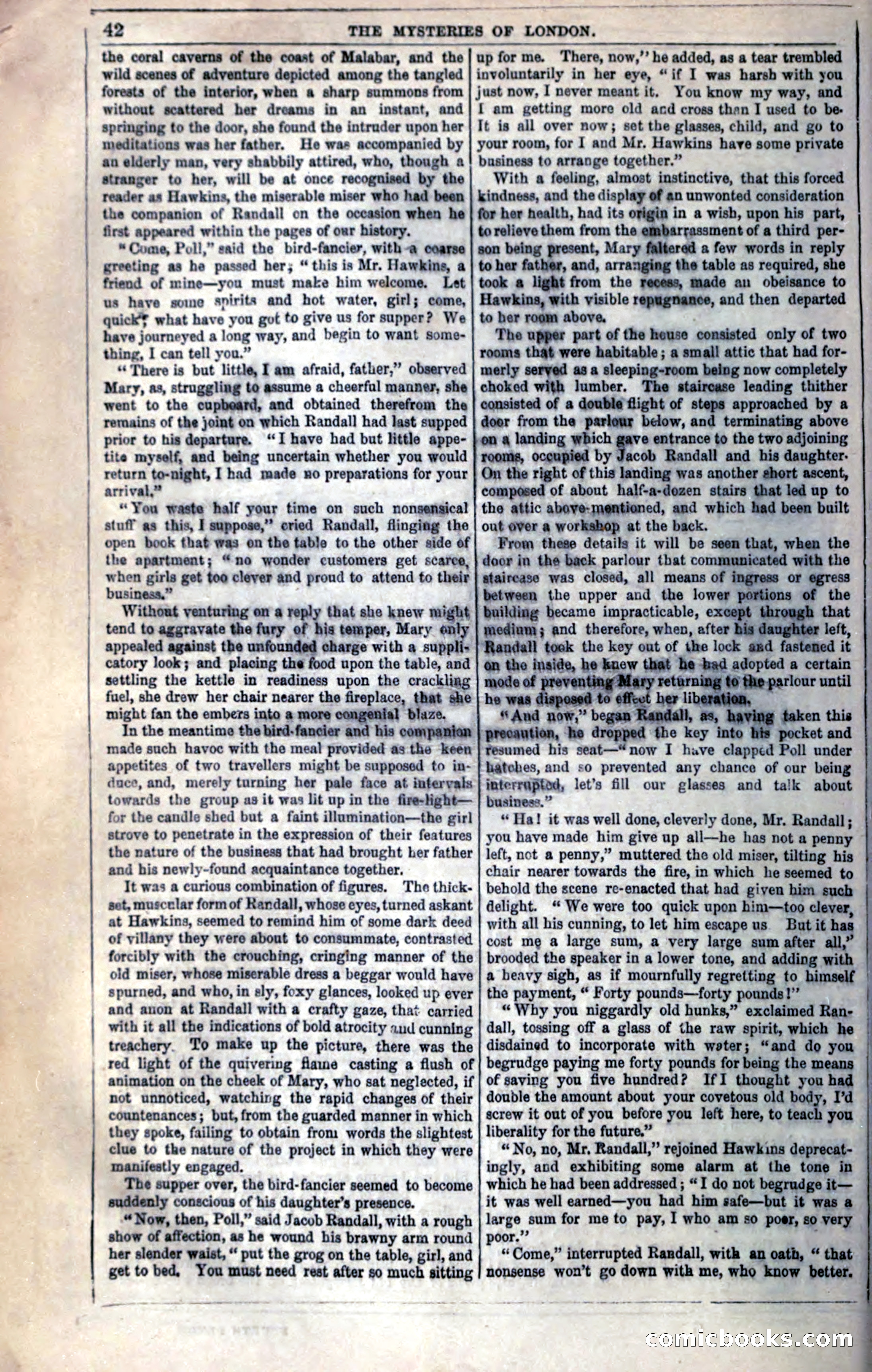
A restored page from Penny Dreadfuls, 1850. Page through the whole issue in the reader above.
📄 Transcribed text from this page (OCR, searchable)
Machine-transcribed from the original scan — historical spelling and the odd misread are preserved.
EE TT TTT ST ——_— TT a a —EEEEE>>——————————eEe———————— ee eee ee — — 42 the coral caverns of the coast of Malabar, and the wild scenes of adventure depicted among the tangled forests of the interior, when a sharp summons from without scattered her dreams in an instant, and springing to the door, she found the intruder upon her meditations was her father. He was accompanied by an elderly man, very shabbily attired, who, though a stranger to her, will be at once recognised by the reader as Hawkins, the miserable miser who had been the companion of Randall on the occasion when he first appeared within the pages of our history. "Come, Poll,” eaid the bird-fancier, witha coarse greeting as he passed her; “this is Mr. Hawkins, a friend of mine—you must make him welcome, Let us have some spirits and hot water, girl; come, quick? what have you got to give us for supper? We have journeyed a long way, and begin to want some- thing, I can tell you.” “There is but little, I am afraid, father,” observed Mary, as, struggling to assume a cheerful manner, she went to the cupbeard, and obtained therefrom the remains of the joint on which Randall had last supped prior to his departure. “I have had but little appe- tite myself, and being uncertain whether you would return to-night, I had made no preparations for your arrival,” “You waste half your time on such nonsengical stuff as this, I suppose,” cried Randall, flinging the open book that was on the table to the other side of the apartment; “no wonder customers get sc when girls get too clever and proud to attend to their business,” Without venturing on a reply that she knew “— tend to aggravate the fury of his is temper, Mary ¢ appealed against the unfo charge with a su catory look; and placing the: upon the table, and settling the kettle in readiness upon the crackling fuel, she drew her chair nearer the waaeeat’ pet she might fan the embers into a more In the meantime the bird- fancier : made such havoc with the meal provided as the keen appetites of two travellers might be supposed to in- duce, and, merely turning her pale face at intervals towards the group as it was lit up in the fire-light— for the candle shed but a faint illumination—the girl strove to penetrate in the expression of their features the nature of the business that had brought her father and his newly-found acquaintance together. It was a curious combination of figures. The thick- set, muscrlar form of Randall, whose eyes, turned askant at Hawkins, seemed to remind him of some dark deed of yillany they were about to consummate, contrasted forcibly with the crouching, cringing manner of the old miser, whose miserable dress a beggar would have spurned, and who, in sly, foxy glances, looked up ever and anon at Randall with a crafty gaze, that carried with it all the indications of bold atrocity aud cunning treachery. To make up the picture, there was the red light of the quivering flame casting a flush of animation on the cheek of Mary, who sat neglected, if not unnoticed, watching the rapid changes of their countenances; but, from the guarded manner in which they spoke, failing to obtain from words the slightest clue to the nature of the project in which they were manifestly engaged. The supper over, the bird-fancier seemed to become suddenly conscious of his daughter’s presence. “Now, then, Poll,” said Jacob Randall, with a rough show of affection, as he wound his brawny arm round her slender waist, “ put the grog on the table, girl, and get to bed, You must need rest after so much sitting ——— | mediam; and therefore, when, after his companion | ——— « — ee 0. ee ea ee eee THE MYSTERIES OF LONDON. up forme. There, now,’’ he added, as a tear trembled involuntarily in her eye, “if I was harsh with you just now, I never meant it. You know my way, and [I am getting more old ard cross than I used to be It is all over now; set the glasses, child, and go to your room, for I and Mr. Hawkins have some private business to arrange together.” With a feeling, almost instinctive, that this forced kindness, and the display of an unwonted consideration for her health, had its origin in a wish, upon his part, to relieve them from the embarrassment of a third per- t, Mary faltered a few words in reply » and, reas Ot eS took a from the recess, made an Hawkins, with visible neggnaate, and then a me to her roam above. The upper part of the house consisted only of two rooms that were habitable ; a small attic that had for- merly as a slee being now rag toed lumber. The staircase leading thither consisted of a double flight of doer from the parlour below, an pace epee 3 te cab ig trrey the two adjoining rooms, occupied Randall and his daughter. On the right of this landing was another short ascent, composed of about half-a-dezen stairs that led up to the attic above-mentioned, and which had been built out over a workshop at the back. From these details it will be seen that, when the door in the back parlour that communicated with the staircase was closed, all means of ing between the upper and the lower, poi building became impracticable, ‘Randall took the key out of the lock and faster v that Fags «ds certain ng to the parlour precaution, — | fesumed his seat—“*now I have dae Poll under hatches, and so prevented any chance of our being interrapted, let’s fill our glasses and talk about business.” “Hal it was well done, cleverly done, Mr. Randall; you have made him give up all—he has not a penny ~ left, not a penny,” muttered the old miser, tilting his chair nearer towards the fire, in which he seemed to behold the scene re-enacted that had giyen him such delight. “ We were too quick upon him—too clever, with all his cunning, to let him escape us But r, cost me a large sum, a very large sum after brooded the speaker in a lower tone, and adding a beavy sigh, as if mournfully regretting to seit the payment, “ Forty pounds—forty fe “Why you niggardly old hunks,” exclaimed Ran- dall, tossing off a glass of the raw spirit, which he | disdained to incorporate with water; “and do you | begrudge paying me forty pounds for being the m of saying you five hundred? IfI oa eM double the amount about your covetous screw it out of you before you left here, to liberality for the future,” “No, no, Mr, Randall,” rejoined Hawkins deprecat- ingly, and exhibiting some alarm at the tone in which he had been addressed ; “I do not begrudge it— it was well earned—you had him safe—but it large sum for me to pay, I who am so poer, poor. 33 ) very “Come,” interrupted Randall, with an oath, “ that nonsense ‘won't go down with me, who know better. j — —.- += ee Gomichdoo <S-GOm re | was 8