
Penny Dreadfuls, 1850 · page 46 of 394
The Mysteries of London; or, Lights and Shadows of London Life — page 46: what you’re looking at
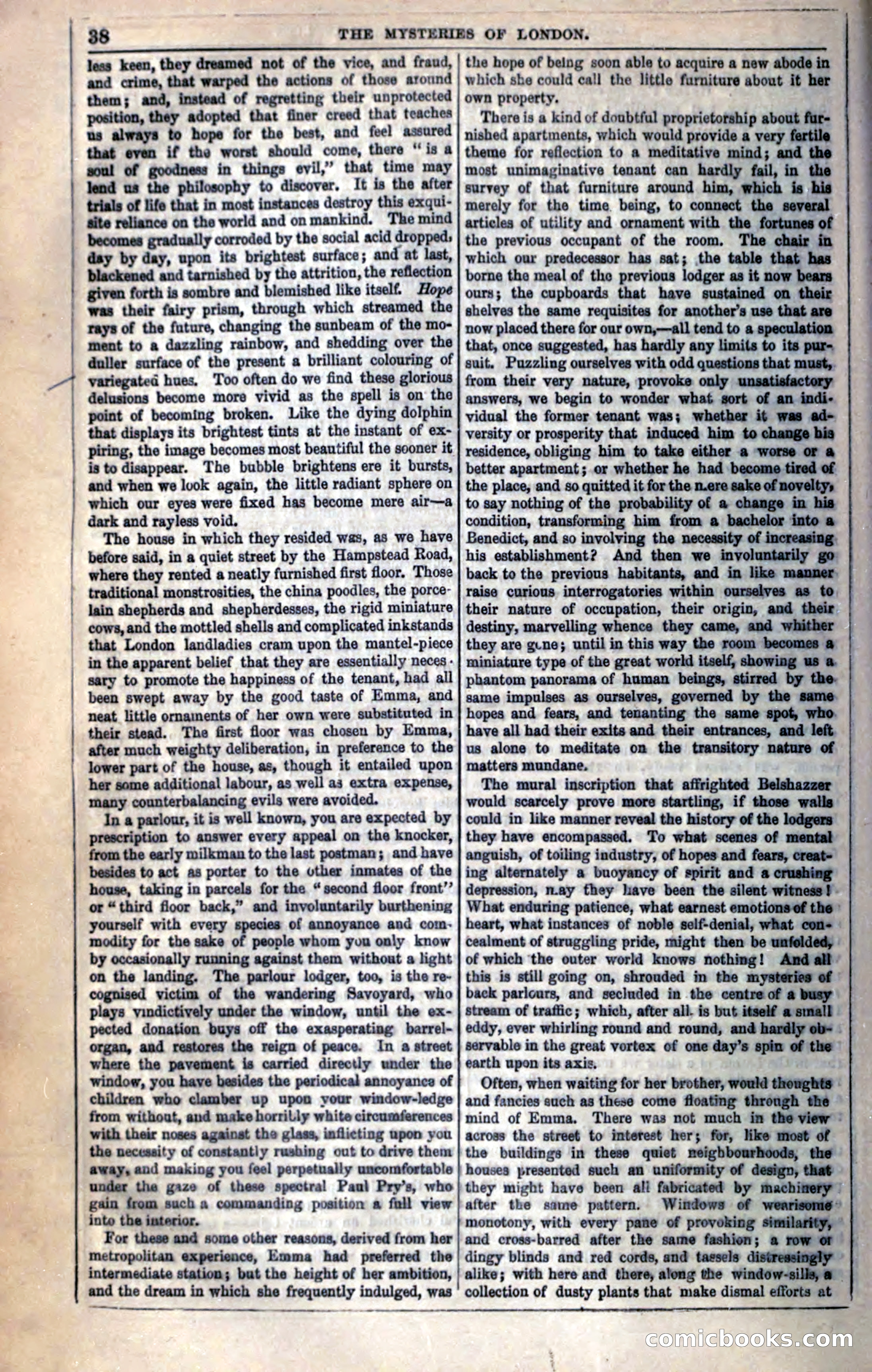
A restored page from Penny Dreadfuls, 1850. Page through the whole issue in the reader above.
📄 Transcribed text from this page (OCR, searchable)
Machine-transcribed from the original scan — historical spelling and the odd misread are preserved.
38 less keen, they dreamed not of the vice, and fraud, and crime, that warped the actions of those around them; and, instead of regretting their unprotected position, they adopted that finer creed that teaches us always to hope for the best, and feel assured that even if the worst should come, yer “is a soul of goodness in things evil,” that time may lend us the philosophy to discover. It is the after trials of life that in most instances destroy this exqui- site reliance on the world and on mankind. The mind becomes gradually corroded by the social acid dropped, dsy by day, upon its brightest surface; and at last, blackened and tarnished by the attrition, the reflection given forth is sombre and blemished like itself. Hope was their fairy prism, through which streamed the rays of the future, changing the sunbeam of the mo- ment to a dazzling rainbow, and shedding over the duller surface of the present a brilliant colouring of variegated hues, Too often do we find these glorious delusions become more vivid as the spell is on the point of becoming broken. Like the dying dolphin that displays its brightest tints at the instant of ex- piring, the image becomes most beautiful the sooner it is to disappear. The bubble brightens ere it bursts, and when we look again, the little radiant sphere on which our eyes were fixed has become mere air—a dark and rayless void. The house in which they resided was, as we have before said, in a quiet street by the Hampstead Road, where they rented a neatly furnished first floor. Those traditional monstrosities, the china poodles, the porce- lain shepherds and shepherdesses, the rigid miniature cows, and the mottled shells and complicated inkstands that London landladies cram upon the mantel-piece in the apparent belief that they are essentially neces - sary to promote the happiness of the tenant, had all been swept away by the good taste of Emma, and neat little ornaments of her own were substituted in their stead. The first floor was chosen by Emma, after much weighty deliberation, in preference to the lower part of the house, as, though it entailed upon her some additional labour, as well a3 extra expense, many counterbalancing evils were avoided. In a parlour, it is well known, you are expected by prescription to answer every appeal on the knocker, from the early milkman to the last postman; and have besides to act as porter to the other inmates of the house, taking in parcels for the “second floor front’’ or “third floor back,” and involuntarily burthening yourself with every species of annoyance and com- modity for the sake of people whom you only know by occasionally running against them without a light on the landing. The parlour lodger, too, is the re- cognised victim of the wandering Savoyard, who plays vindictively under the window, until the ex- pected donation buys off the exasperating barrel- organ, and restores the reign of peace. In a street where the pavement is carried directly under the window, you have besides the periodical annoyance of children who clamber up upon vour window-ledge from without, and make horrilly white circumferences with their noses against the glass, inflicting upon you the necessity of constantly rushing out to drive them away, and making you feel perpetually uncomfortable under the gaze of these spectral Paul Pry’s, who gain from such a commanding position a full view inte the interior. For these and some other reasons, derived from her THE MYSTERIES OF LONDON. the hope of belng soon able to acquire a new abode in which she could call the little furniture about it her own property. There is a kind of doubtful proprietorship about fur- nished apartments, which would provide a very fertile theme for reflection to a meditative mind; and the most unimaginative tenant can hardly fail, in the survey of that furniture around him, which is his merely for the time being, to connect the several articles of utility and ornament with the fortunes of the previous occupant of the room. The chair in which our predecessor has sat; the table that has borne the meal of the previous lodger as it now bears ours; the cupboards that have sustained on their shelves the same requisites for another’s use that are now placed there for our own,—all tend to a speculation that, once suggested, has hardly any limits to its pur- suit. Puzzling ourselves with odd questions that must, from their very nature, provoke only unsatisfactory answers, we begin to wonder what sort of an indi- vidual the former tenant was; whether it was ad- versity or prosperity that induced him to change bis residence, obliging him to take either a worse or a better apartment; or whether he had become tired of the place, and so quitted it for the n.ere sake of noveltys to say nothing of the probability of a change in his condition, transforming him from a bachelor into a Benedict, and so involving the necessity of increasing. his establishment? And then we involuntarily go back to the previous habitants, and in like manner raise curious interrogatories within ourselves as to [ their nature of occupation, their origin, and their destiny, marvelling whence they came, and whither they are gine; until in this way the room becomes @ miniature type of the great world itself, showing us a. phantom panorama of human beings, stirred by the. same impulses as ourselves, governed by the same | hopes and fears, and tenanting the same spot, who. have all had their exits and their entrances, and left us alone to meditate on the transitory nature of matters mundane. The mural inscription that affrighted Belshazzer would scarcely prove more startling, if those walls could in like manner reveal the history of the lodgers they have encompassed. To what scenes of mental anguish, of toiling industry, of hopes and fears, creat- ing alternately a buoyancy of spirit and a crushing depression, may they have been the silent witness! What enduring patience, what earnest emotionsof the ° heart, what instances of noble self-denial, what con+ | cealment of struggling pride, might then be unfolded, of which ‘the outer world knows nothing! And all’ this is still going on, shrouded in the mysteries of © back parlours, and secluded in the centre of a busy stream of traffic; which, after all. is but itself a small eddy, ever whirling round and round, and hardly ob- - servable in the great vortex of one day’s spin of the earth upon its axis, aha Often, when waiting for her brother, would thoughts - and fancies such as these come floating through the mind of Emma. There was not much in the view ° across the street to imterest her; for, like most of the buildings in these quiet neighbourhoods, the houses presented such an uniformity of design, that they might have been all fabricated by machinery after the same pattern. Windows of wearisomé® monotony, with every pane of provoking similarity, © and cross-barred after the same fashion; a row or | dingy blinds and red cords, and taesels distressingly | alike; with here and there, along the window-sills, a — collection of dusty plants that make dismal efforts at mee a eee metropolitan experience, Emma had preferred the intermediate station; but the height of her ambition, and the dream in which she frequently indulged, was a com Gomichboo cS