
Penny Dreadfuls, 1850 · page 38 of 394
The Mysteries of London; or, Lights and Shadows of London Life — page 38: what you’re looking at
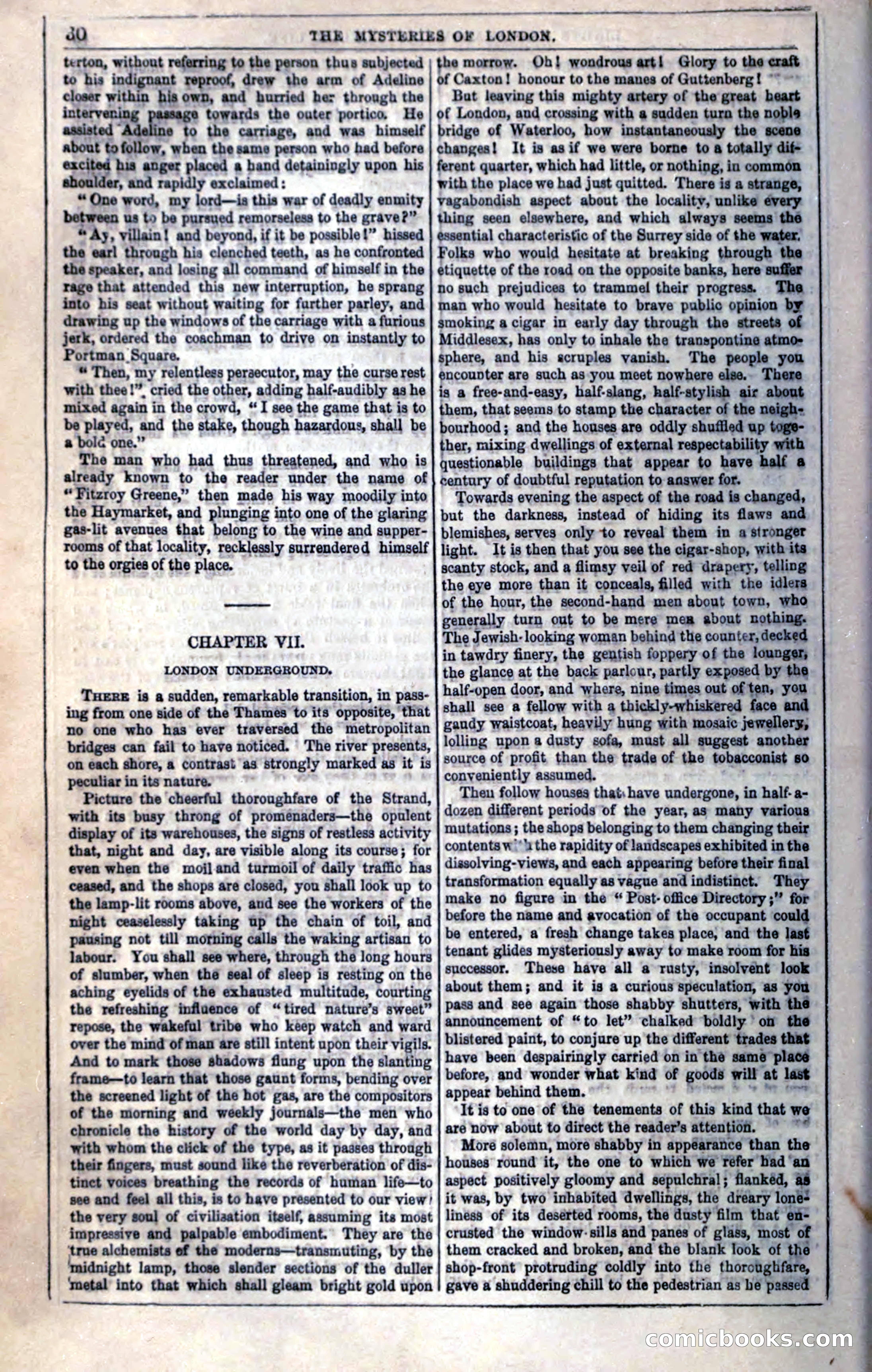
A restored page from Penny Dreadfuls, 1850. Page through the whole issue in the reader above.
📄 Transcribed text from this page (OCR, searchable)
Machine-transcribed from the original scan — historical spelling and the odd misread are preserved.
ae eee en ne 2 ee eS dO THE MYSTERIES OF LONDON, Re Oo eeeeeEeEEEEEEEaEaEEE>EEE——— LEE SSN. terton, without referring to the person thus subjected | the morrow. Oh! wondrous arti Glory to the exalt to his indignant reproof, drew the arm of Adeline | of Caxton! honour to the manes of Guttenberg! ” closer within his own, and hurried her through the| Bat leaving this mighty artery of the great heart intervening towards the outer portico. He | of London, and crossing with a sudden turn the noble assisted © ne to the carriage, and was himself| bridge of Waterloo, how instantaneously the scene —_ to follow, when the same person who had before | changes! It is as if we were borne to a totally dif- d his anger placed a band detainingly upon his | ferent quarter, which had little, or nothing, in common er, and rapidly exclaimed : with the place we had just quitted. There is a strange, “One word, my lord—is this war of deadly enmity | vagabondish aspect about the locality, unlike éyery between us to be pursued remorseless to the grave?” | thing seen elsewhere, and which always seems thé * Ay, villain! and beyond, if it be possible!” hissed | essential characteristic of the Surrey side of the water, the earl through his clenched teeth, as he confronted | Folks who would hesitate at breaking through the the speaker, and losing all command of himself in the | etiquette of the road on the opposite banks, here suffer rage that attended this new interruption, he sprang} no such prejudices to trammel their progress. The into his seat without waiting for farther parley, and | man who would hesitate to brave public opinion by drawing up the windows of the carriage with a furious | smoking a cigar in early day through the streets of jerk, ordered the coachman to drive on instantly to} Middlesex, has only to inhale the transpontine atmo- Portman Square. sphere, and his scruples vanish. The people you “ Then, my relentless peraecutor, may the curse rest encounter are such as you meet nowhere else. There with thee!” cried the other, adding half-audibly as he | is a free-and-easy, half-slang, half-stylish air about mixed again in the crowd, “1 see the game that is to them, that seems to stamp the character of the neigh- be played, and the stake, though hazardous, shall be | bourhood; and the houses are oddly shuffled up toge- a bolé one.” ther, mixing dwellings of external respectability with The man who had thus threatened, and who is questionable buildings that appear to have half a already known to the reader under the name of | century of doubtful reputation to answer for. | “Fitzroy Greene,” then made his way moodily into} Towards evening the aspect of the road is changed, the Haymarket, and plunging into one of the glaring | put the darkness, instead of hiding its flaws and gas-lit avenues that belong to the wine and supper- | blemishes, serves only to reveal them in a stronger rooms of that locality, recklessly surrendered himself light. It is then that you see the cigar-shop, with its to the orgies of the place. scanty stock, and a flimsy veil of red drapery, telling the eye more than it conceals, filled with the idlers of the hour, the second-hand men about town, who generally turn out to be mere mem ebout nothing. The Jewish- looking woman behind the counter, decked in tawdry finery, the gentish foppery of the lounger; the glance at the back parlour, partly exposed by the half-open door, and where, nine times out of ten, you shall see a fellow with a thickly-whiskered face and gaudy waistcoat, heavily hung with mosaic jewellery, lolling upon a dusty sofa, must all suggest another source of profit than the trade of the tobacconist so conyeniently assumed. Theu follow houses that: have undergone, in half- a- dozen different periods of the year, as many various mutations ; the shops belonging to them changing their contents w "i the rapidity of tandscapes exhibited in the dissolving-views, and each appearing before their final transformation equally as vague and indistinct. They make no figure in the “ Post- office Directory ;” for before the name and avocation of the occupant could be entered, a fresh change takes place, and the last tenant glides mysteriously away to make room for his successor. These have all a rusty, insolvent look about them; and it is a curious speculation, as you pass and see again those shabby shutters, with the announcement of “to let” chalked boldly ‘on the blistered paint, to conjure up the different ‘trades that have been despairingly carried on in the same “place before, and wonder what kind of goods will at last appear behind them.” ~ | le ae It is to one of the tenements of this kind that we are now about to direct the reader’s attention. 16 Moré solemn, more shabby in appéarance than the houses round it, the one to which we refer had “an aspect positively gloomy and sepulchral ; ‘flankéd, as it was, by two inhabited dwellings, the dreary lone- liness of its deserted rooms, the dusty film that en- | crusted the window: sills and panes of glass, most of them cracked and broken, and the blank Took of the , shop-front protruding coldly into the thorotg sifare, gave a shuddering chill to the pedestrian as he passed CHAPTER VII. LONDON UNDERGROUND, THERE is a sudden, remarkable transition, in pass- ing from one side of the Thamés ‘to its opposite, ‘that no one who has ever traversed the metropolitan bridges can fail to have noticed. The river presents, on each shore, a contrast as strongly marked as it is peculiar in its nature. Picture the cheerful thoroughfare of the Strand, with its busy throng of proménaders—the opulent display of its warehouses, the signs of restless activity that, night and day, are visible along its course; for even when the mojjand turmoil of daily traffic has ceased, and the shops are closed, you shall look up to the lamp-lit rooms above, and see the workers of the night ceaselessly taking up the chain of toil, and pausing not till morning calls the waking artisan to labour. You shall see where, through the long hours of slumber, when thé seal of sleep is resting on the aching eyelids of the exhausted multitude, courting the refreshing influence of “tired nature’s sweet” repose, the wakeful tribe who keep watch and ward over the mind of man are still intent upon their vigils. And to mark those shadows flung upon the slanting frame—to learn that those gaunt forms, bending over the screened light of the hot gas, are the compositors of the miorning and weekly journals—the men who chronicle the history of the world day by day, and with whom the click of the type, as it passes through their fingers, must sound like the reverberation of dis- tinct voices breathing the records of human life—to see and feel all this, is to have presented to our view! the very soul of civiliaation itself, assuming its most impressive and palpable embodiment. They are the ‘true alchemists of the moderns—transmuting, by the ight lamp, those slender sections of the duller ‘metal into that which shall gleam bright gold upon Gomicivooks.co