
Penny Dreadfuls, 1850 · page 376 of 394
The Mysteries of London; or, Lights and Shadows of London Life — page 376: what you’re looking at
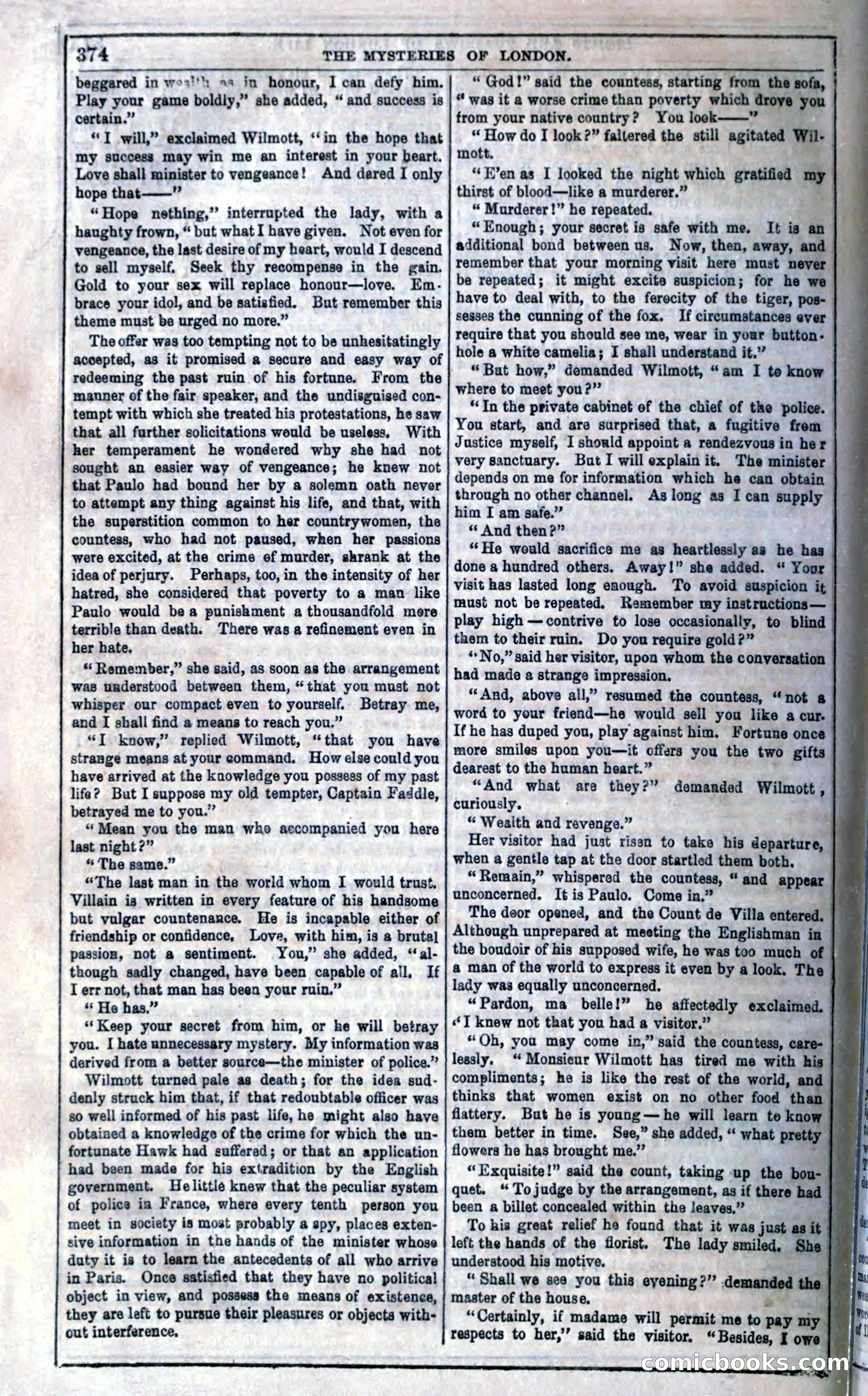
A restored page from Penny Dreadfuls, 1850. Page through the whole issue in the reader above.
📄 Transcribed text from this page (OCR, searchable)
Machine-transcribed from the original scan — historical spelling and the odd misread are preserved.
374 beg in wes'': a8 in honour, I can defy him. Play your game boldly,” she added, “ and success is certain.” “T will,” exclaimed Wilmott, ‘“‘in the hope that my success may win me an interest in your beart. Love shall minister to vengeance! And dared I only hope that——” “Hope nething,” interrupted the lady, with a haughty frown, “ but what I have given. Not even for vengeance, the last desire of my heart, would I descend to sell myself, Seek thy recompense in the gain. Gold to your sex will replace honour—love. Em- brace your idol, and be satisfied. But remember this theme must be urged no more.” The offer was too tempting not to be unhesitatingly accepted, as it promised a secure and easy way of redeeming the past ruin of his fortune. From the manner of the fair speaker, and the undisguised con- tempt with which she treated his protestations, he saw that all further solicitations would be useless, With her temperament he wondered why she had not sought an easier way of vengeance; he knew not that Paulo had bound her by a solemn oath never to attempt any thing against his life, and that, with the superstition common to her countrywomen, the countess, who had not paused, when her passions were excited, at the crime ef murder, shrank at the idea of perjury. Perhaps, too, in the intensity of her hatred, she considered that poverty to a man like Paulo would bea punishment a thousandfold more terrible than death. There was a refinement even in her hate. “ Remember,” she said, as soon as the arrangement was understood between them, “that you must not whisper our compact even to yourself. Betray me, and I shall find a means to reach you,” “T know,” replied Wilmott, “that you have strange means at your command. How else could you have arrived at the knowledge you possess of my past life? But I suppose my old tempter, Captain Faddle, betrayed me to you.” “Mean you the man who accompanied you here last night ?” * The same.” “The last man in the world whom I would trus¢, Villain is written in every feature of his handsome but vulgar countenance. He is incapable either of friendship or confidence, Love, with him, is a brutal passion, not a sentiment. You,” she added, “al- though sadly changed, have been capable of all, If I err not, that man has been your ruin.” ‘* He has.” “Keep your secret from him, or he will betray you. I hate unnecessary mystery. My information was derived from a better source—the minister of police.” Wilmott turned pale as death; for the idea sud- denly struck him that, if that redoubtable officer was so well informed of his past life, he might also have obtained a knowledge of the crime for which the un- fortunate Hawk had suffered; or that an application had been made for his extradition by the English government. NHelittle knew that the peculiar system of police ia France, where every tenth person you meet in society is most probably a spy, places exten- sive information in the hands of the minister whose duty it is to learn the antecedents of all who arrive in Paris. Once satisfied that they have no political object in view, and possess the means of existence, they are left to pursue their pleasures or objects with- out interference. THE MYSTERIES OF LONDON. “ God!” said the countess, avila eek was it a worse crime than poverty which eo h from your native country? You look——” “ How do I look?” faltered the still agitated m| 4 mott. “en as I looked the night which gratified ) thirst of blood—like a murderer.” “ Murderer!” he repeated. “Enough; your secret is safe with me. It is an additional bond between us. Now, then, away, and | remember that your morning visit here must be repeated; it might excite suspicion; for he . a4 have to deal with, to the ferecity of the tiger, pos- sesses the cunning of the fox. If circumstances ever require that you should see me, wear in your button- hole a white camelia; I shall understand it.” “But how,” demanded Wilmott, “am I te know where to meet you?” “In the private cabinet of the chief of the police. You start, and are surprised that, a fugitive frem Justice myself, I should appoint a rendezvous in her very sanctuary. ButI will explain it. The minister depends on me for information which he can obtain | through no other channel. As long as I can supply | g him I am safe.” ** And then ?” J “He would sacrifice me as heartlessly as he has ; done a hundred others. Away!” she added. “ Your } visit has lasted long enough. To avoid suspicion it f i p must not be repeated. Remember my instructions — play high —contrive to lose occasionally, to blind | them to their ruin. Do you require gold?” ** No,” said her visitor, upon whom the conversation | had made a strange impression, “And, above all,” resumed the countess, “not a word to your friend—he would sell you like a cure If he has duped you, play against him. Fortune once | more smiles upon you—it offers you the two gifts | dearest to the human heart.” “And what are they?” curiously, “ Weaith and revenge.” Her visitor had just risen to take his departure, when a gentle tap at the door startled them both. “ Remain,” whispered the countess, and appear, unconcerned. It is Paulo. Come in.” The door opened, and the Count de Villa entered. Although unprepared at meeting the Englishman i the boudoir of his supposed wife, he was too much « a man of the world to express it even by a look. The lady was equally unconcerned. “Pardon, ma belle!” he affectedly exclaimed. “7 knew not that you had a visitor,” “Oh, you may come in,” said the countess, ¢ lessly, “ Monsicur Wilmott has tired me with «. compliments; he is like the rest of the wor! | thinks that women exist on no other food tha ' flattery. But he is young—he will learn te know them better in time. See,” she added, “ what pretty. flowers he has brought me.” 4 “Exquisite!” said the count, taking up the t quet. “ Tojudge by the arrangement, as if there h been a billet concealed within the leaves,” To his great relief ho found that it was just a left the hands of the florist. The lady es understood his motive. “ Shall we see you this eyening?”’ .d master of the house, a” rf “Certainly, if madame will permit me to pay m respects to her,’ said the visitor. “Besides, I o comircbook demanded Wilmott , | . ih - she f : ’ ‘