
Penny Dreadfuls, 1850 · page 369 of 394
The Mysteries of London; or, Lights and Shadows of London Life — page 369: what you’re looking at
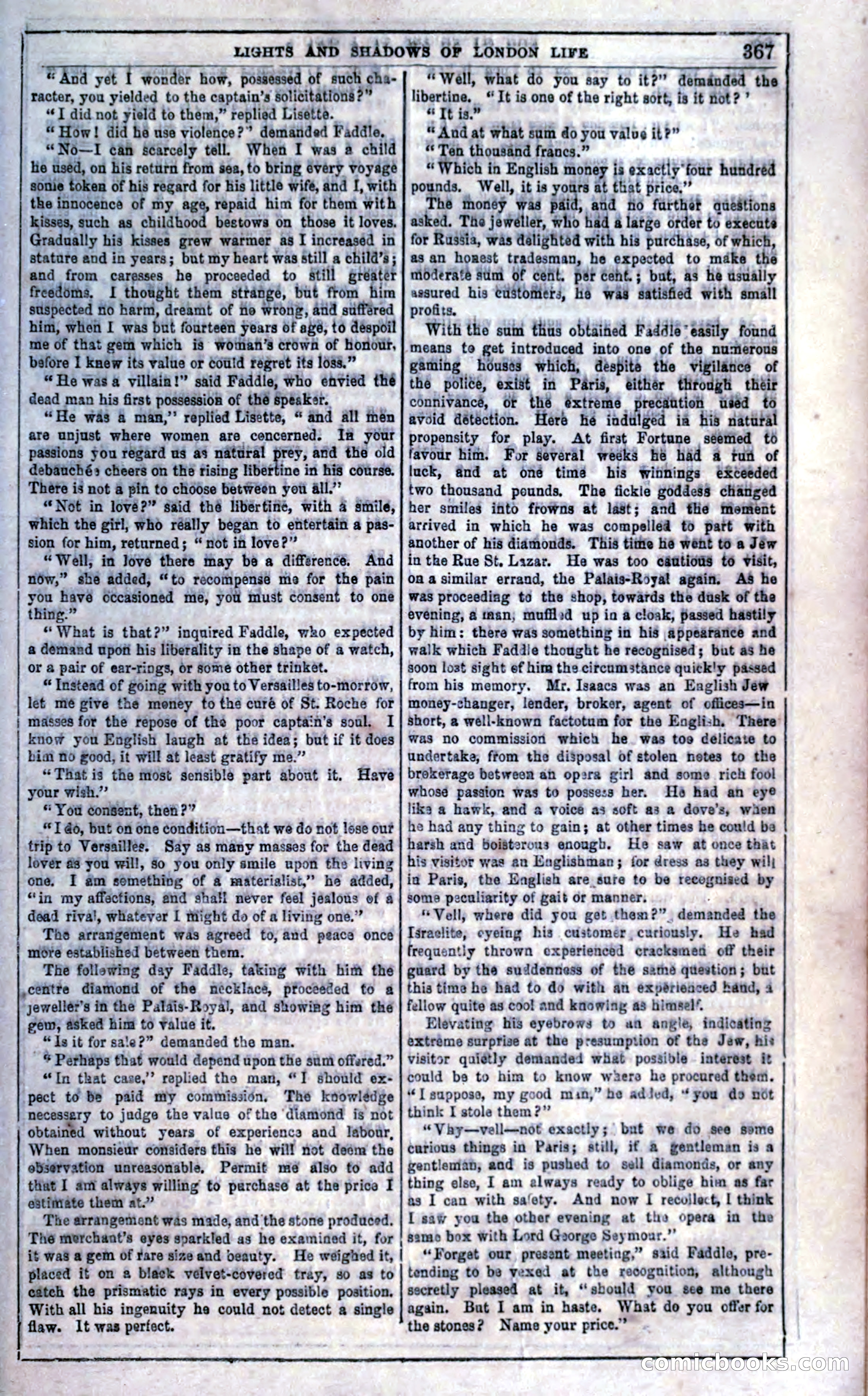
A restored page from Penny Dreadfuls, 1850. Page through the whole issue in the reader above.
📄 Transcribed text from this page (OCR, searchable)
Machine-transcribed from the original scan — historical spelling and the odd misread are preserved.
. LIGHTS AND SHADOWS OF LONDON Live wonder how, possessed of . such ch a- | “Well, what racter, you yielded to the captain’s Solicitations ? “T did not zield to them,” replied Lisette. « How! did ha use violence?” dematided Faddle, “No—I can scarcel When I was a child e used, on his return from sea, to bring, Gvéry. voyage mie tok regard for his little wifé, and I, with J rebhc such atatare and in years; but om caresses he sade hought th of my age, repaid him for them with childbood bestows on those it loves. my heart was still a child’s; at roceeded to still grdater stispected to hari, dreamt of fo wrong, aiid suffered iim, whieh I was but fourteen years of agé, to despoil mie of that géti which is woman’s crown of Honour, before I knew its value or Cotild regret its 1688.” “ Be was 4 villain!” - Sigivas envied thé dead his first possession of peaker. “He was & man,” replied Lisette, “ and all mén ate unjust where women are cencerned. Ia 1 passions you regard us as natural prey, atid the old debauchés cheers on the tising libertine in his course. Théte is not a pin to chddse between you all.” “Not in lové?” said thé libertine, with 4 smile, which the gitl, who réally began to entertain a pas- sion for him, returned; “ not in love?” : “Well, in Jove there may be a differencé. And now,” she added, “to recompensé mie for the pain tos Occasioned me, you must consent to one t : “ What is that?” inquired Faddle, who expected a demand upofi his liberality in the shape of a watch, or a pair of ear-rings, or some other trinket. “ Instead of going with you to Versailles to-morrow, let mé give the money to the curé of St. Roche for } masses for the repose of the poor captain’s soul. I ktiow you English laugh at thé idea; but if it does biai No good, it will at least gratify me.” | “That is the most sensible part about it. Have your wish.” * You consent, thet ?” “1 46, but on one condition—that we do not lose ou? trip to Versailles. Say as many masses for the dead lover a8 you will, So you only smile upon the living one, I am something of a materialist,” he added, “in my affections, and shall never feel jéalous of 4 dead rival, whatever I tight do of a living one.” The arrangement was agreed to, and peace once more established between them. The following day Faddle, taking with him thé céntte diamond of the nécklacé, pfocteded fo a -jewellér’s in the Paldis-Royal, and showing him the géw, asked him to Value it. “Is it for sale?” demanded the man. - © Perhaps that would depend upon the sum offered.” _ “Tn that case,’”’ replied the man, “I should ex- ‘pect to Be paid my comimission, The ktowlédge eco y to judge the value of the ‘diamond is not | obtai without years of experienca and labour, When monsieur considers this he will not deém the observation unreasonable, Permit mé dlso to add that I ani always willing to parchase at the price I estimate them at.” : - ital it waS a gem of rare size and beauty. He weighed it, | placed it on a black velvet-covered fray, so as to eateh the prismatic rays in every possible position. With all his ingenuity he could not detect a single flaw. It was perfect. means to The arrangemiont was made, andthe stone produced. | 1 saw you the other evening at the opera in the The merchant’s eyes sparkled as he examined it, for | 88me box with Lord George Seymour.’ 367 inertia. “It is one of the right sort, is it not? ’ “i “ And at what sum do you value it?” “Ten thousand francs.” “Which in English money is exactly*four hutidréd ponds Well, it is aes that price,” : | ponte As , and fo farthe® auestions asked. The jawéller, who had a latge ordat to executs for Russia, was délighted with his purchase, of which as an honest tradesman, he expected to mdke the moderate Stimi Of cefit, per éeht.; but, a3 he usually ney his eustomers, hd was satisfied with small profits. With the sum thus obtaihed Paddle "easily found t introduced into one of the numerous gaming aan which, despite the vigilance of the polite, exist in Paris, either through théir connivancé, of thé @xtreme precdition used to avoid aétéction. Here he indt te id his —— ropensity for play. At first Fortune séemed fatoude him. For bavérit ives ne had a tun of luck, and at oné timé his Witnings eteeded two thousand pounds, The fickle goddess changed her smiles into frowns at la8t; and flie Moment arrived in which he was compelled t} part with another of his didmonds. This tite ie wéht to a Jéw in the Rue St, Lazar. He was too catitioas t6 visit, on a similar errand, the Palais-Royat again. A&s he was proceeding to the shop, towards the dusk of the evening, a tagn; muffled up in a cloak, passed hastily by him: there was something in his appeararice and walk which Faddie thought he recogniséd; but as he soon lost sight ef him the circumstance quitk!y passed from his memory. Mr. Isaacs was an English Jew money-changer, lender, broker, agent of offices—in short, a well-known factotum for the English, There’ was no commission which he. was toe délicate to undertake, from the disposal of stolen netes to the broketage between ah opera girl and some rich fool whosé passion was to possess her. Hé had ah eye lika a hawk, and a voicé as soft a3 a dove’s, when he had any thing to gain; at other times he could be harsh and boisterous enough. He saw at once that his visitor was an Englishman; for dress aa they will in Paris, the English are sure to be recognised by some peculiarity of gait or manner. Vell, where did you get them?” demanded the Israelite; eyeing his customér, curiously. He had frequently thrown experienced cracksmed off their guard by the suddenness of the sathe question; but this time he had to do with an expérienced hatid, 4 fellow quite as cool and knowing as himsel’. Elevating his eyebrows to an angle, indicating extréme surprise at the presumption of the Jew, his visitor quiétly demanded what possible interest it could be to him to know where he procured them. “T suppose, my good mun,” be added, “you do not think I stole them?” “Vby—vell—not exactly; but we do see some carious things in Paris; still, if a gentleman is a gentleman; and is pushed to sell diamonds, or any thing else, I am always ready to oblige him as far as I can with safety. And now I recuijlect, | think ie 2 “Forget our present meeting,” said Paddle, pre- tending to be vexed at the recognition, although secretly pleased at it, “sbould you see me there again. But I am in haste. What do you offer for the stones? Name your price.” O)O)O do you say to it?” demanded the (CO) Ee