
Penny Dreadfuls, 1850 · page 361 of 394
The Mysteries of London; or, Lights and Shadows of London Life — page 361: what you’re looking at
A restored page from Penny Dreadfuls, 1850. Page through the whole issue in the reader above.
📄 Transcribed text from this page (OCR, searchable)
Machine-transcribed from the original scan — historical spelling and the odd misread are preserved.
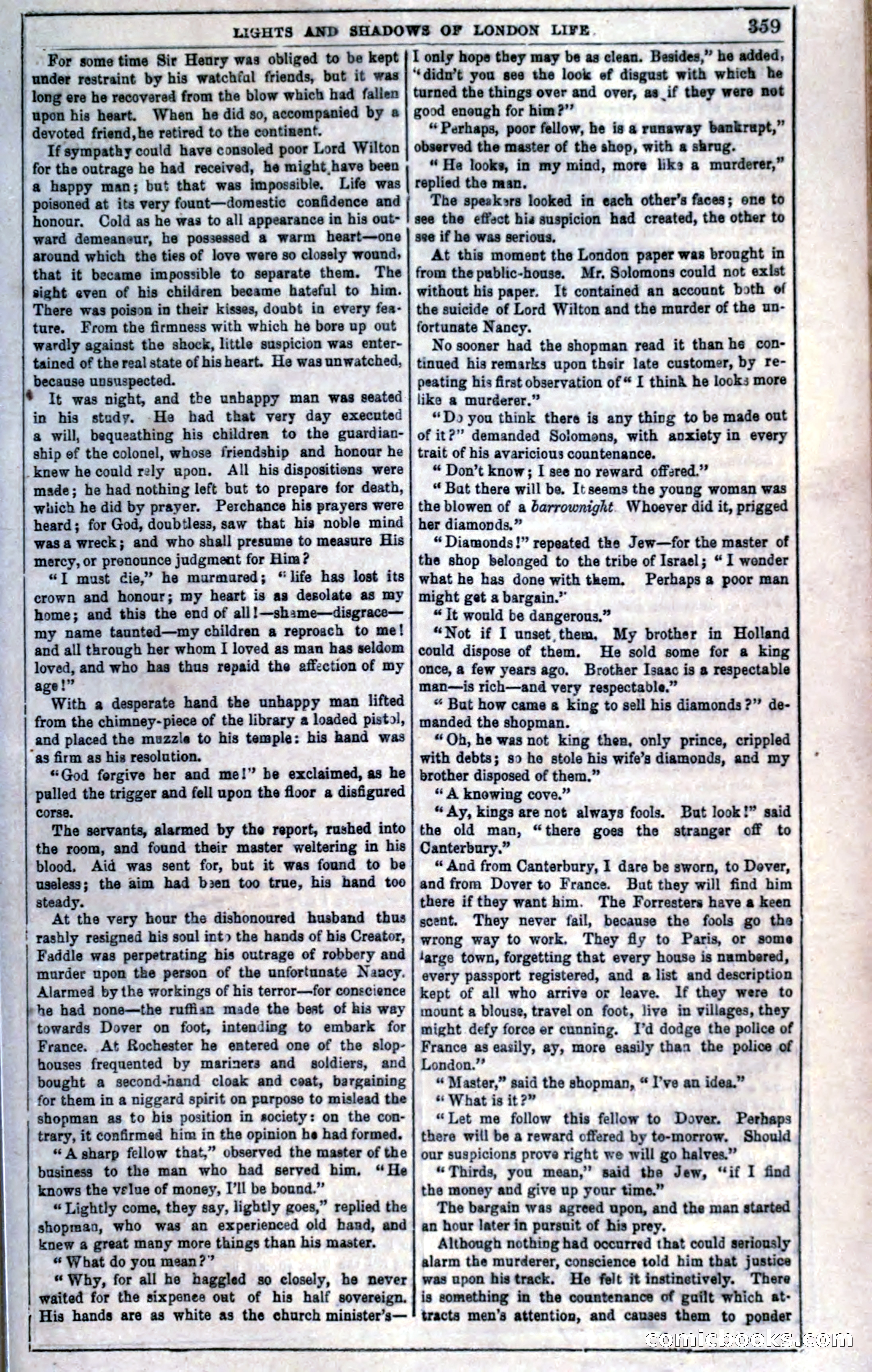
- For some time Sir Henry was obliged to be kept under restraint by his watchful friends, but it was long ere he recovered from the blow which had fallen upon his heart. When he did so, accompanied by « devoted friend, he retired to the continent. If sympathy could have consoled poor Lord Wilton for the outrage he had received, he might have been a happy man; but that was impossible. Life was at its very fount—domestic confidence and honour. Cold as he was to all appearance in his out- ward demeaneur, he possessed a warm heart—one around which the ties of love were so closely wound, that it became impossible to separate them. The of his children beeame hateful to him. poison in their kisses, doubt in every fea- From the firmness with which he bore up out wardly against the shock, little suspicion was enter- tained of the real state of his heart. He was unwatched, unsuspected. It was night, and the unbappy man was seated in his study. -He had that very day executed a will, bequeathing his children to the guardian- ship ef the colonel, whose friendship and honour he _knew he could rely upon. All his dispositions were made; he had nothing left but to prepare for death, which he did by prayer. Perchance his prayers were heard; for God, doubtless, saw that his noble mind was a wreck; and who shall presume to measure His mercy, or prenounce judgment for Him? “T must die,” he murmured; “life has lost its crown and honour; my heart is as desolate as my home; and this the end of all!—shame—disgrace— my name taunted—my children a reproach to me! and all through her whom I loved as man has seldom loved, and who has thus repaid the affection of my age!” With a desperate hand the unhappy man lifted from the chimney-piece of the library a loaded pistol, and placed the muzzle to his temple: his hand was ‘as firm as his resolution. “God fergive her and me!” be exclaimed, as he pulled the trigger and fell upon the floor a disfigured corse. The servants, alarmed by the report, rushed into the room, and found their master weltering in his blood. Aid was sent for, but it was found to be useless; the aim had b2en too true, his hand too steady. At the very hour the dishonoured husband thus rashly resigned his soul int» the hands of his Creator, Faddle was perpetrating his outrage of robbery and murder upon the person of the unfortunate Naacy. Alarmed by the workings of his terror—for conscience he had none—the ruffian made the best of his way ‘towards Dover on foot, intending to embark for France. At Rochester he entered one of the slop- houses frequented by mariners and soldiers, and bought a second-hand cloak and coat, bargaining for them in a niggard spirit on purpose to mislead the shopman as to his position in society: on the con- trary, it confirmed him in the opinion he had formed. “ A sharp fellow that,” observed the master of the business to the man who had served him, “He knows the velue of money, I’ll be bound.” “Lightly come, they say, lightly goes,” replied the shopman, who was an experienced old hand, and knew a great many more things than his master. * What do you mean?” “ Why, for all he haggled so closely, he never waited for the sixpenes out of his half sovereign. His hands are as white as the church minister’s— [ee ee LIGHTS AND SHADOWS OF LONDON LIFE 359 I only hope they may be as clean. Besides,” he added, “didn’t you ses the look ef disgust with which he turned the things over and over, as_if they were not good eneugh for him ?’’ “ Perhaps, poor fellow, he is a ranaway bankrupt,” observed the master of the shop, with a shrug. “ He looks, in my mind, more like a murderer,” replied the man. The speakers looked in each other’s faces; one to see the effect hia suspicion had created, the other to see if he was serious, At this moment the London paper was brought in from the public-house. Mr, Solomons could not exist without his paper. It contained an account both of the suicide of Lord Wilton and the murder of the un- fortunate Nancy. No sooner had the shopman read it than he con- tinued his remarks upon their late customer, by re- peating his first observation of “ I think he looks more like a murderer.” “Do you think there is any thing to be made out of it?” demanded Solomons, with anxiety in every trait of his avaricious countenance. “ Don’t know; I see no reward offered.” “ Bat there will be. It seems the young woman was the blowen of a barrownight. Whoever did it, prigged her diamonds.” “ Diamonds!” repeated the Jew—for the master of the shop belonged to the tribe of Israel; “ I wonder what he has done with them. Perhaps a poor man might get a bargain.” “ Jt would be dangerons,” “Not if I unset, them, My brother in Holland could dispose of them. He sold some for a king once, @ few years ago. Brother Isaac is a respectable man—is rich—and very respectable.” “ But how came a king to sell his diamonds?” de- manded the shopman. “Oh, he was not king then, only prince, crippled with debts; so he stole his wife’s diamonds, and my brother disposed of them.” “ A knowing cove.” “ Ay, kings are not always fools. But look!” said the old man, “there goes the stranger off to Canterbury.” “ And from Canterbury, I dare be sworn, to Dever, and from Dover to France. But they will find him there if they want him. The Forresters have a keen scent. They never fail, because the fools go the wrong way to work. They fly to Paris, or some large town, forgetting that every house is numbered, every passport registered, and a list and description kept of all who arrive or leave. If they were to mount a blouse, travel on foot, live in villages, they might defy force er cunning. I’d dodge the police of France as easily, ay, more easily than the police of London.” “ Master,” said the shopman, “ I’ve an idea.” “ What is it?” “Let me follow this fellow to Dover. Perhaps there will be a reward offered by te-morrow. Should our suspicions prove right we will go halves.” “Thirds, you mean,” said the Jew, “if I find the money and give up your time.” The bargain was agreed upon, and the man started an hour later in pursuit of his prey. Although nothing had occurred that could seriously alarm the murderer, conscience told him that justice was upon his track. He felt it instinctively. There is something in the countenance of guilt which at- tracts men’s attention, and causes them to ponder CONMICLOQO) Ss mM