
Penny Dreadfuls, 1850 · page 358 of 394
The Mysteries of London; or, Lights and Shadows of London Life — page 358: what you’re looking at
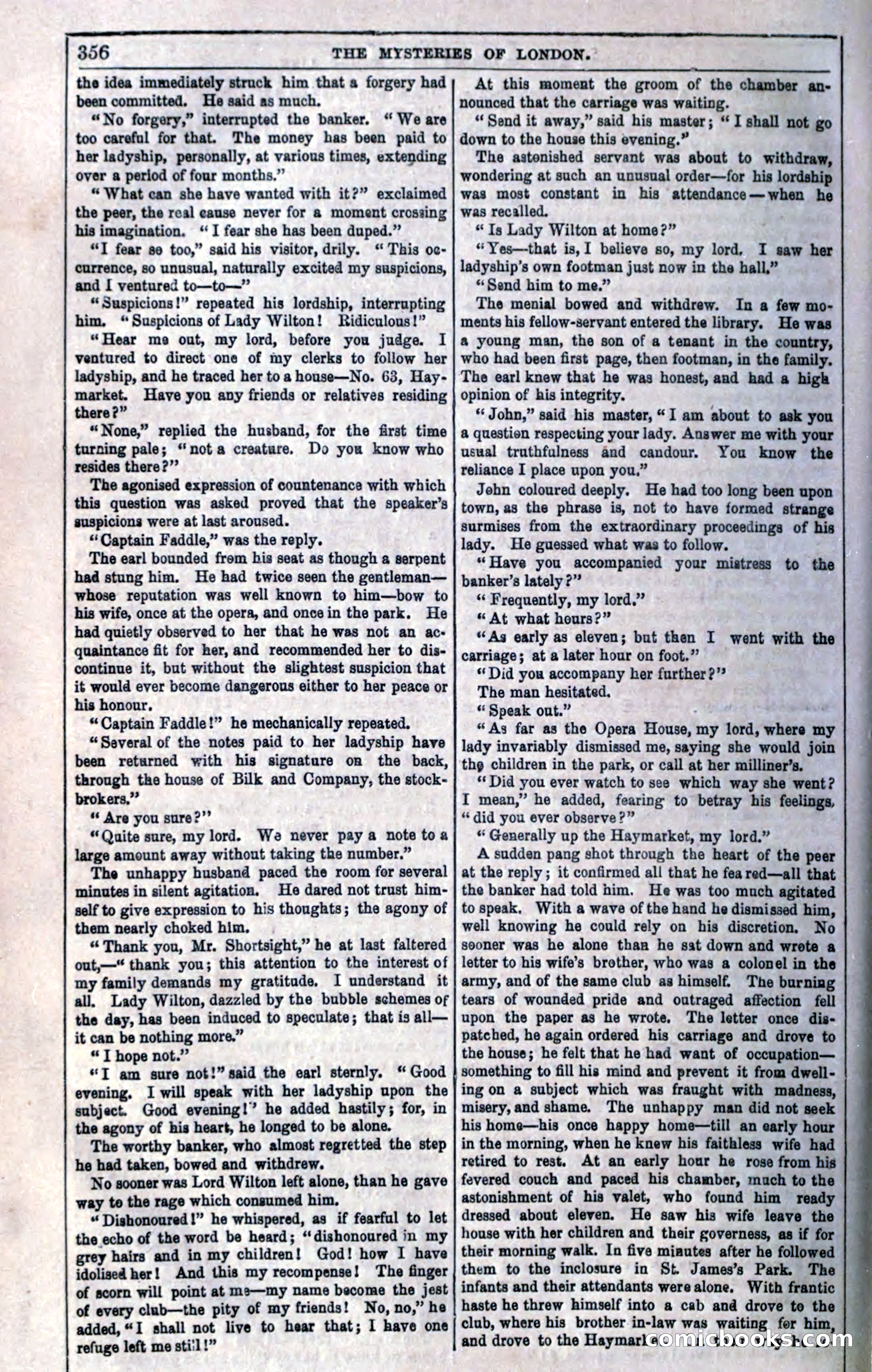
A restored page from Penny Dreadfuls, 1850. Page through the whole issue in the reader above.
📄 Transcribed text from this page (OCR, searchable)
Machine-transcribed from the original scan — historical spelling and the odd misread are preserved.
356 the idea immediately struck him that a forgery had been committed. He said as much. “No forgery,” interrupted the banker. “ We are too careful for that. The money has been paid to her ladyship, personally, at various times, extending over a period of four months.” “ What can she have wanted with it?” exclaimed the peer, the real eause never for a moment crossing his imagination. ‘I fear she has been duped.” “T fear se too,” said his visitor, drily. ‘ This oc- currence, so unusual, naturally excited my suspicions, and I ventured to—to—” “Suspicions!” repeated his lordship, interrupting him, “Suspicions of Lady Wilton! Ridiculous!” “Hear me out, my lord, before you judge. I ventured to direct one of my clerks to follow her ladyship, and he traced her to a house—No. 63, Hay- market. Have you any friends or relatives residing there?” “None,” replied the husband, for the first time turning pale; “nota creature. Do you know who resides there ?”’ The agonised expression of countenance with which this question was asked proved that the speaker’s suspicions were at last aroused. “Captain Faddle,” was the reply. The earl bounded from his seat as though a serpent had stung him. He had twice seen the gentleman— whose reputation was well known to him—bow to his wife, once at the opera, and oncein the park. He had quietly observed to her that he was not an ac- quaintance fit for her, and recommended her to dis- continue it, but without the slightest suspicion that it would ever become dangerous either to her peace or his honour. “Captain Faddle!” he mechanically repeated. “Several of the notes paid to her ladyship have been returned with his signature on the back, through the house of Bilk and Company, the stock- brokers,” “ Are you sure?”’ “Quite sure, my lord. We never pay a note toa large amount away without taking the number.” The unhappy husband paced the room for several minutes in silent agitation. He dared not trust him- self to give expression to his thoughts; the agony of them nearly choked him, “ Thank you, Mr. Shortsight,” he at last faltered out,—‘“ thank you; this attention to the interest of my family demands my gratitude, I understand it all. Lady Wilton, dazzled by the bubble schemes of the day, has been induced to speculate; that is all— it can be nothing more,” “T hope not.” “T am sure not!” said the earl sternly. “ Good evening. I will speak with her ladyship upon the subject. Good evening!’ he added hastily; for, in the agony of his heart, he longed to be alone. The worthy banker, who almost regretted the step he had taken, bowed and withdrew. No sooner was Lord Wilton left alone, than he gave way te the rage which consumed him. “ Dishonoured!” he whispered, as if fearful to let the echo of the word be heard; “‘dishonoured in my grey hairs and in my children ! God! how I have idolised her! And this my recompense! The finger of scorn will point at me—my name become the jest of every club—the pity of my friends! No, no,” he added, “I shall not live to hear that; I have one refuge left me sti:l!” THE MYSTERIES OF LONDON. At this moment the groom of the chamber an- nounced that the carriage was waiting. “ Send it away,” said his master ; “T shall not go down to the house this evening.” The astonished servant was about to withdraw, wondering at such an unusual order—for his lordship was most constant in his attendance—when he was recalled, “Ts Lady Wilton at home?” “ Yes—-that is, I believe so, my lord, I saw her ladyship’s own footman just now in the hall,” “Send him to me,” The menial bowed and withdrew. In a few mo- ments his fellow-servant entered the library. He was & young man, the son of a tenant in the country, who had been first page, then footman, in the family. The earl knew that he was honest, and had a high opinion of his integrity. John,” said his master, “I am about to ask you & question respecting your lady. Answer me with your usual truthfulness and candour. You know the reliance I place upon you,” Jehn coloured deeply. He had too long been upon town, as the phrase is, not to have formed surmises from the extraordinary proceedings of his lady. He guessed what was to follow. “Have you accompanied your mistress to the banker’s lately ?” ‘“ Frequently, my lord.” “ At what hours?” “As early as eleven; but then I went with the carriage; at a later hour on foot,” “Did you accompany her further?” The man hesitated, * Speak ont.” “As far as the Opera fouse.’ my lord, Sides’ my lady invariably dismissed me, saying she would join thg children in the park, or call at her milliner’s. **Did you ever watch to see which way she went? I mean,” he added, fearing to betray his feelings, “did you ever observe ?” “ Generally up the Haymarket, my lord.” A sudden pang shot through the heart of the peer at the reply; it confirmed all that he fea red—all that the banker had told him. He was too much agitated to speak. With a wave of the hand he dismissed him, well knowing he could rely on his discretion. No sooner was he alone than he sat down and wrote a letter to his wife’s brother, who was a colonel in the army, and of the same club as himself. The burning tears of wounded pride and outraged affection fell upon the paper as he wrote, The letter once dis- patched, he again ordered his carriage and drove to the house; he felt that he had want of occupation— something to fill his mind and prevent it from dwell- ing on a subject which was fraught with madness, misery, and shame. The unhappy man did not seek his home—his once happy home—till an early hour in the morning, when he knew his faithless wife had retired to rest. At an early hour he rose from his | fevered couch and paced his chamber, mach to the | astonishment of his valet, who found him ready | dressed about eleven. He saw his wife leave the | house with her children and their governess, as if for their morning walk. In five miautes after he followed them to the inclosure in St. James’s Park. The infants and their attendants werealone. With frantic haste he threw himself into a cab and oe bs) ex club, where his brother in-law was Teva and drove to the Haymarl ao) (ii \@ 9X0.) op com 7