
Penny Dreadfuls, 1850 · page 351 of 394
The Mysteries of London; or, Lights and Shadows of London Life — page 351: what you’re looking at
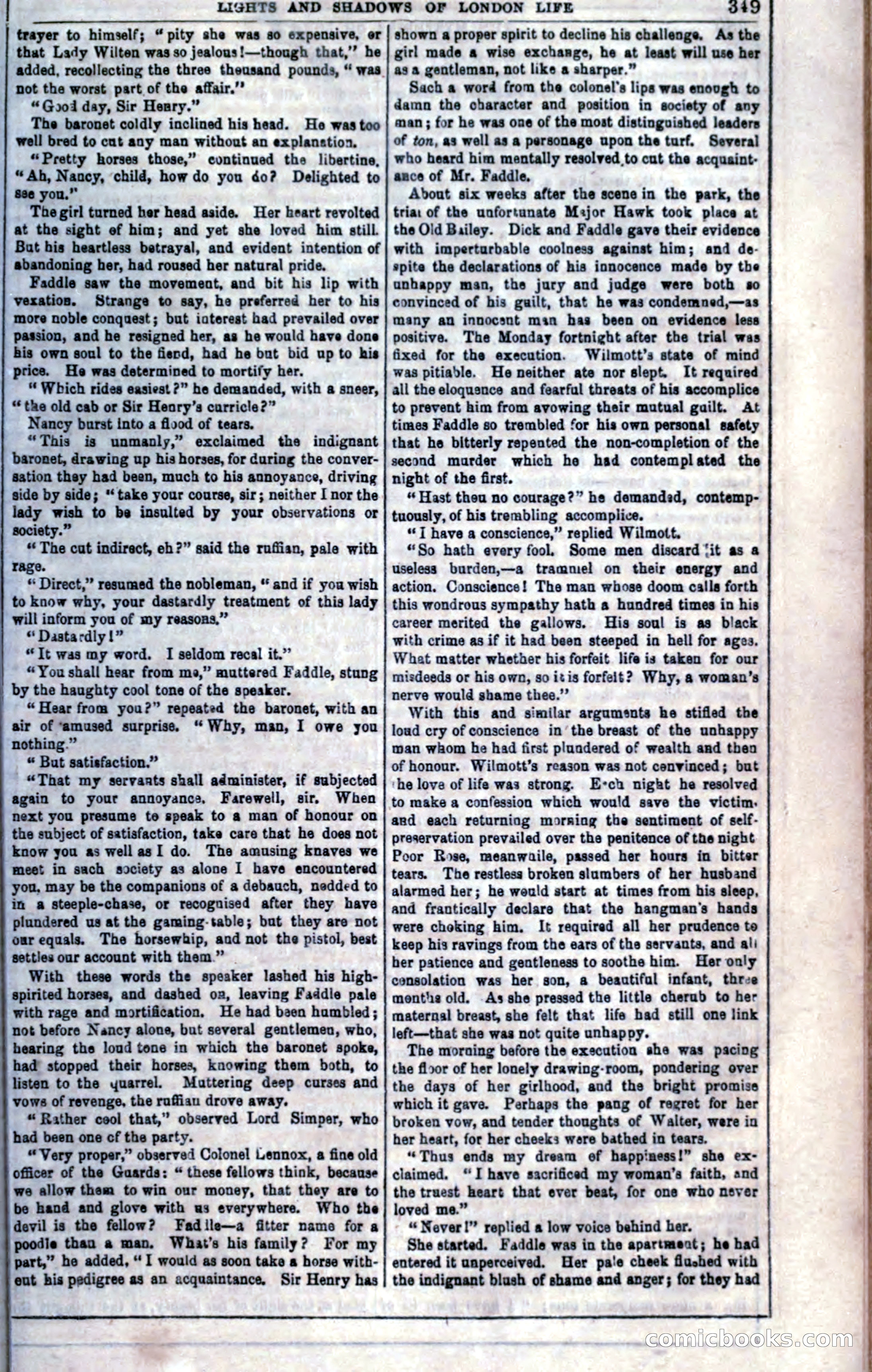
A restored page from Penny Dreadfuls, 1850. Page through the whole issue in the reader above.
📄 Transcribed text from this page (OCR, searchable)
Machine-transcribed from the original scan — historical spelling and the odd misread are preserved.
LIGHTS AND SHADOWS OF trayer to himself; “pity she was so expensive, or that Lady Wilten was so jealous!—though that,” he added, recollecting the three theusand pounds, “ was. not the worst part of the affair.” | “Good day, Sir Henry.” The baronet coldly inclined his head. He was too well bred to cut any man without an explanation, “Pretty horses those,” continued the libertine, “ Ah, Nancy, ‘child, how do you do? Delighted to 88e you.” The girl turned her head aside. Her heart revolted at the sight ef him; and yet she loved him still. Bat his heartless betrayal, and evident intention of abandoning her, had roused her natural pride. Faddle saw the movement, and bit his lip with vexatios. Strange to say, he preferred her to his noble conquest; but iaterest had prevailed over and he resigned her, as he would have done own soul to the fiend, had he but bid up to his He was determined to mortify her. “ Which rides easiest ?” he demanded, with a sneer, “ the old cab or Sir Heary’s curricle?” Nancy burst into a flood of tears. “This is unmanly,” exclaimed the indignant baronet, drawing up his horses, for during the conver- sation they had been, much to his annoyance, driving | side by side; “‘ take your course, sir; neither I nor the lady wish to be insulted by your observations or ” AHT : “ The cut indirect, eh?” said the ruffian, pale with rage. “ Direct,” resumed the nobleman, “ and if you wish to know why, your dastardly treatment of this lady will inform you of my reasons,” * Dastardly 1” “It was my word. I seldom recal it.” “You shall hear from me,” muttered Faddle, stung by the haughty cool tone of the speaker. “ Hear from you?” repeated the baronet, with an sir of ‘amused surprise. “Why, man, I owe you srace 2? “ But satisfaction.” “That my servants shall administer, if subjected again to your annoyance, Farewell, sir. When next you presume te speak to a man of honour on the subject of satisfaction, take care that he does not know you as wellasI do. The amusing knaves we meet in sach society as alone I have encountered you, may be the companions of a debauch, nedded to in a steeple-chase, or recognised after they have plundered us at the gaming-table; but they are not our equals. The horsewhip, and not the pistol, best settles our account with them.” — With these words the speaker lashed his high- spirited horses, and dashed on, leaving Faddie pale with rage and mortification. He had been humbled; not before Nancy alone, but several gentlemen, who, hearing the loud tene in which the baronet spoke, had stopped their horses, knowing them both, to listen to the yuarrel. Mauttering deep curses and vows of revenge, the ruffian drove away. “ Rather cool that,” observed Lord Simper, who had been one cf the party. “Very proper,” observed Colonel Lennox, a fine old officer of the Gaards: “ these fellows think, because allow them to win our money, that they are to hand and glove with us everywhere. Who the is the fellow? Fadile—a fitter name for a than a man. What's his family? For my he added, “ I would as soon take a horse with- pedigree as an acquaintance, Sir Henry has at LONDON LIFE 0t*9 shown a proper spirit to decline his challenge, As the girl made a wise exchange, he at least will use her as a gentleman, not like a sharper.” Sach a word from the colonel's lips was enough to damn the character and position in society of any man ; for he was one of the most distinguished leaders of ton, a3 well as a personage upon the turf. Several who heard him mentally resolved to cut the acquaint- ance of Mr. Faddle. About six weeks after the scenein the park, the tria: of the unfortunate Major Hawk took place at the Old Bailey. Dick and Faddle gave their evidence with impertarbable coolness against him; and de- spite the declarations of his innocence made by the unhappy man, the jury and judge were both so convinced of his guilt, that he was condemned,—as many an innocent man has been on evidence less positive. The Monday fortnight after the trial was fixed for the execution. Wilmott’s state of mind was pitiable. He neither ate nor slept. It required all the eloquence and fearful threats of his accomplice to prevent him from avowing their mutual guilt. At times Faddle so trembled for his own personal safety that he bitterly repented the non-completion of the second murder which he had contemplated the night of the first. “ Hast theu no courage?” he demanded, contemp- tuously, of his trembling accomplice. “‘T have a conscience,” replied Wilmott. “So hath every fool. Some men discard tit as a useless burden,—a trammel on their energy and action. Conscience! The man whose doom calls forth this wondrous sympathy hath a hundred times in his career merited the gallows. His soul is as black with crime as if it had been steeped in hell for ages. What matter whether his forfeit life is taken for our misdeeds or his own, so itis forfeit? Why, a woman’s nerve would shame thee.” With this and similar arguments he stifled the loud cry of conscience in’ the breast of the unhappy man whom he had first plundered of wealth and then of honour. Wilmott’s reason was not cenvinced; but ‘he love of life was strong. E-ch night he resolved to make a confession which would save the victim. and each returning morning the sentiment of self- preservation prevailed over the penitence of the night Poor Rose, meanwaile, passed her hours in bitter tears. The restless broken slumbers of her husband alarmed her; he would start at times from his sleep, and frantically declare that the hangman’s hands were choking him, It required all her prudence te keep his ravings from the ears of the servants, and ali her patience and gentleness to soothe him. Her only consolation was her son, a beautiful infant, three monte old. As she pressed the little cherub to her maternal breast, she felt that life had still one link left—that she was not quite unhappy. The morning before the execution she was pacing the floor of her lonely drawing-room, pondering over the days of her girlhood, and the bright promise which it gave. Perhaps the pang of regret for her broken vow, and tender thoughts of Walter, were in her heart, for her cheeks were bathed in tears. “Thus ends my dream ef happimess!” she ex- claimed. “I have sacrificed my woman's faith, and the truest heart that ever beat, for one who never loved me.” “ Never!” replied a low voice behind her. She started. Faddle was in the apartment; he had entered it unperceived. Her pa'e cheek flashed with the indignant blash of shame and anger; for they had (C(O) PMLCLOO@ S (CO)