
Penny Dreadfuls, 1850 · page 349 of 394
The Mysteries of London; or, Lights and Shadows of London Life — page 349: what you’re looking at
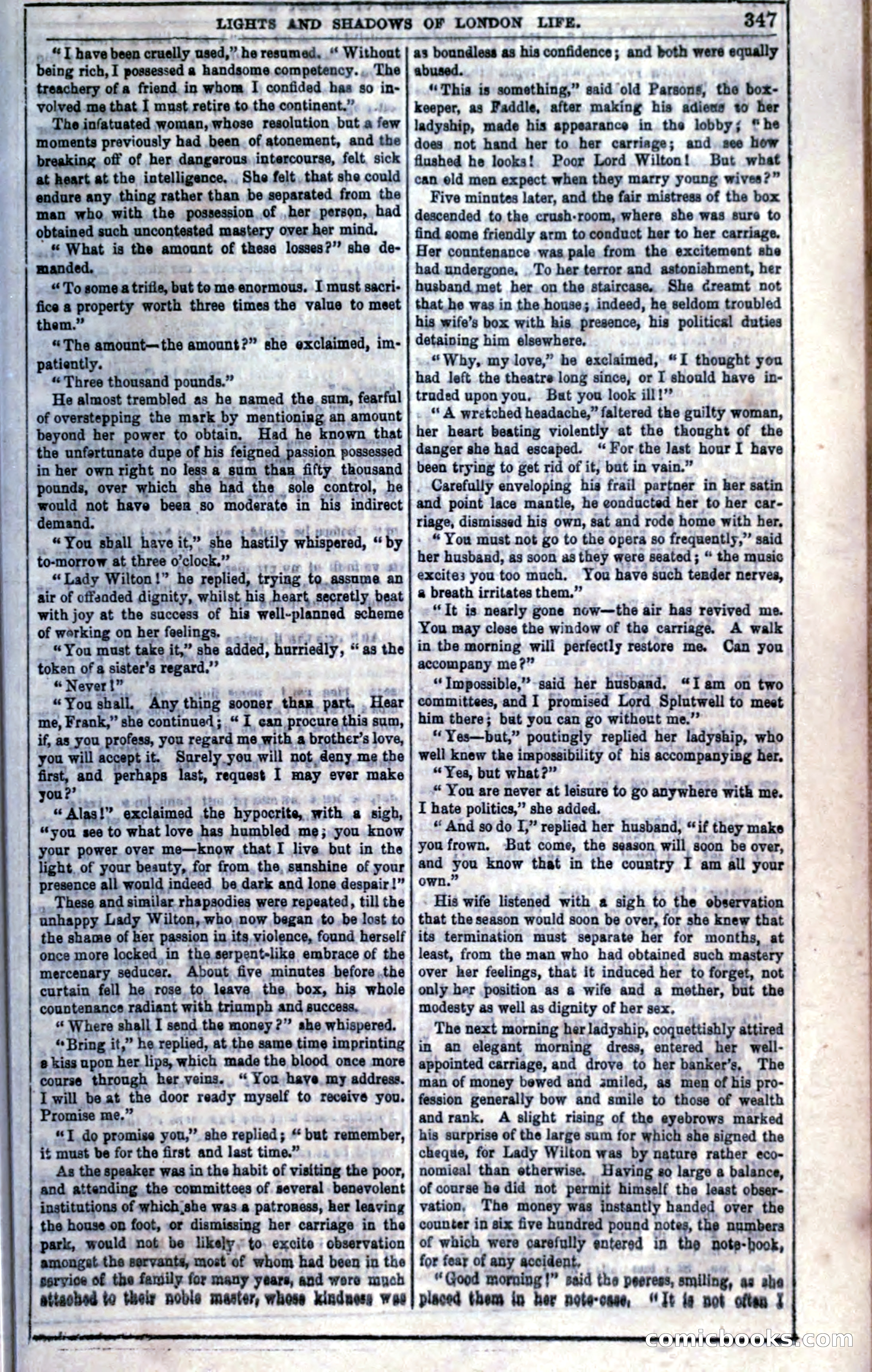
A restored page from Penny Dreadfuls, 1850. Page through the whole issue in the reader above.
📄 Transcribed text from this page (OCR, searchable)
Machine-transcribed from the original scan — historical spelling and the odd misread are preserved.
LIGHTS AND SHADOWS OF LONDON ee ee ees oe (ae ee ee ». “ Lhave been cruelly used,” he resumed, “ Without being rich, I possessed a handsome competency... The treachery ofa friend in whom I confided has so in- volved me that I must.retire tothe continent.” . The infatuated woman, whose resolution but a few moments previously had been of atonement, and the off of her dangerous. intercourse, felt, sick at heart at the intelligence, . She felt. that she could endure any thing rather than be separated from the man who with the possession of her person, had obtained such uncontested mastery over her mind. _™ What is the amount of these losses?” she de- _ “Tosomea trifie, but te me enormous. I must sacri- fice a property worth three times the value to meet them.” “The glia the amount?” she exclaimed, im- patiently. ; “Three thousand poun He almost trembled as “al named the sam, fearful of overstepping the mark by mentioning an amount re 7 her power to obtain. Had he known that the unfertunate dupe of his feigned. passion possessed in her own right no less a sum than fifty thousand pounds, over which she had. the sole control, he would not have been so moderate in his indirect and demand. - You shall | have it,” she | hastily whispered, “ ‘ by to-morrow at three o’clock.” _ | “Lady Wilton!” he replied, trying, to. assume an air of offended dignity, whilst his heart secretly beat with joy at the success of his well-planned scheme of working on her feelings, | “You must, take it,” she added, hurriedly, * as the token of a sister's regard.” “ Never!” sates “You shall, Any thing sooner ‘than. part, . Hear me, Frank,” she continued; “ 1 ean procure this sum, of as you profess, you regard me with a brother’s love, va we accept it, Barely, ye0, will not, deny. me the d perhaps last, request I pcm « Alga!” exclaimed the hypocrite, with. a sigh, “you see to what love has humbled me; you know eg) Rents oyer me—know that I live but in the beauty, for from the, sunshine of your pea would indeed be dark and lone despair!” These and similar rhapsodies were repeated, till the unhappy Lady Wilton, who, now began to be lost to the shame of her passion in its violence, found herself once more locked in the.serpent-like embrace of the mercenary seducer. ut five minutes before .the curtain fell he rose. to. leave, the, box, his whole countenance radiant with triampb and success, “ Where shall I send the money?” she whispered. « Bring it,” he replied, at the same time imprinting e kiss upon her lips, which made the blood once more you? course her veins. “ You haye my address. ‘I will be. at e door ready myself to receive you. Promise me,” “TI do promise you,” she replied; “ but remember, Se bs for the first and last time.” As the speaker was in the habit of visiting the poor, and attending the committees of several benevolent institutions of which,she was a patroness, her leaving the house on foot, or dismissing her carriage in the pk, would not be kl to. excite . observation Le age ay may ‘of whom had been jn the service of the family for many years, and wore much attached (0 thelr noble master, whose kindness wae LIFE. 347 rm en ee as boundless as his confidence; and both were equally abused. “This is something,” said old Parsons, the box- keeper, as Paddle, after making his adiens to her ladyship, made his appearance in the lobby; “he does not hand her to her carriage; and see how flushed he looks! Poor Lord Wilton! But what can eld men expect when they marry young wives?” Five minutes later, and the fair mistress of the box descended to the crush-room, where she was sure to find some friendly arm to conduct her to her carriage. Her countenance was pale from the excitement she had. undergone, .To her terror and astonishment, her husband met her on the staircase. She dreamt not that. he was in the house; indeed, he seldom troubled his wife’s box with his. presence, his political duties detaining him elsewhere. “Why, my love,” he exclaimed, “I thought you had left the theatre long since, or I should have in- truded upon you. But you look ill!” “A wretched headache,” faltered the guilty woman, her heart beating violently at the thought of the danger she had escaped. “For the Jast hourI have been trying to get rid of it, but in vain.” Carefully enveloping his frail partner in her satin point lace mantle, he conducted her to her car- riage, dismissed his own, sat and rode home with her, . “You must not go to the opera so frequently,”’ said her husbaad, as soon as they were seated; “ the music excites you too much. You have such tender nerves, a breath irritates them.” “It is nearly gone now—the air has revived me. You may clese the window of the carriage. A walk in the morning will perfectly restore me. Can you accompany me?” “Impossible,” said her husband. “Iam on two committees, and I promised Lord Splutwell to mest him there; bat you can go without me.” _ % Yes—but,” poutingly replied her ladyship, who well knew the impossibility of his accompanying her. “Yes, but what?” “ ht ed “ You are never at leisure to go anywhere with me. I hate politics,” she added. “ And so do I,” replied her husband, “if they make you frown. Bat come, the season will soon be over, and you know that in the country I am all your own.” - His wife listened with a sigh to the observation that the season would soon be over, for she knew that its termination must separate her for months, at least, from the man who had obtained such mastery over her feelings, that it induced her to forget, not only her position as a wife and a mother, but the modesty as well as dignity of her sex, The next morning her ladyship, coquettishly attired in an elegant morning dress, entered her well- appointed carriage, and drove to her banker’s, The man of money bewed and smiled, as men of his pro- fession generally bow and smile to those of wealth and rank, A slight rising of the eyebrows marked his surprise of the large sum for which she signed the cheque, for Lady Wilton was by nature rather eco- nomieal than etherwise, Haying so large a balance, of course he did not permit himself the least obser- vation, The money was instantly ee te Fh the counter in six five hundred pound sip Pay Bes ig note- hook, of which were carefully entered in for fear of any accident, “Good morning!” said the peeress, smiling, as abe placed them in her note-oase, It ig not often I MILCOOOKS,