
Penny Dreadfuls, 1850 · page 346 of 394
The Mysteries of London; or, Lights and Shadows of London Life — page 346: what you’re looking at
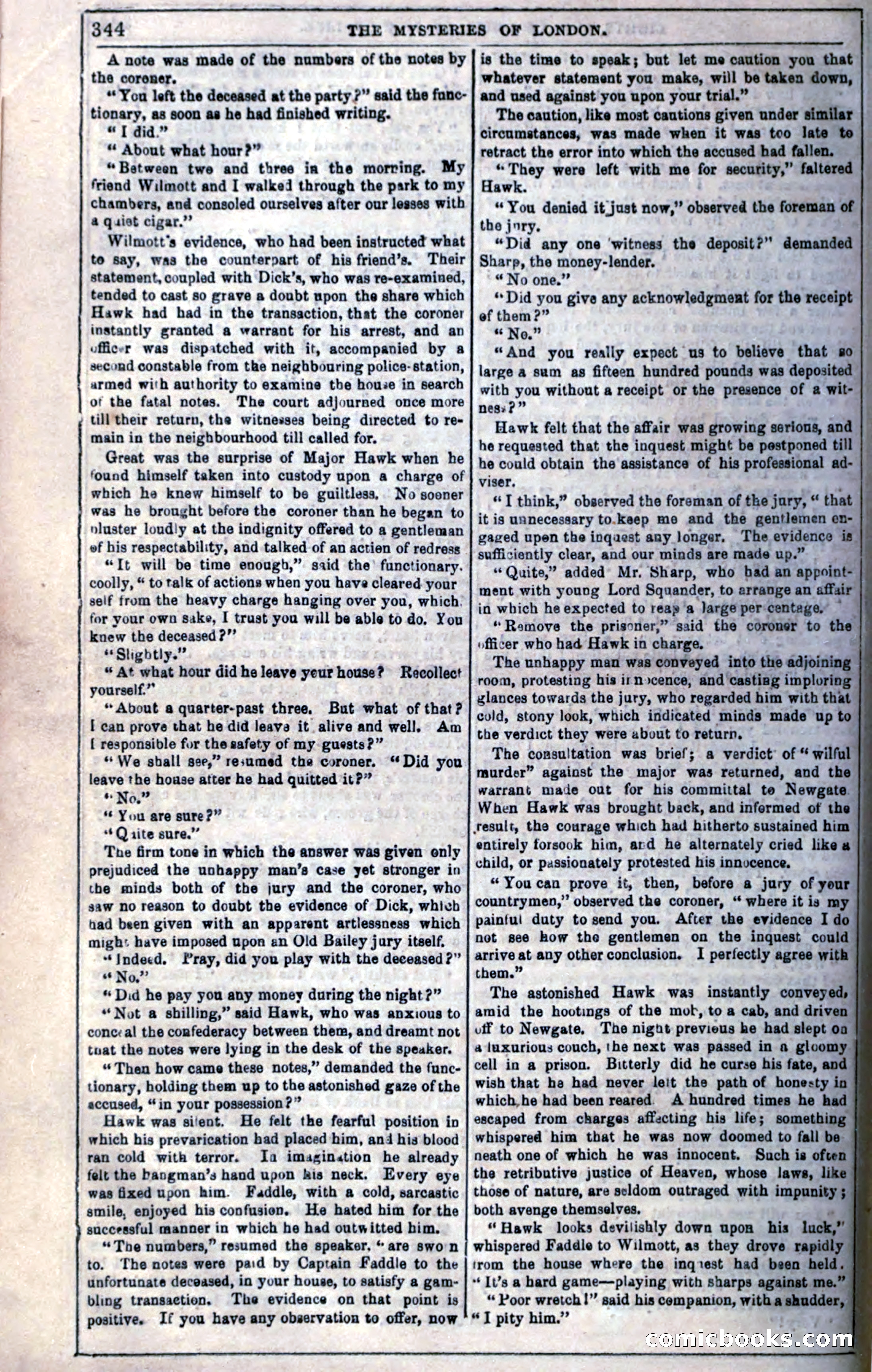
A restored page from Penny Dreadfuls, 1850. Page through the whole issue in the reader above.
📄 Transcribed text from this page (OCR, searchable)
Machine-transcribed from the original scan — historical spelling and the odd misread are preserved.
344 A note was made of the numbers of the notes by the coroner. “You left the deceased at the party?” said the func- tionary, as soon as he had finished writing. “I did.” “ About what hour?” “Between twe and three in the morring. My friend Wilmott and I walked through the park to my chambers, and consoled ourselves after our lesses with a quist cigar.” Wilmott’s evidence, who had been instructed what to say, was the counterpart of his friend’s. Their statement, coupled with Dick’s, who was re-examined, tended to cast so grave a doubt upon the share which Hawk had had in the transaction, that the coroner instantly granted a warrant for his arrest, and an officer was dispatched with it, accompanied by a second constable from the neighbouring police-station, armed with authority to examine the house in search ot the fatal notes. The court adjourned once more till their return, the witnesses being directed to re- main in the neighbourhood till called for. Great was the surprise of Major Hawk when he found himself taken into custody upon a charge of which he knew himself to be guiltless, No sooner was he brought before the coroner than he began to nluster loud!y at the indignity offered to a gentleman ef his respectability, and talked of an actien of redress “It will be time enough,” said the’ functionary. coolly, “ to talk of actions when you have cleared your self from the heavy charge hanging over you, which. for your own Sake, I trust you will be able to do. You knew the deceased ?”’ “Slightly.” “ At what hour did he leave yeur house? Recollect yourself.” * About a quarter-past three. f can prove that he did leave it alive and well, { responsible for the safety of my guests?” “We shall see,” resumed the coroner. “ Did you leave the house atter he had quitted it?” * No.” ** You are sure?” “*Q iite sure.” The firm tone in which the answer was given only prejudiced the unhappy man’s case yet stronger in the minds both of the jury and the coroner, who saw no reason to doubt the evidence of Dick, which had been given with an apparent artlessness which might have imposed upon an Old Bailey jury itself. “Indeed. Pray, did you play with the deceased?” «é No.”’ * Did he pay you any money during the night?” “Not a shilling,” said Hawk, who was anxious to conc al the confederacy between them, and dreamt not tuat the notes were lying in the desk of the speaker. “Then how came these notes,” demanded the func- tionary, holding them up to the astonished gaze of the accused, “in your possession?” Hawk was silent. He felt the fearful position in which his prevarication had placed him, and his blood ran cold with terror. Ia imagination he already felt the bangman’s hand upon kis neck. Every eye was fixed upon him. Faddle, with a cold, sarcastic smile, enjoyed his confusion. He hated him for the successful manner in which he had outwitted him. “Tbe numbers,” resumed the speaker, “ are swon to. The notes were paid by Captain Faddle to the unfortunate deceased, in your house, to satisfy a gam- bling transaction. The evidence on that point is positive. If you have any observation to offer, now But what of that? Am result, the courage which had hitherto sustained him THE MYSTERIES OF LONDON. is the time to speak; but let me caution you that | whatever statement you make, will be taken down, and used against you upon your trial.” The caution, like most cautions siven under aalibeel circumstances, was made when it was too late to | retract the error into which the accused had fallen. _ “They were left with me for security,” faltered | Hawk. “You denied it just now,’ observed the foreman of | the jnry. | “Did any one ‘witness the deposit?” demante | Sharp, the money-lender. } “No one.” “Did you give any acknowledgment for the sit | ef them ?” *“ No.” a | “And you really expect us to believe that 80° large a sum as fifteen hundred pounds was. leposited | with you without a receipt or the presence of a wit- | nesi?” Hawk felt that the affair was growing serious, and . he requested that the inquest might be pestponed till } he could obtain the assistance of his ad- viser. “T think,” observed the foreman of tbe sry ~ that . it is unnecessary to.keep me and the ge en en- | gaged upen the inqaest any longer, The evidence | ; sufficiently clear, and our minds are made up.” rf 3 “Quite,” added Mr. Sharp, who had an apps ; ment with young Lord Squander, to arrange an in which he expected to reap ‘a large per : “Remove the prisoner,” said the cd: officer who had Hawk in charge. The unhappy man was conveyed into the < \ room, protesting his irnocence, and castiag fia loi ms glances towards the jury, who regarded him with t , cold, stony look, which indicated minds made up t the verdict they were about to return, © The consultation was brief; a verdict of * will i murder” against the major was returned, and the warrant made out for his committal te Newgate When Hawk was brought back, and infermed of t entirely forsook him, ard he alternately cried like a child, or passionately protested his innocence, “You can prove it, then, before a jury of your countrymen,” observed the coroner, “ where it is yi painful duty tosend you. After the evidence iq not see how the gentlemen on the inquest could arrive at any other conclusion. I perfectly agree | vit bh them.” » oa The astonished Hawk was instantly cor amid the hootings of the mob, to a cab, and driv off to Newgate. The night previeus he had slept 0% a luxurious couch, the next was passed in a gloc cell in a prison. Bitterly did he curse his fate, 7 wish that he had never leit the path of honesty in which, he had been reared. A hundred times he hi : escaped from charges affecting his life; ing whispered him that he was now doomed to fall b neath one of which he was innocent. Sach is < the retributive justice of Heaven, whose lawecil those of nature, are seldom outraged with both avenge themselves, “Hawk looks devilishly down upon his whispered Faddle to Wilmott, as they drove r trom the house where the inquest had been b *Iv’s a hard game—playing with sharps ist “ Poor wretch!” said his companion, witt “J pity him.” <j Gomichoo