
Penny Dreadfuls, 1850 · page 341 of 394
The Mysteries of London; or, Lights and Shadows of London Life — page 341: what you’re looking at
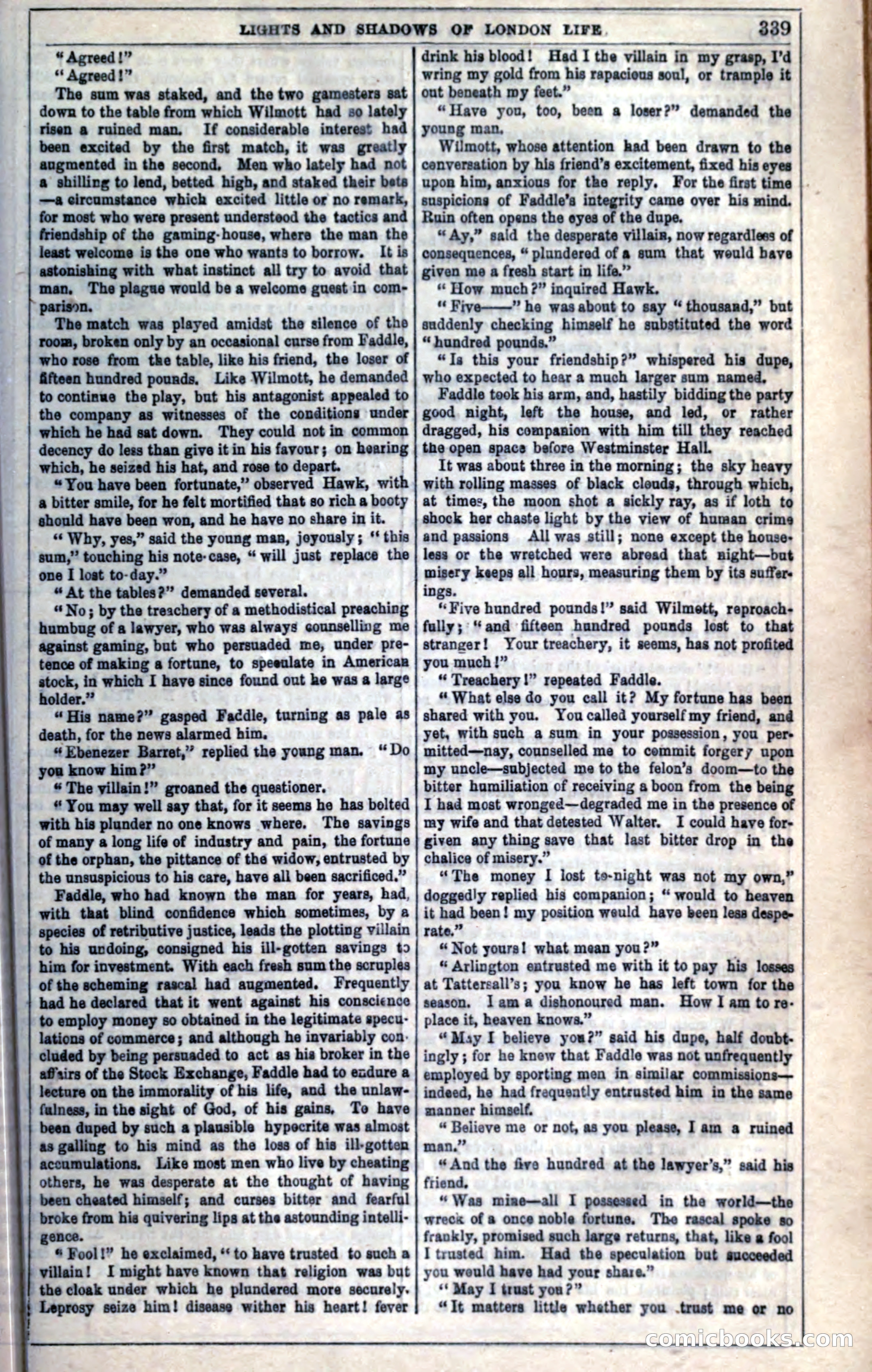
A restored page from Penny Dreadfuls, 1850. Page through the whole issue in the reader above.
📄 Transcribed text from this page (OCR, searchable)
Machine-transcribed from the original scan — historical spelling and the odd misread are preserved.
LIGHTS AND SHADOWS OF LONDON LIFE. 339 * Agreed |” “* Agreed !” The sum was staked, and the two gamesters sat down to the table from which Wilmott had so lately risen a ruined man. If considerable interest had been excited by the first match, it was greatly augmented in the second, Men who lately had not a shilling to lend, betted high, and staked their bets —a circumstance which excited little or no remark, for most who were present understeod the tactics and friendship of the gaming-house, where the man the least welcome is the one who wants to borrow. It is astonishing with what instinct all try to avoid that man, The plague would be a welcome guest in com- parison. The match was played amidst the silence of tho room, broken only by an occasional curse from Faddle, who rose from tke table, like his friend, the loser of fifteen hundred pounds, Like Wilmott, he demanded to continue the play, but his antagonist appealed to the company as witnesses of the conditions under which he had sat down. They could not in common decency do less than give it in his fayour; on hearing which, he seized his hat, and rose to depart. “You have been fortunate,” observed Hawk, with a bitter smile, for he felt mortified that so rich a booty should have been won, and he have no share in it. “‘ Why, yes,” said the young man, joyously; ‘** this sum,” touching his note-case, “ will just replace the one I lost to-day.” “ At the tables?” demanded several. “ No; by the treachery of a methodistical preaching humbug of a lawyer, who was always counselling me against gaming, but who persuaded me, under pre- tence of making a fortune, to speeulate in American stock, in which I have since found out he was a large holder.” “ His name?” gasped Faddle, turning as pale as death, for the news alarmed him. “ Ebenezer Barret,” replied the young man. “Do you know him?” « The yillain!” groaned the questioner. “ You may well say that, for it seems he has bolted with his plunder no one knows where. The savings of many a long life of industry and pain, the fortune of the orphan, the pittance of the widow, entrusted by the unsuspicious to his care, have all been sacrificed.” Faddle, who had known the man for years, had, with that blind confidence which sometimes, by a species of retributive justice, leads the plotting villain to his undoing, consigned his ill-gotten savings to him for investment. With each fresh sum the scruples of the scheming rascal had augmented. Frequently had he declared that it went against his conscience to employ money so obtained in the legitimate specu- lations of commerce; and although he invariably con. cluded by being persuaded to act as hia broker in the affairs of the Steck Exchange, Faddle had to exdure a lecture on the immorality of his life, and the unlaw- fulness, in the sight of God, of his gains, To have been duped by such a plausible hypocrite was almost as galling to his mind as the loss of his ill-gotten } accumulations, Like most men who live by cheating others, he was desperate at the thought of having been cheated himself; and curses bitter and fearful broke from his quivering lips at the astounding intelli- gence. & Fool!” he exclaimed, *‘ to have trusted to such a villain! I might have known that religion was but | the cloak under which he plundered more securely. | Leprosy seize him! disease wither his heart! fever drink his blood! Had I the villain in my grasp, I’d wring my gold from his rapacious soul, or trample it out beneath my feet.” “Have you, too, been a loser?” demanded the young man, Wilmott, whose attention had been drawn to the cenversation by his friend’s excitement, fixed his eyes upon him, anxious for the reply. For the first time |. suspicions of Faddle’s integrity came over his mind. Ruin often opens the eyes of the dupe. “Ay,” sald the desperate villain, now regardless of consequences, “ plundered of a sum that would bave given me a fresh start in life.” “ How much ?” inquired Hawk. “ Five——” he was about to say “thousand,” but suddenly checking himself he substituted the word “hundred pounds.” “Ts this your friendship?” whispered his dupe, who expected to hear a much larger sum named, Faddle teok his arm, and, hastily bidding the party good. night, left the house, and led, or rather dragged, his companion with him till they reached the open space before Westminster Hall. It was about three in the morning; the sky heavy with rolling masses of black clouds, through which, at times, the moon shot a sickly ray, as if loth to shock her chaste light by the view of human crime and passions All was still; none except the house- less or the wretched were abread that night—but misery keeps all hours, measuring them by its suffer. ings. “Five hundred pounds!” said Wilmett, reproach- fully; ‘‘and fifteen hundred pounds lost to that stranger! Your treachery, it seems, has not profited you much !” “ Treachery |!” repeated Faddle. “ What else do you call it? My fortune has been shared with you. You called yourself my friend, and yet, with such a sum in your possession, you per- mitted—nay, counselled me to commit forgery upon my uncle—subjected me to the felon’s doom—to the bitter humiliation of receiving a boon from the being I had most wronged—degraded me in the presence of my wife and that detested Walter. I could have for- given any thing save that last bitter drop in the chalice of misery.” “The money I lost to-night was not my own,” doggedly replied his companion; “ would to heaven it had been! my position weuld have been less despe- rate,” — “ Not yours! what mean you?” “ Arlington entrusted me with it to pay his losses at Tattersall’s; you know he has left town for the season. lama dishonoured man. How I am to re- place it, heaven knows.” “May I believe you?” said his dupe, half doubt- ingly ; for he knew that Faddle was not unfrequently employed by sporting men in similar commissions— indeed, he had frequently entrusted him in the same manner himself. “ Believe me or not, as you please, Iam a ruined man.” “And the five hundred at the lawyer’s,” said his friend, “Was mine—all I possessed in the world—the wreck of a once noble fortune. The rascal spoke so frankly, promised such large returns, that, like @ fool I trusted him. Had the speculation but succeeded you weuld have had your share.” ‘* May I trust you?” “Tt matters little whether you .trust me or no OMicbookseGgo