
Penny Dreadfuls, 1850 · page 337 of 394
The Mysteries of London; or, Lights and Shadows of London Life — page 337: what you’re looking at
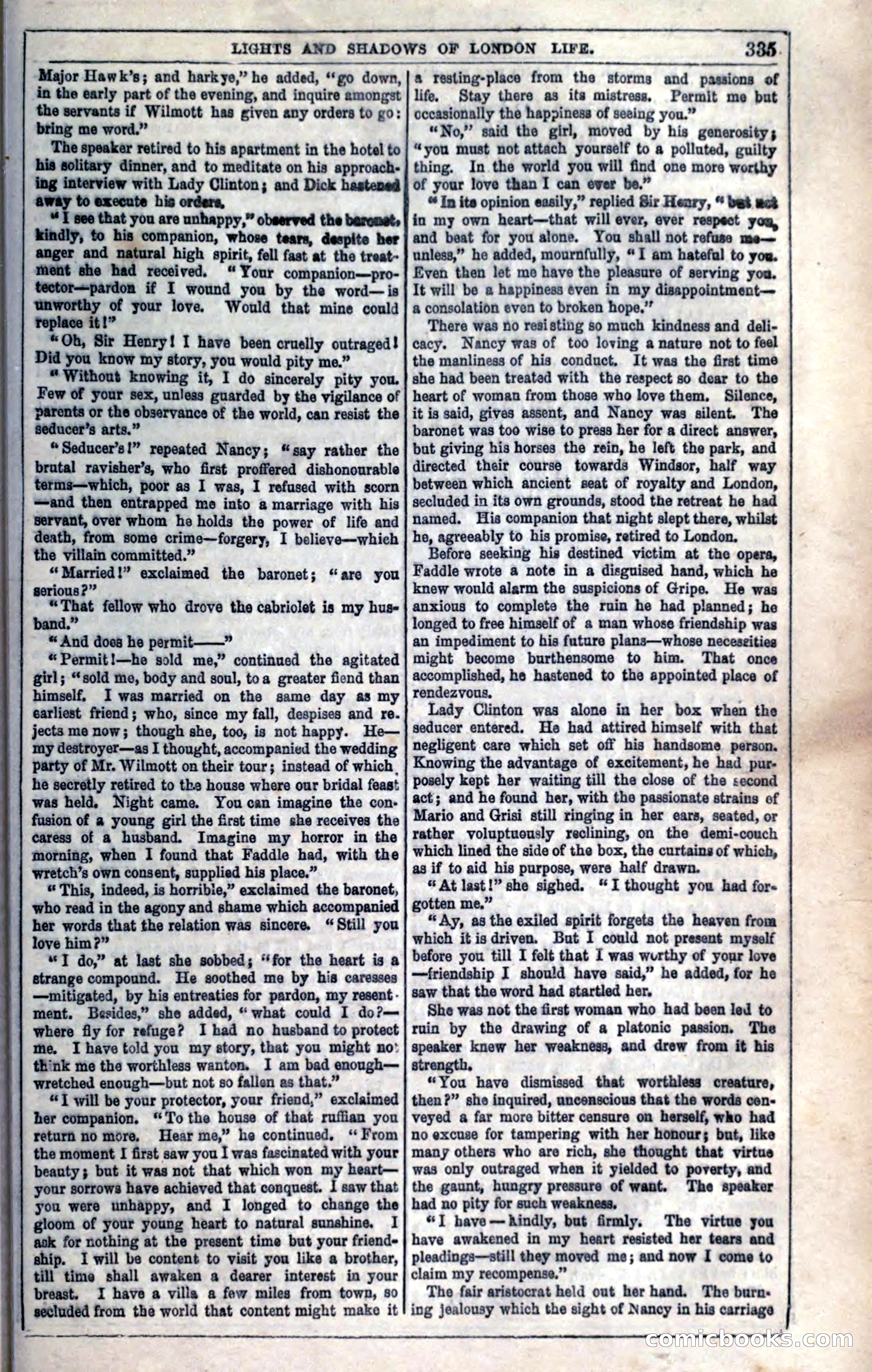
A restored page from Penny Dreadfuls, 1850. Page through the whole issue in the reader above.
📄 Transcribed text from this page (OCR, searchable)
Machine-transcribed from the original scan — historical spelling and the odd misread are preserved.
LIGHTS AND SHADOWS OF LONDON LIFE, Major Hawk’s; and harkye,” he added, “go down,|a resting-place in the early part of the evening, and inquire amongst the servants if Wilmott has given any orders to go: bring me word.” The speaker retired to his apartment in the hotel to his solitary dinner, and to meditate on his approach- ing interview with Lady Clinton; and Dick hastened os 4 to execute his orders, ; “T see that you are unhappy,” observed the baronet, _ | kindly, to his companion, whose tears, her | anger and nat high spirit, fell fast at the treat- | ment she had received. “Your companion—pro- | don if I wound you by the word—is unworthy of your love. Would that mine could teplace it!” “Ob, Sir Henry! I have been cruelly outraged! | Did you know my story, you would pity me.” “Without knowing it, I do sincerely pity you. Few of your sex, unless guarded by the vigilance of _| parents or the observance of the world, can resist the ; “ Seducer’s!” repeated Nancy; “say rather the brutal ravisher’s, who first proffered dishonourable ms—v poor as I was, I refused with scorn —and then entrapped me into a marriage with his servant, over whom he holds the power of life and ; death, from some crime—forgery, I believe—whieh the villain committed.” | “Married!” exclaimed the baronet; “are you serious?” "That fellow who drove the cabriolet is my hus- “And does he permit——” «Permit!—he sold me,” continued the agitated girl; “sold me, body and soul, toa greater fiend than himself, I was married on the same day as my earliest friend; who, since my fall, despises and re. jects me now; though she, too, is not happy. He— my destroyer—as I thought, accompanied the wedding party of Mr. Wilmott on their tour; instead of which | he secretly retired to the house where our bridal feast was held, Night came. You can imagine the con- fusion of a young girl the first time she receives the caress of a husband. Imagine my horror in the | morning, when I found that Faddle had, with the wretch’s own consent, supplied his place.” | “This, indeed, is horribie,” exclaimed the baronet, who read in the agony and shame which accompanied her words that the relation was sincere. “Still you love him?” “T do,” at last she sobbed; “for the heart is a strange compound. He soothed me by his caresses —mitigated, by his entreaties for pardon, my resent - ment. Besides,” she added, “ what could I do?— where fly for refuge? I had no husband to protect me. I have told you my story, that you might no think me the worthless wanton. I am bad enough— wretched enough—but not so fallen as that.” “] will be your protector, your friend,” exclaimed her companion. “To the house of that ruffian you { returh no more, Hear me,” he continued, “ From the moment I first saw you I was fascinated with your | beanty; but it was not that which won my heart— your sorrows have achieved that conquest. I saw that you were unhappy, and I longed to change the gloom of your young heart to natural sunshine. I | aok for nothing at the present time but your friend- | ship. I will be content to visit you like a brother, till time shall awaken a dearer interest in your 385. from the storms and passions of life. Stay there as its mistress, Permit me but occasionally the happiness of seeing you.” “No,” said the girl, moved by his generosity; “you must not attach yourself to a polluted, guilty thing. In the world you will find one more worthy of your love than I can ever be.” “ In ite opinion easily,” replied Sir Heary, “ bet act in my own heart—that will ever, ever respect you, and beat for you alone. You shall not refuse me— unless,” he added, mournfully, “I am hateful to you. Even then let me have the pleasure of serving you. It will be a happiness éven in my disappointment— a consolation even to broken hope,” There was no resisting so much kindness and deli- cacy. Nancy was of too loving a nature not to feel the manliness of his conduct. It was the first time she had been treated with the respect so dear to the heart of woman from those who love them. Silence, it is said, gives assent, and Nancy was silent. The baronet was too wise to press her for a direct answer, but giving his horses the rein, he left the park, and directed their course towards Windsor, half way between which ancient seat of royalty and London, secluded in its own grounds, stood the retreat he had named. His companion that night slept there, whilst he, agreeably to his promise, retired to London. Before seeking his destined victim at the opera, Faddle wrote a note in a disguised hand, which he knew would alarm the suspicions of Gripe. He was anxious to complete the ruin he had planned; he longed to free himself of a man whose friendship was an impediment to his future plans—whose necesgities might become burthensome to him. That once accomplished, he hastened to the appointed place of rendezvous, Lady Clinton was alone in her box when the seducer entered. He had attired himself with that negligent care which set off his handsome person. Knowing the advantage of excitement, he had pur- posely kept her waiting till the close of the second act; and he found her, with the passionate strains of Mario and Grisi still ringing in her ears, seated, or rather voluptuously reclining, on the demi-couch which lined the side of the box, the curtains of which, as if to aid his purpose, were half drawn. “ At last!” she sighed. “I thought you had for- gotten me,” “Ay, as the exiled spirit forgets the heaven from which itis driven. But I could not present myself before you till I felt that 1 was wurthy of your love —friendship I should have said,” he added, for he saw that the word had startled her. She was not the first woman who had been led to ruin by the drawing of a platonic passion. The speaker knew her weakness, and drew from it his “You have dismissed that worthless creature, then?” she inquired, unconscious that the words coen- veyed a far more bitter censure on herself, who had no excuse for tampering with her honours; but, like many others who are rich, she thought that virtue was only outraged when it yielded to poverty, and the gaunt, hungry pressure of want. The speaker had no pity for such weakness, “JT have—hindly, but firmly, The virtue you have awakened in my heart resisted her tears and pleadings—=still they moved me; and now I come to claim my recompense,” The fair aristocrat held out her hand, The burn- ing jealousy which the sight of Nancy in his carriage . cS | breast. I have a villa a few miles from town, 80 secludéd from the world that content might make it a ee Ona erene) ———