
Penny Dreadfuls, 1850 · page 333 of 394
The Mysteries of London; or, Lights and Shadows of London Life — page 333: what you’re looking at
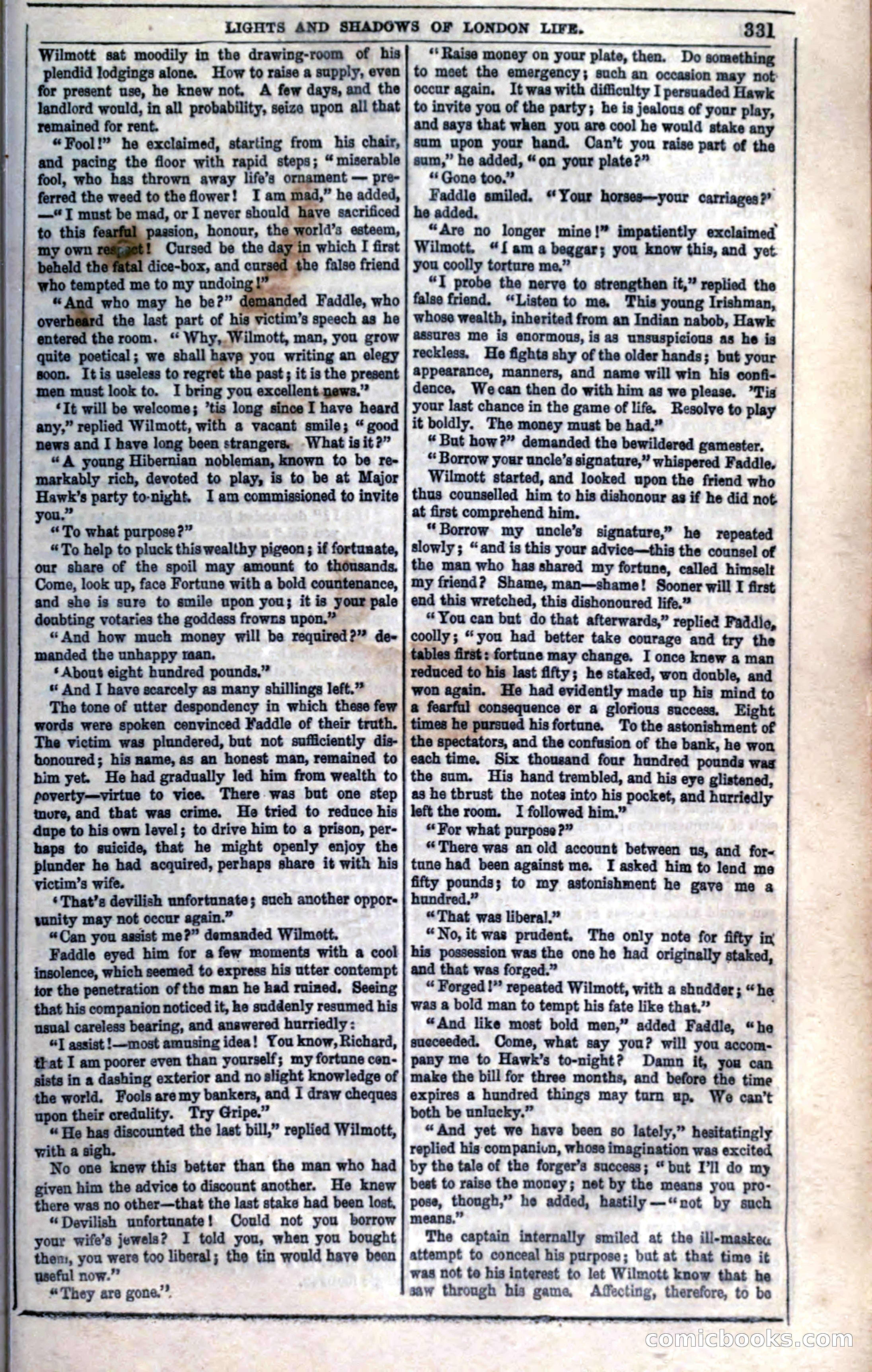
A restored page from Penny Dreadfuls, 1850. Page through the whole issue in the reader above.
📄 Transcribed text from this page (OCR, searchable)
Machine-transcribed from the original scan — historical spelling and the odd misread are preserved.
LIGHTS AND SHADOWS OF LONDON LIFE. 331 EEE —————————— Wilmott sat moodily in the drawing-room of his} ‘‘ Raise money on your plate, then. Do something plendid lodgings alone. How to raise a supply, even for present use, he knew not, A few days, and the landlord would, in all probability, seize upon all that remained for rent. “Fool!” he exclaimed, starting from his chair, and pacing the floor with rapid steps; “ miserable fool, who has thrown away life’s o ent — pre- ferred the weed to the flower! I am mad,” he added, —*T must be mad, or I never shoul ve sacrificed to this | on, honour, the world’s esteem, my own Cursed be the 1 which I first beheld the dice-box, and c e false friend who tempted me to my undo : * who may he be?” nded Faddle, who overbear the last part of his victim’s speech as he en the room. ‘“ Why,, Wilmott, man, you grow quite poetical; we shall have you writing an elegy soon. It is useless to regret the past; it is the present men must look to. I bring you excellent. news.” *It will be welcome; ’tis long since I have heard any,” replied Wilmott, with a vacant smile; “ good news and I have long been strangers. What is it ?” “A young Hibernian nobleman, known to be re- markably rich, devoted to play, is to be at Major Hawk’s party to-night. I am commissioned to invite ” . ee To what purpose?” “To help to pluck this wealthy pigeon ; if fortunate, our share of the spoil may amount to thousands. Come, look up, face Fortune with a bold countenance, and she is sure to smile upon you; it is your pale doubting votaries the goddess frowns upon.” “And how much money will be required?” de- manded the unhappy tan, * About eight hundred pounds,” * And I have scarcely as many shillings left.” The tone of utter despondency in which these few words were spoken convinced Faddle of their truth. The victim was plundered, but not sufficiently dis- honoured; his name, as an honest man, remained to him yet. He had gradually led him from wealth to poverty—virtue to vice. There was but one step more, and that was crime. He tried to reduce his dupe to his own level; to drive him to a prison, per- haps to suicide, that he might openly enjoy the plunder he had acquired, perhaps share it with his victim’s wife. ‘That’s devilish unfortunate; such another oppor- not occur again.” por teye assist me?” demanded Wilmott. Faddle eyed him for a few moments with a cool insolence, which seemed to express his utter contempt tor the penetration of the man he had ruined. Seeing that his companion noticed it, he suddenly resumed his nsual careless bearing, and answered hurriedly : «J assist !—most amusing idea! You know, Richard, that I am poorer even than yourself; my fortune cen- sists in a dashing exterior and no slight knowledge of the world. Fools ogg — and I draw cheques “ ie aie discounted the last bill,” replied Wilmott, ith a "No 4 better than the man who had given him the advice to discount another. He knew there was no other—that the last stake had been lost, “Devilish unfortunate! Could not you borrow your wife’s jewels? I told you, when you bought then:, you were too liberal; the tin would have been useful now.” “They are gone.” to meet the emergency; such an occasion may not occur again. It was with difficulty I persuaded Hawk to invite you of the party; he is jealous of your play, and says that when you are cool he would stake any sum upon your hand. Oan’t you raise part of the sum,” he added, “on your plate?” ** Gone too.” Faddle smiled. “Your horses—your carriages?’ he added, oe “Are no longer mine!” impatiently exclaimed Wilmott. “fam a beggar; you know this, and yet you coolly torture me,” “I probe the nerve to strengthen it,” replied the false friend. “Listen to me, This young Irishman, whose wealth, inherited from an Indian nabob, Hawk assures me is enormous, is as unsuspicious as he is reckless, He fights shy of the older hands; but your appearance, manners, and name will win his confi- dence, Wecan then do with him as we please. "Tis your last chance in the game of life. Resolve to play it boldly. The money must be had,” “ But how?” demanded the bewildered gamester. “ Borrow your uncle’s signature,” whispered Faddle, Wilmott started, and looked upon the friend who thus counselled him to his dishonour as if he did not at first comprehend him. “Borrow my unele’s signature,” he repeated slowly; “and is this your advice—this the counsel of the man who has shared my fortune, called himselt my friend? Shame, man—shame! Sooner will I first end this wretched, this dishonoured life.” “You can but do that afterwards,” replied Paddio, coolly; “you had better take courage and try the bles first: fortune may change. I once knew a man reduced to his last fifty; he staked, won double, and won again. He had evidently made up his mind to @ fearful consequence er a glorious success, Eight times he p his fortune. To the astonishment of the spectators, and the confusion of the bank, he won each time. Six thousand four hundred pounds wag the sum. His hand trembled, and his eye glistened, a3 he thrust the notes into his pocket, and hurriedly left the room. I followed him.” “For what purpose?” “There was an old account between us, and for< tune had been against me. I asked him to lend me fifty pounds; to my astonishment he gaye me a hundred,” “That was liberal.” “No, it was prudent, The only note for fifty in his possession was the one he had originally staked, and that was forged.” “ Forged !” repeated Wilmott, with a shudder; “he was a bold man to tempt his fate like that.” , “And like most bold men,” added Faddle, “he sueceeded. Come, what say you? will you accom- pany me to Hawk’s to-night? Damn it, you can make the bill for three months, and before the time expires a hundred things may turn up, We can’t both be unlucky.” “And yet we have been so lately,” hesitatingly replied his companiun, whose imagination was excited by the tale of the forger’s success; “but I'll do my best to raise the money; net by the means you pro- pose, though,” he added, hastily—‘“not by such means.” The captain internally smiled at the ill-maske« attempt to conceal his purpose; but at that time it was not to his interest to let Wilmott know that he saw through his game, Affecting, therefore, to be COMmicboOoks.c©