
Penny Dreadfuls, 1850 · page 330 of 394
The Mysteries of London; or, Lights and Shadows of London Life — page 330: what you’re looking at
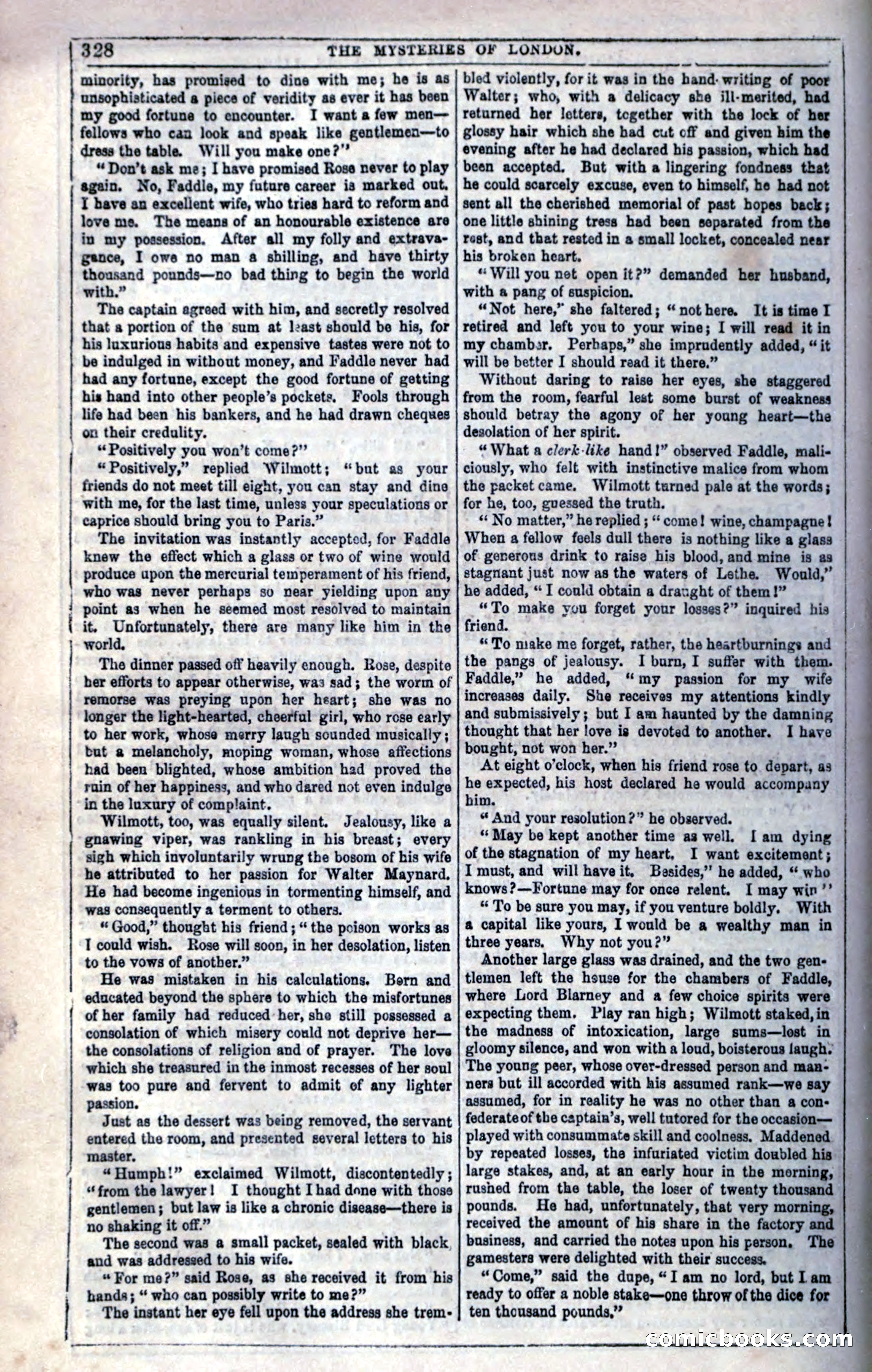
A restored page from Penny Dreadfuls, 1850. Page through the whole issue in the reader above.
📄 Transcribed text from this page (OCR, searchable)
Machine-transcribed from the original scan — historical spelling and the odd misread are preserved.
328 minority, has promised to dine with me; he is as unsophisticated a piece of veridity as ever it has been my good fortune to encounter. I want a few men— fellows who can look and speak like gentlemen—to dress the table. Will you make one?” “Don’t ask me; I have promised Rose never to play again. No, Faddle, my future career is marked out, I bave an excellent wife, who tries hard to reform and love me. The means of an honourable existence are in my possession. After all my folly and extrava- gence, I owe no man a shilling, and have thirty thousand pounds—no bad thing to begin the world with.” The captain agreed with him, and secretly resolved that a portion of the sum at least should be his, for his luxurious habits and expensive tastes were not to be indulged in without money, and Faddle never had had any fortune, except the good fortune of getting his hand into other people’s pockets, Fools through life had been his bankers, and he had drawn cheques on their credulity. “ Positively you won’t come?” “ Positively,” replied Wilmott; “but as your friends do not meet till eight, you can stay and dine with me, for the last time, unless your speculations or caprice should bring you to Paris.” The invitation was instantly accepted, for Faddle knew the effect which a glass or two of wine would produce upon the mercurial temperament of his friend, who was never perhaps so near yielding upon any / point as when he seemed most resolved to maintain it. Unfortunately, there are many like him in the world, The dinner passed off heavily enough. Rose, despite her efforts to appear otherwise, was sad; the worm of remorse was preying upon her heart; she was no longer the light-hearted, cheerful girl, who rose early to her work, whose merry laugh sounded musically; but a melancholy, moping woman, whose affections had been blighted, whose ambition had proved the ruin of her happiness, and who dared not even indulge in the luxury of complaint. Wilmott, too, was equally silent. Jealousy, like a gnawing viper, was rankling in his breast; every sigh which involuntarily wrung the bosom of his wife he attributed to her passion for Walter Maynard, He had become ingenious in tormenting himself, and was consequently a terment to others. “ Good,” thought his friend; “the poison works as I could wish. Rose will soon, in her desolation, listen to the vows of another.” He was mistaken in his calculations. Born and _ educated beyond the sphere to which the misfortunes of her family had reduced:her, she still possessed a consolation of which misery could not deprive her— the consolations of religion and of prayer. The love which she treasured in the inmost recesses of her soul was too pure and fervent to admit of any lighter passion. Just as the dessert was being removed, the servant entered the room, and presented several letters to his master, “Humph!” exclaimed Wilmott, discontentedly ; “from the lawyer! I thought I had done with those gentlemen; but law is like a chronic disease—there is no shaking it off.” The second was a small packet, sealed with black. and was addressed to his wife. “For me?” said Rose, as she received it from his hands; “ who can possibly write to me?” | The instant her eye fell upon the address she trem- ee ee ——- a — St ES o@ THE MYSTERIES OF LONDON, bled violently, for it was in the hand. writing of vr Walter; who, with a delicacy she ill-merited, had returned her letters, together with the lock of her glossy hair which she had cut off and given him the evening after he had declared his passion, which had been accepted. But with a lingering fondness that he could scarcely excuse, even to himself, he had not sent all the cherished memorial of past hopes back; one little shining tress had been separated from the rest, and that rested in a small locket, concealed near his broken heart. “ Will you net open it?” demanded her husband, with a pang of suspicion. “Not here,” she faltered; “nothere. It is time I retired and left you to your wine; I will read it in my chambor. Perhaps,” she imprudently added, “it will be better I should read it there,” Without daring to raise her eyes, she staggered from the room, fearful lest some burst of weakness should betray the agony of her young heart—the desolation of her spirit. “ What a clerk-like hand!” observed Faddle, mali- ciously, who felt with instinctive malice from whom the packet came. Wilmott turned pale at the words; for he, too, guessed the truth. “‘ No matter,” he replied ; “ come! wine, champagne! When a fellow feels dull there is nothing like a glass of generous drink to raise his blood, and mine is as stagnant just now as the waters of Lethe. Would,” he added, “ I could obtain a draught of them!” “To make you forget your losses?” inquired his . friend. : “To niake me forget, rather, the heartburnings ated the pangs of jealousy. I burn, I suffer with them. Faddle,” he added, “my passion for my wife increases daily. She receives my attentions kindly and submissively; but I am haunted by the damning thought that her love is devoted to another. I have bought, not won her.” At eight o’clock, when his friend rose to depart, as he expected, his host declared he would accompany him. “ And your resolution?” he observed. ‘** May be kept another time as well. [am dying | © of the stagnation of my heart, I want excitement; I must, and will have it, Besides,” he added, “ who knows ?—Fortune may for once relent. I may win ’’ “ To be sure you may, if you venture boldly, With a capital like yours, I would be a wealthy man in three years. Why not you?” Another large glass was drained, and the two gen- tlemen left the house for the chambers of Faddle, where Lord Blarney and a few choice spirits were expecting them. Play ran high; Wilmott staked, in the madness of intoxication, large sums—lost in gloomy silence, and won with a loud, boisterous laugh, The young peer, whose over-dressed person and man- ners but ill accorded with his assumed rank—we say assumed, for in reality he was no other than a con- federate of the captain’s, well tutored for the occasion— played with consummate skill and coolness. Maddened. by repeated losses, the infuriated victim doubled his large stakes, and, at an early hour in the m By Hes rushed from the table, the loser of twenty thousnlt 4 pounds. He had, unfortunately, that very morning, received the amount of his share in the factory and | business, and carried the notes upon his person. The | gamesters were delighted with their success, “Come,” said the dupe, “I am no lord, but Lam ready to offer a noble stake—one throw of the dice for — ten thousand pounds,” bool Ssicom