
Penny Dreadfuls, 1850 · page 319 of 394
The Mysteries of London; or, Lights and Shadows of London Life — page 319: what you’re looking at
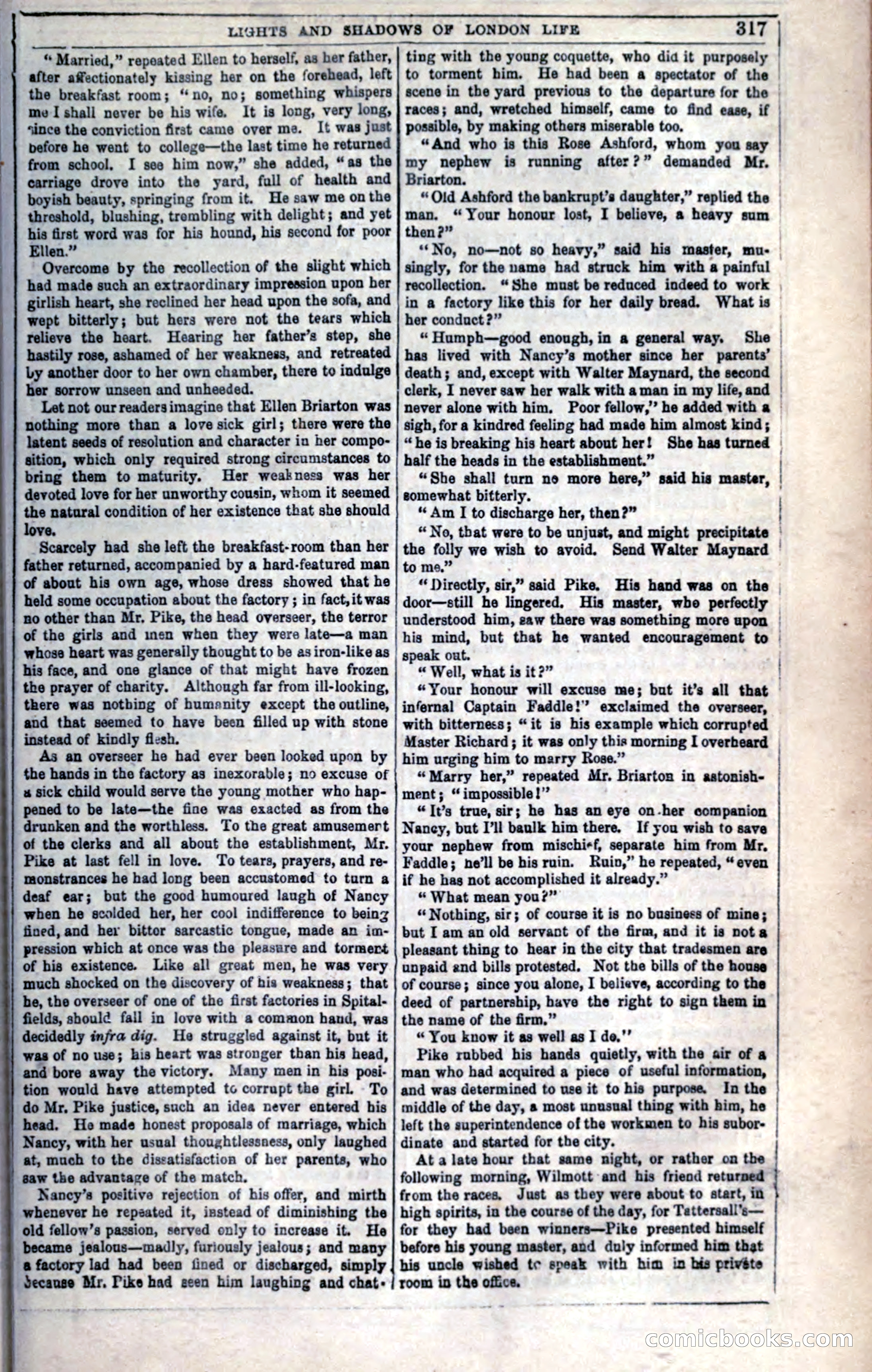
A restored page from Penny Dreadfuls, 1850. Page through the whole issue in the reader above.
📄 Transcribed text from this page (OCR, searchable)
Machine-transcribed from the original scan — historical spelling and the odd misread are preserved.
| | K A rrr rrr rs terre enh LIGHTS AND SHADOWS OF LONDON LIVE NE ne “ Married,” repeated Ellen to herself, as her father, after affectionately kissing her on the forehead, left the breakfast room; “no, no; something whispers me I shall never be his wife. It is long, very long, since the conviction first came over me. It was just before he went to college—the last time he returned from school, I see him now,” she added, “as the i carriage drove into the yard, full of health and boyish beauty, springing from it. He saw me onthe blushing, trembling with delight; and yet | his first word was for his hound, his second for poor Ellen.” Overcome by the recollection of the slight which had made such an extraordinary impression upon ber “ah } girlish heart, she reclined her head upon the sofa, and wept bitterly; but hers were not the tears which | relieve the heart. Hearing her father’s step, she hastily rose, ashamed of her weakness, and retreated | Uy another door to her own chamber, there to indulge Let not our readers imagine that Ellen Briarton was more than a love sick girl; there were the | latent seeds of resolution and character in her compo- ] sition, which only required strong circumstances to bring them to maturity. Her weakness was her devoted love for her unworthy cousin, whom it seemed | the natural condition of her existence that she should | Scarcely had she left the breakfast-room than her father returned, accompanied by a hard-featured man } of about his own age, whose dress showed that he held some occupation about the factory ; in fact,it was no other than Mr. Pike, the head overseer, the terror of the girls and inen when they were late—a man whose heart was generaily thought to be asiron-like as his face, and one glance of that might have frozen | the prayer of charity. Although far from ill-looking, there was nothing of humanity except the outline, and that seemed to have been filled up with stone instead of kindly flesh. As an overseer he had ever been looked upon by the hands in the factory as inexorable; no excuse of _# sick child would serve the young mother who hap- pened to be late—the fine was exacted as from the drunken and the worthless. To the great amusemert of the clerks and all about the establishment, Mr. Pike at last fell in love. To tears, prayers, and re- monstrances he had long been accustomed to turn a | deaf ear; but the good humoured laugh of Nancy when he scolded her, her cool indifference to being | fined, and her bittor sarcastic tongue, made an im- ion which at once was the pleasure and tormert of his existence. Like all great men, he was very much shocked on the discovery of his weakness; that he, the overseer of one of the first factories in Spital- fields, should fall in love with a common hand, was ‘decidedly infra dig. He struggled against it, but it of no use; his heart was stronger than his head, bach bore away the victory. Many men in his posi- tion would have attempted to corrupt the girl. To do Mr, Pike justice, such an idea never entered bis head. He made honest proposals of marriage, which Nancy, with her usual thoughtlessness, only laughed at, much to the dissatisfaction of her parents, who paw the advantage of the match. Nancy’s positive rejection of his offer, and mirth whenever he repeated it, instead of diminishing the old fellow’s passion, served only to increase it. He became jealous—madly, furiously jealous; and many a factory lad had been fined or discharged, simply because Mr. Pike had seen him laughing and chat- a . 317 ting with the young coquette, who did it purposely to torment him. He had been a spectator of the scene in the yard previous to the departure for the | races; and, wretched himself, came to find ease, if possible, by making others miserable too. “And who is this Rose Ashford, whom you say my nephew is running after?” demanded Mr. Briarton. “Old Ashford the bankrupt’s daughter,” replied the | man. “Your honour lost, I believe, a heavy sum then ?” *‘No, no—not so heavy,” said his master, mu- singly, for the name had struck him with a painful recollection. “She must be reduced indeed to work | in a factory like this for her daily bread. What is her condact ?” “ Humph—good enough, in a general way, has lived with Nancy’s mother since her parents’ — death; and, except with Walter Maynard, the second clerk, I never saw her walk with aman in my life, and never alone with him. Poor fellow,’’ he added with a sigh, for a kindred feeling had made him almost kind; “he is breaking his heart about her! She has turned half the heads in the establishment.” “She shall turn no more here,” said his master, somewhat bitterly. ** Am I to discharge her, then?” * No, that were to be unjust, and might precipitate the folly we wish to avoid. Send Walter Maynard to ms,” - ~~ ————S ew oe eee “ Directly, sir,” said Pike, His hand was on the | door—still he lingered. His master, who perfectly understood him, saw there was something more upon | his mind, but that he wanted encouragement to speak out. “ Well, what is it?” ‘ “Your honour will excuse me; but it’s all that — infernal Captain Faddle!”’ exclaimed the overseer, with bitterness; “it is his example which corrupted Master Richard; it was only this morning I overheard | him urging him to marry Rose.” “Marry her,” repeated Mr. Briarton in astonish- ment; “impossible!” “It’s true, sir; he has an eye on-her companion Nancy, but I’ll baulk him there. If you wish to save your nephew from mischi+f, separate him from Mr, Faddle; ne’ll be his ruin. Ruin,” he repeated, “even if he has not accomplished it already.” “ What mean you?” “ Nothing, sir; of course it is no business of mine; but I am an old servant of the firm, and it is nota pleasant thing to hear in the city that tradesmen are unpaid and bills protested. Not the bills of the house of course; since you alone, I believe, according to the deed of partnership, have the right to sign them in the name of the firm,” “ You know it as well as I de,’’ Pike rubbed his hands quietly, with the air of a man who had acquired a piece of useful information, and was determined to use it to his purpose. In the middle of the day, a most unusual thing with him, he left the superintendence of the workmen to his subor- dinate and started for the city. At a late hour that same night, or rather on the following morning, Wilmott and his friend returned from the races, Just as they were about to start, in high spirits, in the course of the day, for Tattersall’s— for they had been winners—Pike presented himself before his young master, and duly informed him that his uncle wished tc speak with him in his privéte room in the office. CORNICLOO ——— SS (CO) im