
Penny Dreadfuls, 1850 · page 316 of 394
The Mysteries of London; or, Lights and Shadows of London Life — page 316: what you’re looking at
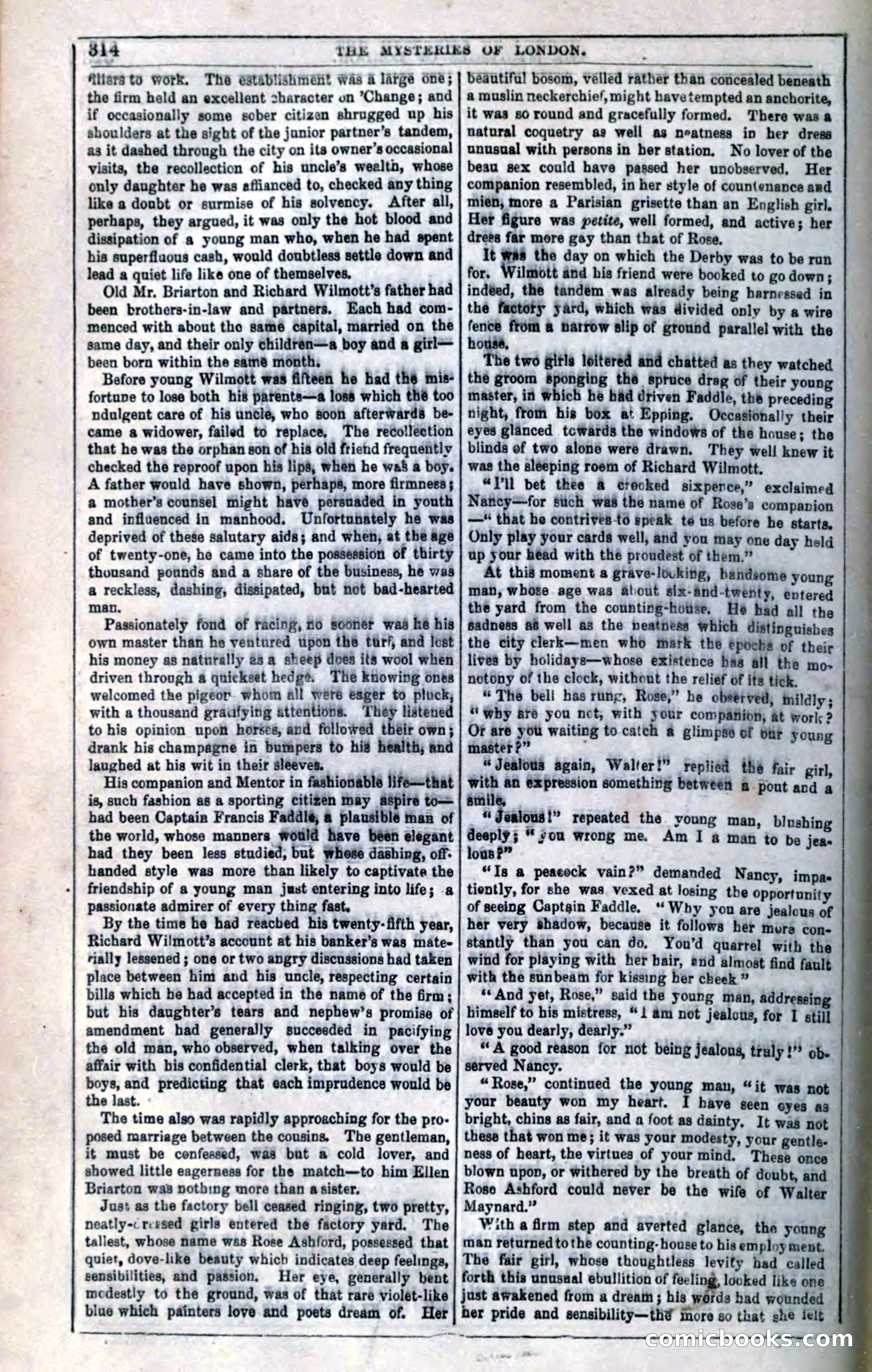
A restored page from Penny Dreadfuls, 1850. Page through the whole issue in the reader above.
📄 Transcribed text from this page (OCR, searchable)
Machine-transcribed from the original scan — historical spelling and the odd misread are preserved.
314 Aliers to work. Th6 SStablishmeit Was a large one; the firm held an excellent zharacter un Change; and if occasionally some sober citizen shrugged up his shoulders at the sight of the junior partner’s tandem, a3 it dashed through the city on its owner’s occasional visits, the recollection of his uncle’s wealth, whose only daughter he was affianced to, checked any thing like a doubt or surmise of his solvency. After all, perhaps, they argued, it was only the hot blood and dissipation of a young man who, when he had spent his superfluous cash, would doubtless settle down and lead a quiet life like one of themselves, Old Mr. Briarton and Richard Wilmott’s father had been brothers-in-law and partners. Each had com- menced with about the samé capital, married on the same day, and their only children—a boy and a girl been born within the samé month, Before young Wilmott was fifteen he had thé mis- fortune to lose both his patents—a loss which thé too ndulgent care of his uncle, who soon afterwards be- came a widower, failed to replace, The recollection that he was the orphan son of his old friend frequently checked the reproof upon his lips, when he wa’ a boy. A father would have shown, pérhaps, more firmness; a mother’s counsel might have persuaded in youth and influenced in manhood. Unfortunately he was deprived of these salutary aids; and when, at the age of twenty-one, he came into the possession of thirty thousand pounds and a share of the business, he was a reckless, dashing, dissipated, but not bad-hearted man. Passionately fond of racing, no sooner wad he his own master than he ventured tipon the turf, and lost his money as naturally a8 a sheep doés its wool when driven through a qhickset hedge. The knowing ones welcomed the pigeor. whom all were eager to pluck; with a thousand gradfyitg attentions. éy listened to his opinion upon horses, and followéd théit own; drank his champagne in butapers to hid health, and laughed at his wit in their sleeves, His companion and Mentor in fashionable life-that is, such fashion as a sporting citizen may aspire to— had been Captain Francis Faddlé, & plausible man of the world, whose manners would have been elegant had they been less studied, but Whose dashing, off: handed style was more than likely to captivate the friendship of a young man just entering into life; a passionate admirer of every thing fast, By the time he had reacbed his twenty-fifth year, Richard Wilmott’s account at his banker’s was mate- rially lessened ; one or two angry discussions had taken place between him and his uncle, respecting certain bills which he had accepted in the name of the firm; but his daughter’s tears and nephew’s promise of amendment had genera/ly succeeded in pacifying the old man, who observed, when talking over the affair with bis confidential clerk, that boys would be boys, and predicting that each imprudence would be the last. The time also was rapidly approaching for the pro- posed marriage between the cousins, The gentleman, it must be confessed, was bat a cold lover, and showed little eagerness for the match—to him Ellen Briarton was nothing more than a sister. Just as the factory bell ceased ringing, two pretty, neatly-c reesed girls entered the factory yard. The tallest, whose name was Rose Ashford, possessed that quiet, dove-like beauty which indicates deep feelings, sensibilities, and passion, Her eye, generally bent modestly to the ground, was of that rare violét-like blue which painters love and poets dream of. Her — --—_——- eat - — oe ae THE MYSTEKLES OF LONDON. cm —_ A ee beautiful bosom, veiled rather than coticéaled beneath a muslin neckerchief, might have tempted an anchorite, it was so round and gracefully formed. There was a natural coquetry ag well as neatness in her dress unusual with persons in her station. No lover of the beau sex could have passed her unobserved, Her companion resembled, in her style of countenance ard mien, more a Parisian grisette than an English girl, Het figure was petite, well formed, and active; her drets far more gay than that of Rose. It Was the day on which the Derby was to be ran for. Wilmott and bis friend were booked to go down; indéed, the tandem was already being harnessed in the factoty yard, which was divided only by a wire fence ftom a narrow slip of ground parallel with the houst The two gifls loitered and chatted as they watched thé groom sponging thé sptuce dreg of their young master, in which he had driven Faddle, the preceding night, from his box at Epping. Occasionally their eyes glanced tcwards the windows of the house; the blinds ef two alone were drawn. They well knew it was the sléeping roem of Richard Wilmott. “T’ll bet thee & crooked sixpence,” exclaimed peg EH stich was the name of Rose’s companion —* that he contrives-to speak te us before he starts, Only play your cards well, and you may one day held up your bead with the proudest of them.” | At this moment a grave-louking, handsome young | — man, whose age was aout six-And-twenty, entered the yard from the counting-hotise, Hé had all the | sadness #6 well as the neatness Which distingnishes the city clerk—men who mark the epoche of their lives by holidays—whose existence has all the mo- | notony of the clock, without the relief of its tick. " “The beli has rung, Rose,” he observed, inildly ; “why are you net, with your companion, at worl? Or are you waiting to catch a glimpsé of bli young _* Jealous again, Walter!” replied the fair girl, with an expression something between a pont and a =: | “ Jealous!” repeated the young man, deeply; “vou wrong me. Am I a@ man lous?” “Ts a peaeock vain?” demanded Nancy, impa- tiently, for she was vexed at losing the Opportunity of seeing Captgin Faddle. “Why yon are jealous of her very shadow, because it follows her more con- stantly than you can do. You'd quarrel with the wind for playing with het hair, snd almost find fault | with the sunbeam for kissing her cheek ” . **And yet, Rose,” said the young man, addressing | himeelf to his mistress, “1 am not jealous, for I still | lové you dearly, dearly.” “A good reason for not being jealons, truly!” ob. served Nancy. “Rose,” continued the young man, “it was not your beauty won my heart. I have seen cyes as bright, chins as fair, and a foot as dainty, It was not these that won me; it was your modesty, your gentle. ness of heart, the virtues of your mind. These once blown upon, or withered by the breath of doubt, and Rose Ashford could never be the wife of Walter | Maynard.” With a firm step and averted glance, the young man returned tothe counting- house to hisemployment. | The fair girl, whose thoughtless levity had called | forth this unusual ebullition of feeling, looked like one | just awakened from a dream ; his wits had wounded | her pride and sensibility—th@ more so that she felt aco GIOOKS.COM blushing to be jea-