
Penny Dreadfuls, 1850 · page 290 of 394
The Mysteries of London; or, Lights and Shadows of London Life — page 290: what you’re looking at
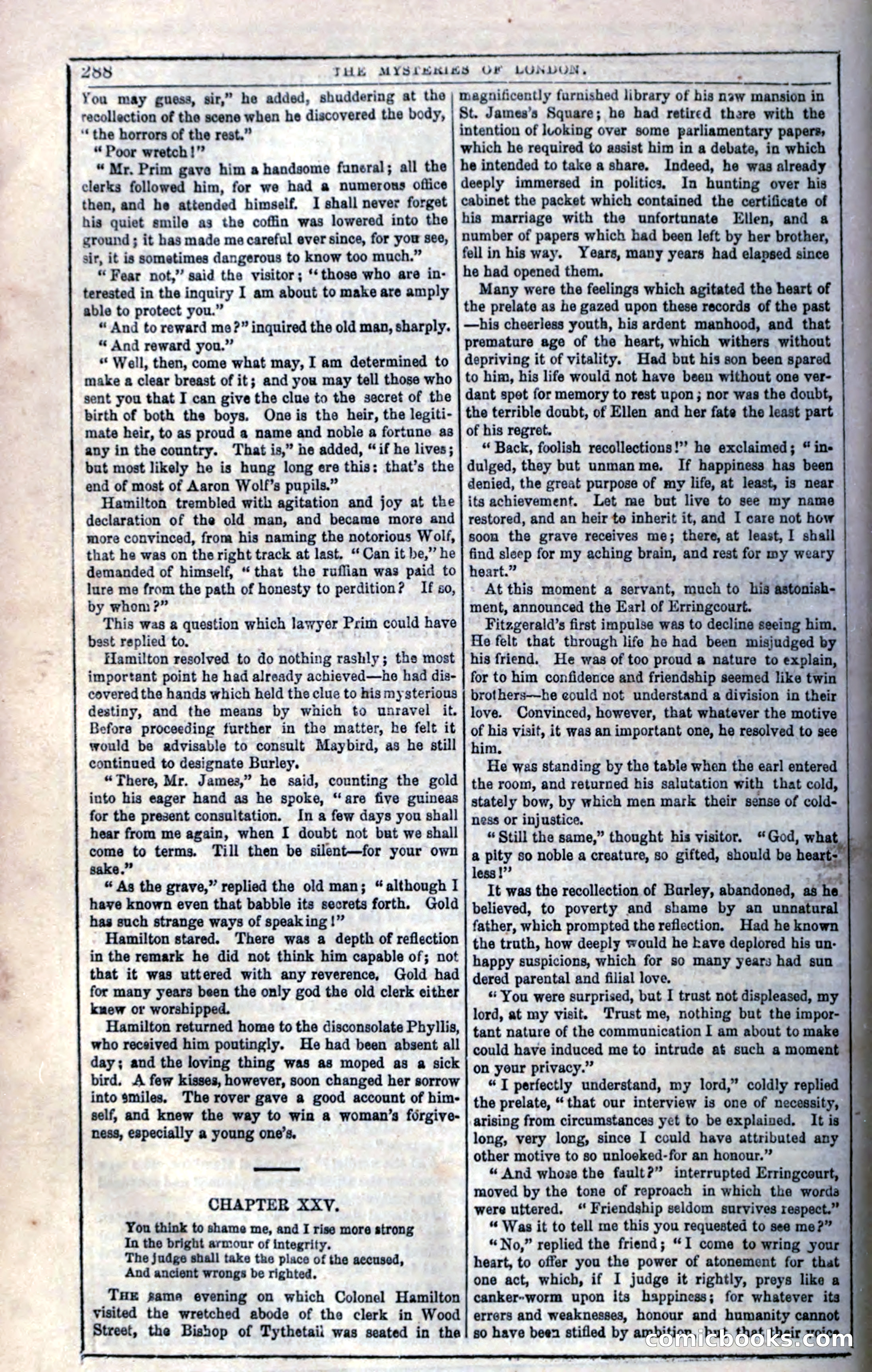
A restored page from Penny Dreadfuls, 1850. Page through the whole issue in the reader above.
📄 Transcribed text from this page (OCR, searchable)
Machine-transcribed from the original scan — historical spelling and the odd misread are preserved.
235 You may guess, sir,” he added, shuddering at the recollection of the scene when he discovered the body, ‘the horrors of the rest.” “ Poor wretch!” “Mr. Prim gave him a handsome faneral; all the clerks followed him, for we had a numerous office then, and he attended himself. I shall never forget his quiet smile as the coffin was lowered into the ground ; it has made me careful ever since, for you see, sir, it is sometimes dangerous to know too much.” “Fear not,” said the visitor; ‘*those who are in- terested in the inquiry I am about to make are amply able to protect you.” “ And to reward me?” inquired the old man, sharply. “ And reward you.” “ Well, then, come what may, I am determined to make a clear breast of it; and you may tell those who sent you that I can give the clue to the secret of the birth of both the boys. One is the heir, the legiti- mate heir, to as proud a name and noble a fortune as any in the country. That is,” he added, “if he lives; but most likely he is hung long ere this; that’s the end of most of Aaron Wolf’s pupils.” Hamilton trembled with agitation and joy at the declaration of the old man, and became more and more convinced, from his naming the notorious Wolf, that he was on the right track at last. “Can it be,” he demanded of himself, “that the ruflian was paid to lure me from the path of honesty to perdition? If so, by whom ?” This was a question which lawyer Prim could have best replied to. Hamilton resolved to do nothing rashly; the most important point he had already achieved—he had dis- covered the hands which held the clue to his mysterious destiny, and the means by which to unravel it. Before proceeding further in the matter, he felt it would be advisable to consult Maybird, as he still continued to designate Burley. “There, Mr. James,” he said, counting the gold into his eager hand as he spoke, “are five guineas for the present consultation. In a few days you shall hear from me again, when I doubt not but we shall come to terms. Till then be silent—for your own sake.” “ As the grave,” replied the old man; “although I have known even that babble its secrets forth. Gold has such strange ways of speaking!” Hamilton stared. There was a depth of reflection in the remark he did not think him capable of; not that it was uttered with any reverence, Gold had for many years been the only god the old clerk either kuew or worshipped, Hamilton returned home to the disconsolate Phyllis, who received him poutingly. He had been absent all day; and the loving thing was as moped as a sick bird. A few kisses, however, soon changed her sorrow into smiles. The rover gave a good account of him- self, and knew the way to win a woman’s forgive- ness, especially a young one’s. CHAPTER XXYV., Youn think to shame me, and I rise more strong In the bright armour of integrity. The judge shall take the place of the aecused, And ancient wrongs be righted. THE gama evening on which Colonel Hamilton visited the wretched abode of the clerk in Wood Street, the Bishop of Tythetail was seated in the THE MYSIRRIZS OF ORDER, magnificently furnished library of his naw mansion in St. James’s Square; he had retired thare with the intention of luoking over some parliamentary which he required to assist him in a debate, in which he intended to take a share. Indeed, he was already deeply immersed in politics, In hunting over his cabinet the packet which contained the certificate of his marriage with the unfortunate Ellen, and a number of papers which had been left by her brother, fellin his way. Years, many years had elapsed since he had opened them. the prelate as he gazed upon these records of the past —his cheerless youth, his ardent manhood, and that premature age of the heart, which withers without depriving it of vitality. Had but his son been spared to him, his life would not have been without one ver- dant spet for memory to rest upon ; nor was the doubt, the terrible doubt, of Ellen and her fate the least part of his regret. dulged, they but unmanme. If happiness has been denied, the great purpose of my life, at least, is near its achievement. restored, and an heir te inherit it, and I care not how | soon the grave receives me; there, at least, I shall | find sleep for my aching brain, and rest for my weary | heart.” SE Many were the feelings which agitated the heart of “ Back, foolish recollections! !’ he exclaimed; “in- | — Let me but live to see my name At this moment a servant, much to his astonish- . ment, announced the Earl of Erringcourt. . Fitzgerald’s first impulse was to decline seeing him, He felt that through life he had been misjudged by | his friend. He was of too proud a nature to expla for to him confidence and friendship seemed like twit brothers—he could not understand a division in their love. Convinced, however, that whatever the motive of his visit, it was an important one, he resolved to see him. He was standing by the table when the earl entered | the room, and returned his salutation with that ld | stately bow, by which men mark their sense of cold- | ness or injustice. “ Still the same,” thought his visitor. “God, wk a pity so noble a creature, so gifted, should be t less |” . ae It was the recollection of Barley, abandoned, 2 he believed, to poverty and shame by an , father, which prompted the reflection. Had he known | the truth, how deeply would he have deplored his un- | happy suspicions, which for so many years had sun. | dered parental and filial love. «You were surprised, but I trust not displeased, my ~ lord, at my visit. Trust me, nothing but the irepond tant nature of the communication I am about to make | could have induced me to intrude at such a mc on your privacy.” “TI perfectly understand, my lord,” coldly replied | the prelate, “that our interview is one of » arising from circumstances yet to be explained. It is long, very long, since I could have attributed any other motive to so unloeked-for an honour.” “ And whose the fault?” interrupted Erringcourt, moved by the tone of reproach in which the wort were uttered. “ Friendship seldom survives respect,’ i “ Was it to tell me this you requested to see me?” “No,” replied the friend; “I come to wring - heart, to offer you the power of atonement for that one act, which, if I judge it rightly, preys like a canker-worm upon its happiness; for whatever its errers and weaknesses, honour and humanity cannot so have been stifled by arrbition ba phy Vosiraries | —_—_—-—=* “ee ' es “ye? + 9