
Penny Dreadfuls, 1850 · page 278 of 394
The Mysteries of London; or, Lights and Shadows of London Life — page 278: what you’re looking at
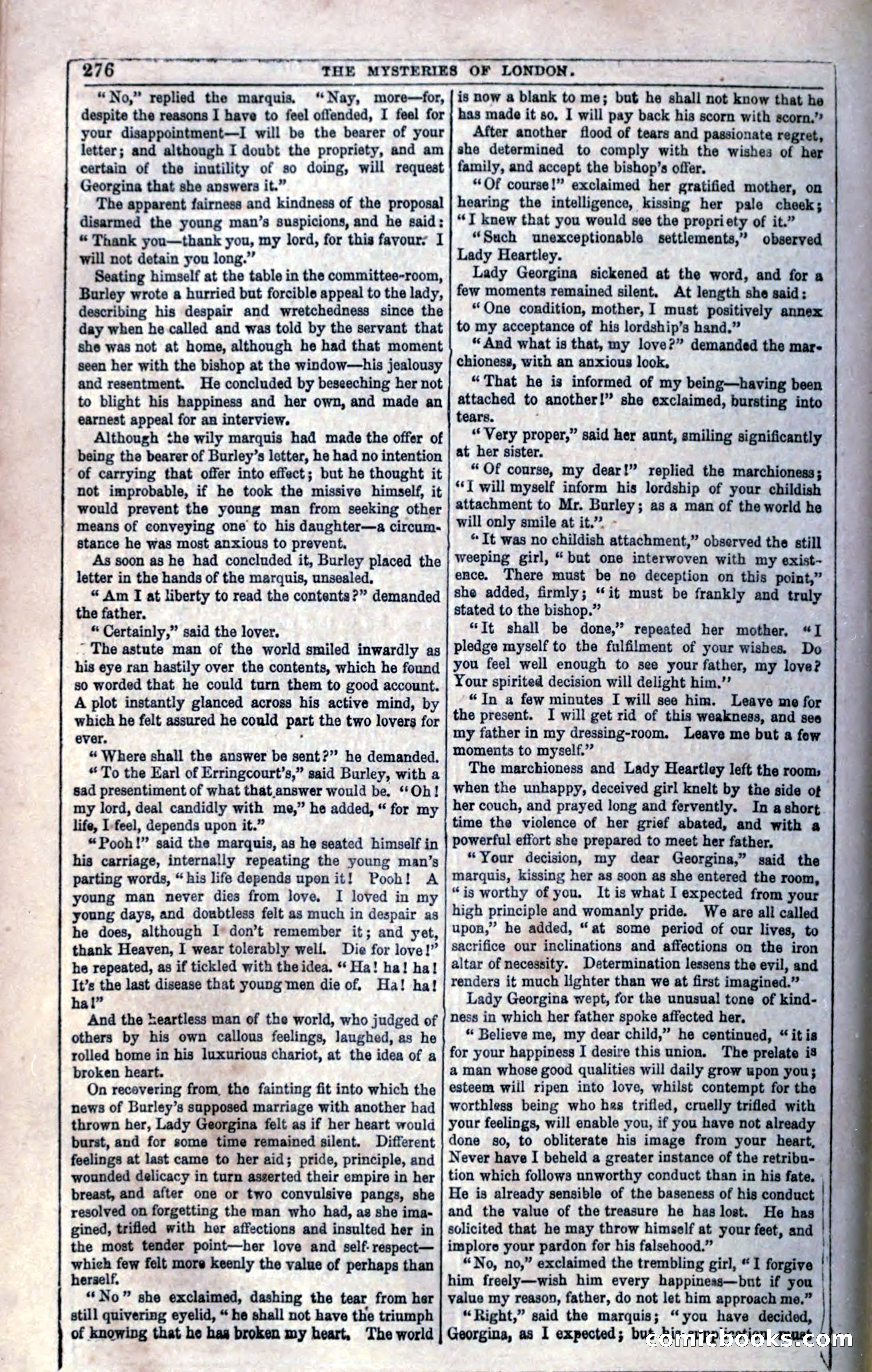
A restored page from Penny Dreadfuls, 1850. Page through the whole issue in the reader above.
📄 Transcribed text from this page (OCR, searchable)
Machine-transcribed from the original scan — historical spelling and the odd misread are preserved.
—_—_ —_ —-.«< 76 “No,” replied the marquis. “Nay, more—for, despite the reasons I have to feel offended, I feel for your disappointment—I will be the bearer of your letter; and although I doubt the propriety, and am certain of the inutility of so doing, will request Georgina that she answers it.” The apparent fairness and kindness of the proposal disarmed the young man’s suspicions, and he said; “ Thank you—thank you, my lord, for this favour: I will not detain you long.” Seating himself at the table in the committee-room, Burley wrote a hurried but forcible appeal to the lady, describing his despair and wretchedness since the day when he called and was told by the servant that she was not at home, although he had that moment seen her with the bishop at the window—his jealousy and resentment. He concluded by beseeching her not to blight his happiness and her own, and made an earnest appeal for an interview. Although the wily marquis had made the offer of being the bearer of Burley’s letter, he had no intention of carrying that offer into effect; but he thought it not improbable, if he took the missive himself, it would prevent the young man from seeking other means of conveying one to his daughter—a circum. stance he was most anxious to prevent, As soon as he had concluded it, Burley placed the letter in the hands of the marquis, unsealed, “ Am I at liberty to read the contents?” demanded the father. “ Certainly,” said the lover. - The astute man of the world smiled inwardly as his eye ran hastily over the contents, which he found so worded that he could turn them to good account. A plot instantly glanced across his active mind, by which he felt assured he could part the two lovers for ever. : “ Where shall the answer be sent?” he demanded. “To the Earl of Erringcourt’s,” said Burley, with a sad presentiment of what that.answer would be. “Oh! my lord, deal candidly with me,” he added, “ for my life, I-feel, depends upon it.” “Pooh!” said the marquis, as he seated himself in his carriage, internally repeating the young man’s parting words, “his life depends upon it! Pooh! A young man never dies from love, I loved in my young days, and doubtless felt as much in despair as he does, although I» don’t remember it; and yet, thank Heaven, I wear tolerably well. Die for love!” he repeated, as if tickled with the idea. *‘ Ha! ha! ha! It’s the last disease that young men die of, Ha! ha! hal” And the heartless man of the world, who judged of others by his own callous feelings, Jaughed, as he rolled home in his luxurious chariot, at the idea of a broken heart. On recevering from, the fainting fit into which the news of Burley’s supposed marriage with another had thrown her, Lady Georgina felt as if her heart would burst, and for some time remained silent. Different feelings at last came to her aid; pride, principle, and wounded delicacy in turn asgzerted their empire in her breast, and after one or two convulsive pangs, she resolved on forgetting the man who had, as she ima- gined, trifled with her affections and insulted her in the most tender point—her love and self: respect— abe felt more keenly the value of perhaps than erself, *“*No” she exclaimed, dashing the tear from her still quivering eyelid, “ he shall not have the triumph of knowing that he has broken my heart, The world THE MYSTERIES OF LONDON. is now a blank to me; but he shall not know that he has made it so. I will pay back his scorn with scorn.’ After another flood of tears and passionate regret, she determined to comply with the wishes of her family, and accept the bishop’s offer. “Of course!” exclaimed her gratified mother, on hearing the intelligence, kissing her pale cheek; “T knew that you would see the propriety of it.” “Such unexceptionable settlements,” observed Lady Heartley. Lady Georgina sickened at the word, and for a few moments remained silent, At length she said; “One condition, mother, 1 must positively annex to my acceptance of his lordship’s hand.” “ And what is that, my love?” demanded the mar- chioness, with an anxious look, “That he is informed of my being—having been attached to another!” she exclaimed, bursting into tears. “Very proper,” said her aunt, smiling significantly at her sister. “Of course, my dear!” replied the marchioness; **{ will myself inform his lordship of your childish attachment to Mr. Burley; as a man of the world he will only smile at it.” - “ It was no childish attachment,” observed the still weeping girl, “but one interwoven with my exist- ence. There must be no deception on this point,” she added, firmly; “it must be frankly and truly stated to the bishop.” “It shall be done,” repeated her mother, “J pledge myself to the fulfilment of your wishes. Do you feel well enough to see your father, my love? Your spirited decision will delight him,’’ “In a few minutes I will see him. Leave me for the present. I will get rid of this weakness, and see my father in my dressing-room. Leave me but a fow moments to myself.” The marchioness and Lady Heartley left the room; when the unhappy, deceived girl knelt by the side of her couch, and prayed long and fervently. In ashort time the violence of her grief abated, and with a powerful effort she prepared to meet her father, “Your decision, my dear Georgina,” said the marquis, kissing her as soon as she entered the room, “is worthy of you. It is what I expected from your high principle and womanly pride. We are all called upon,” he added, “at some period of our lives, to sacrifice our inclinations and affections on the iron altar of necessity. Determination lessens the evil, and renders it much lighter than we at first imagined.” Lady Georgina wept, for the unusual tone of kind- ness in which her father spoke affected her, “ Believe me, my dear child,” he centinued, “ it is for your happiness I desire this union. The prelate is a man whose good qualities will daily grow upon you; esteem will ripen into love, whilst contempt for the worthless being who hes trifled, cruelly trifled with your feelings, will enable you, if you have not already . done so, to obliterate his image from your heart, | — Never have I beheld a greater instance of the retribu- | tion which follows unworthy conduct than in his fate, He is already sensible of the baseness of his conduct and the value of the treasure he has lost. He has solicited that he may throw himself at your feet, and implore your pardon for his falsehood.” “No, no,” exclaimed the trembling girl, “I forgive him freely—wish him every happiness—but if you value my reason, father, do not let him approach me.” “Right,” said the marquis; “you have decided, Georgina, as I expected; but bi -tratystey tare cf,