
Penny Dreadfuls, 1850 · page 274 of 394
The Mysteries of London; or, Lights and Shadows of London Life — page 274: what you’re looking at
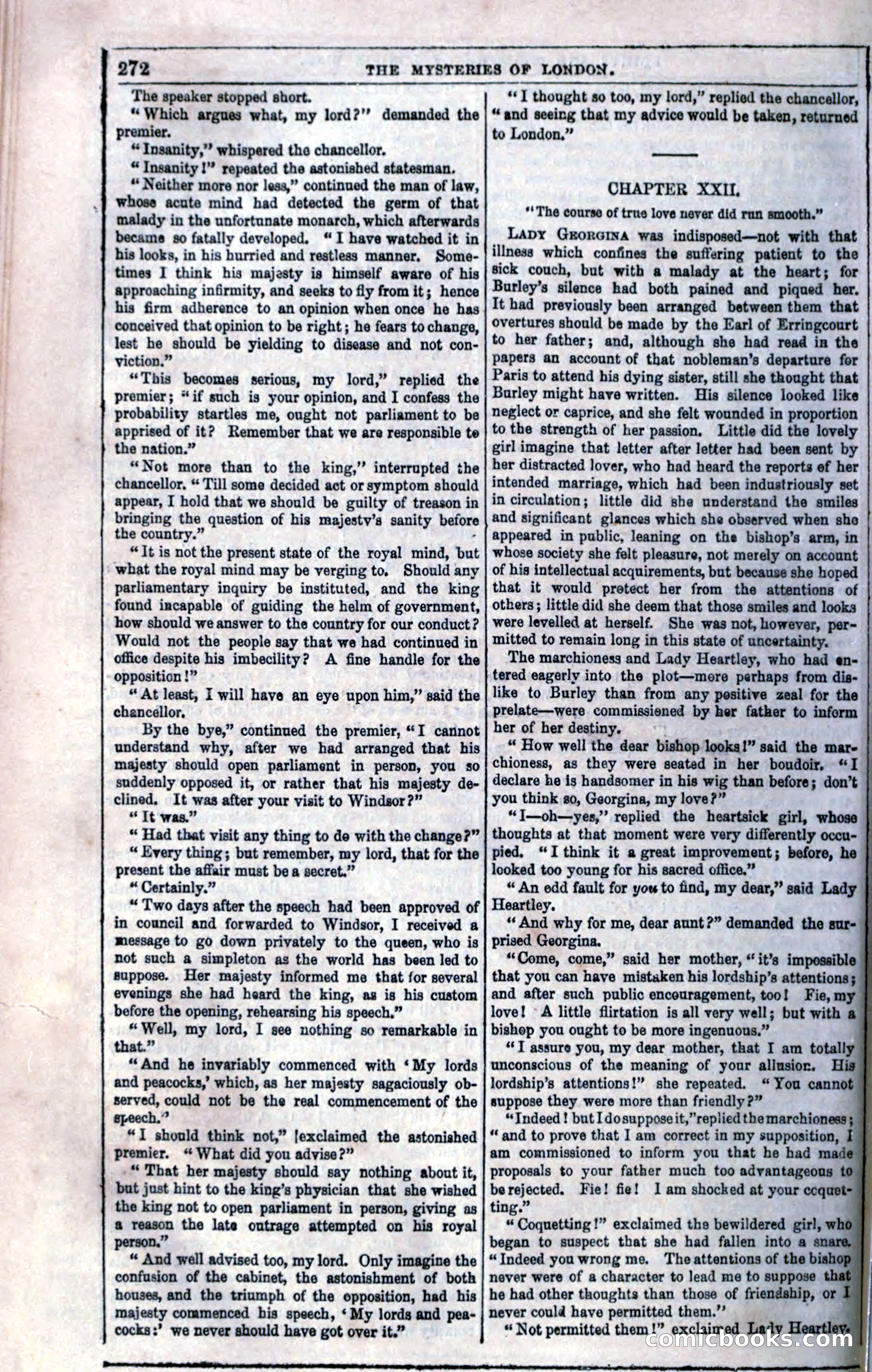
A restored page from Penny Dreadfuls, 1850. Page through the whole issue in the reader above.
📄 Transcribed text from this page (OCR, searchable)
Machine-transcribed from the original scan — historical spelling and the odd misread are preserved.
+ er 272 THE MYSTERIES OF LONDON. The speaker stopped short. “Which argues what, my lord?’’ demanded the premier. “ Insanity,” whispered the chancellor. “Insanity!” repeated the astonished statesman. “ Neither more nor less,” continued the man of law, whose acute mind had detected the germ of that malady in the unfortunate monarch, which afterwards became so fatally developed. “I have watched it in his looks, in his hurried and restless manner, Some- times I think his majesty is himself aware of his approaching infirmity, and seeks to fly from it; hence his firm adherence to an opinion when once he has conceived that opinion to be right; he fears to change, lest he should be yielding to disease and not con- viction.” “This becomes serious, my lord,” replied the premier; “if such is your opinion, and I confess the probability startles me, ought not parliament to be apprised of it? Remember that we are responsible te the nation.” “Not more than to the king,’ interrupted the chancellor, “ Till some decided act or symptom should appear, I hold that we should be guilty of treason in bringing the question of his majesty’s sanity before the country.” , “Jt is not the present state of the royal mind, but what the royal mind may be verging to, Should any parliamentary inquiry be instituted, and the king found incapable of guiding the helm of government, how should we answer to the country for our conduct? Would not the people say that we had continued in office despite his imbecility? A fine handle for the opposition !” “ At least, I will have an eye upon him,” said the chancellor, By the bye,” continued the premier, “I cannot understand why, after we had arranged that his majesty should open parliament in person, you so suddenly opposed it, or rather that his majesty de- clined, It was after your visit to Windsor?” “It was.” “ Had that visit any thing to de with the change?” “ Every thing; but remember, my lord, that for the present the affair must bea secret.” “ Certainly.” “ Two days after the speech had been approved of in council and forwarded to Windsor, I received a message to go down privately to the queen, who is not such a simpleton as the world has been led to suppose. Her majesty informed me that for several evenings she had heard the king, as is his custom before the opening, rehearsing his speech,” * Well, my lord, I see nothing so remarkable in tha ” “And he invariably commenced with ‘My lords and peacocks,’ which, as her majesty sagaciously ob- served, could not be the real commencement of the 4 “] shonld think not,” lexclaimed the astonished premier. “ What did you advise?” .“ That her majesty should say nothing about it, but just hint to the king’s physician that she wished the king not to open parliament in person, giving as 8 reason the late outrage attempted on his royal “ And well advised too, my lord. Only imagine the confusion of the cabinet, the astonishment of both houses, and the triumph of the opposition, had his majesty commenced bis speech, ‘My lords and pea- cocks ;’ we never should have got over it.” TTC carttetiemtitl **] thought so too, my lord,” replied the chancellor, “and seeing that my advice would be taken, returned to London,” CHAPTER XXII, **The course of true love never did run smooth.” LADY GEORGINA was indisposed—not with that illness which confines the suffering patient to the sick couch, but with a malady at the heart; for Burley’s silence had both pained and piqued her. It had previously been between them that overtures should be made by the Earl of Erringcourt to her father; and, although she had read in the papers an account of that nobleman’s departure for Paris to attend his dying sister, still she thought that Burley might have written. His silence looked like neglect or caprice, and she felt wounded in proportion to the strength of her passion, Little did the lovely girl imagine that letter after letter had been sent by her distracted lover, who had heard the reports ef her intended marriage, which had been industriously set in circulation; little did she understand the smiles and significant glances which she observed when she appeared in public, leaning on the bishop’s arm, in whose society she felt pleasure, not merely on account of his intellectual acquirements, but because she hoped that it would protect her from the attentions of | others; little did she deem that those smiles and looks were levelled at herself. She was not, however, per- | mitted to remain long in this state of uncertainty. | The marchioness and Lady Heartley, who had en- | tered eagerly into the plot—more perhaps from dis- | like to Burley than from any positive zeal for the | prelate—were commissioned by her father to inform her of her destiny. “ How well the dear bishop looks!” said the mar- chioness, as they were seated in her boudoir, “I declare he is handsomer in his wig than before; don’t you think so, Georgina, my love?” “I—oh—yes,” replied the heartsick girl, whose thoughts at that moment were very differently occu- pied. “I think it a great improvement; before, he looked too young for his sacred office,” “An edd fault for you to find, my dear,” said Lady Heartley. ‘* And why for me, dear aunt?” demanded the sur- prised Georgina. “Come, come,” said her mother, “it’s impossibl that you can have mistaken his lordship’s attentions; and after such public encouragement, too! Fie,my love! A little flirtation is all very well; but with a bishop you ought to be more ingenuous,” ‘*T assure you, my dear mother, that I am to unconscious of the meaning of your aliusior. : lordship’s attentions!” she repeated. “ You cannot suppose they were more than friendly?” “Indeed ! but I dosuppose it,” replied the marchioness ; “and to prove that I am correct in my supposition, I am commissioned to inform you that he had mad proposals to your father much too adyantageons be rejected. Fie! fie! 1am shocked at your ccc « Coquetting !” exclaimed the bewildered girl, wl began to suspect that she had fallen into a snare “Indeed you wrong me. Theattentions of the bish¢ never were of a character to lead me to suppose the he had other thoughts than those of friendship, or never could have permitted them.” 7 = Not permitted them 1 emctta svete) <9 é