
Penny Dreadfuls, 1850 · page 271 of 394
The Mysteries of London; or, Lights and Shadows of London Life — page 271: what you’re looking at
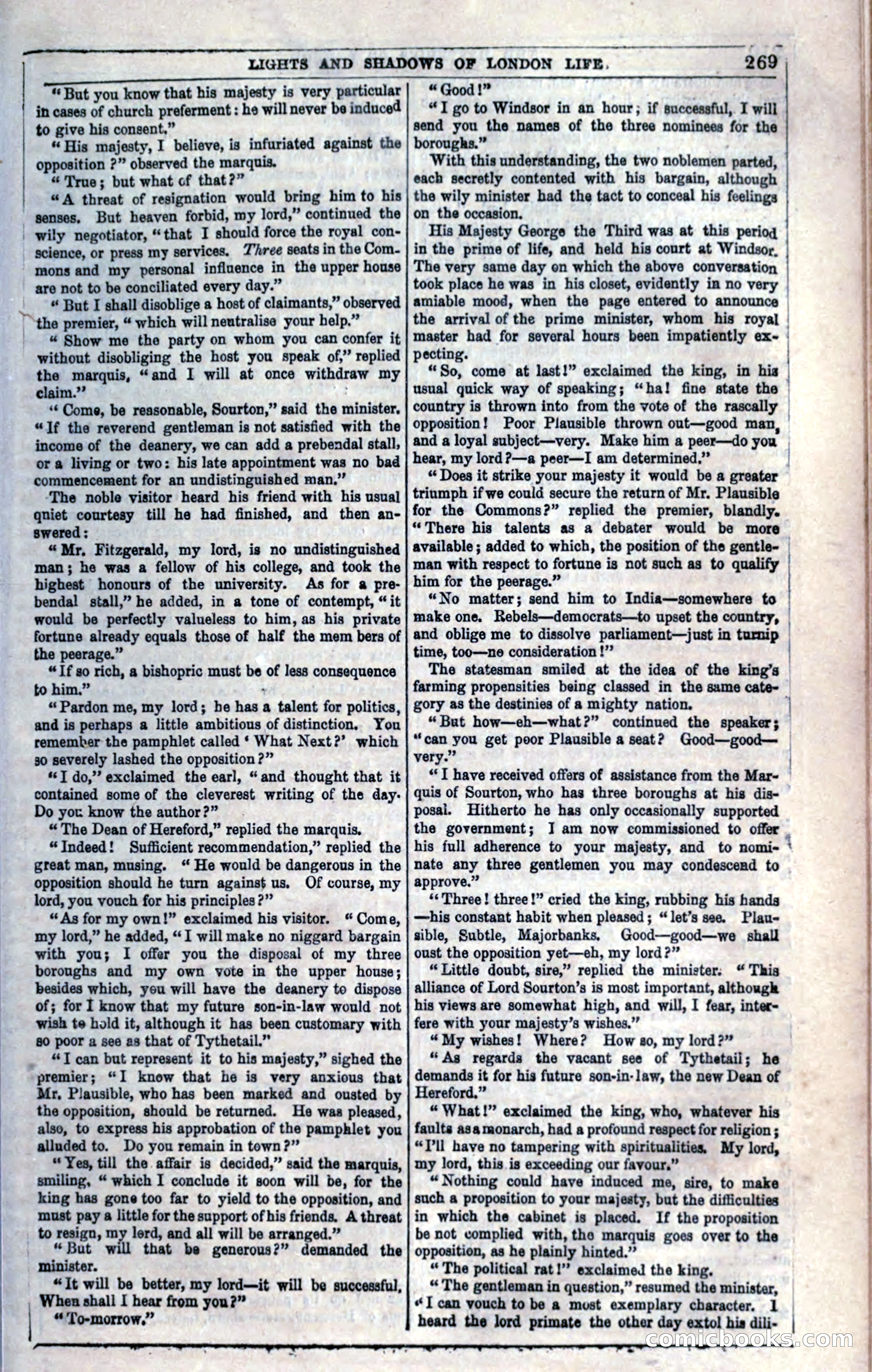
A restored page from Penny Dreadfuls, 1850. Page through the whole issue in the reader above.
📄 Transcribed text from this page (OCR, searchable)
Machine-transcribed from the original scan — historical spelling and the odd misread are preserved.
LIGHTS AND SHADOWS OF LONDON LIFE. 269 _——————_—__——_—— Lx ° “ But you know that his majesty is very particular in cases of church preferment : he will never be induced to give his consent,” “ His majesty, I believe, is infuriated against the opposition ?” observed the marquis. “True; but what of that?” “A threat of resignation would bring him to his genses, But heaven forbid, my lord,” continued the _ wily negotiator, “that I should force the royal con- _ science, or press my services. Three seats in the Com- mons and my personal influence in the upper house are not to be conciliated every day.” “ But I shall disoblige a host of claimants,” observed the premier, “ which will neutralise your help.” _ * Show me the party on whom you can confer it without disobliging the host you speak of,” replied the marquis, “and I will at once withdraw my claim.” . *¢ Come, be reasonable, Sourton,” said the minister, “If the reverend gentleman is not satisfied with the income of the deanery, we can add a prebendal stall, or a living or two: his late appointment was no bad commencement for an undistinguished man,” ‘The noble yisitor heard his friend with his usual qniet courtesy till he had finished, and then an- swered ; “Mr, Fitzgerald, my lord, is no undistinguished man; he was a fellow of his college, and took the highest honours of the university. As for a@ pre- bendal stall,” he added, in a tone of contempt, “it would be perfectly valueless to him, as his private fortune already equals those of half the mem bers of the ” “If so rich, a bishopric must be of less consequence to him,” . “Pardon me, my lord; he has a talent for politics, and is perhaps a little ambitious of distinction. You remember the pamphlet called ‘ What Next?’ which 30 severely lashed the opposition ?” **T do,” exclaimed the earl, “and thought that it contained some of the cleverest writing of the day. Do you. know the author?” “The Dean of Hereford,” replied the marquis, “Indeed! Sufficient recommendation,” replied the great man, musing. ‘“ He would be dangerous in the opposition should he turn against us. Of course, my lord, you vouch for his principles ?” “ As for my own!” exclaimed his visitor. “ Come, my lord,” he added, “‘1 will make no niggard bargain with you; I offer you the disposal of my three boroughs and my own vote in the upper house; besides which, you will have the deanery to dispose of; for I know that my future son-in-law would not wish te hold it, although it has been customary with 80 poor a see as that of Tythetail.” “T can but represent it to his majesty,” sighed the premier; “I know that he is very anxious that Mr, Plausible, who has been marked and ousted by the opposition, should be returned. He was pleased, also, to express his approbation of the pamphlet you alluded to. Do you remain in tewn?” “ Yes, till the affair is decided,” said the marquis, smiling, “ which I conclude it soon will be, for the king has gone too far to yield to the opposition, and must pay a little for the support of his friends. A threat _ to resign, a gre and all will be arranged.” * But that be generous?” demanded the minister. “It will be better, my lord—it will be successful, When shall I hear from you?” “To-morrow.” heard the lord primate the other day extol his dili- | as $i oOmMrebDookKs -, —_—— + —+ ae eee eee “ Good !” “TI go to Windsor in an hour; if successful, I will send you the names of the three nominees for the boroughs.” With this understanding, the two noblemen parted, each secretly contented with his bargain, although the wily minister had the tact to conceal his feelings on the occasion. His Majesty George the Third was at this periog in the prime of life, and held his court at Windsor, The very same day on which the above conversation took place he was in his closet, evidently in no very amiable mood, when the page entered to announce the arrival of the prime minister, whom his royal | master had for several hours been impatiently ex- | pecting. “So, come at last!” exclaimed the king, in his usual quick way of speaking; “ha! fine state the country is thrown into from the vote of the rascally opposition! Poor Plausible thrown out—good man, | and a loyal subject—very. Make him a peer—do you | hear, my lord ?—a peer—I am determined,” | “ Does it strike your majesty it would be a greater triumph if we could secure the return of Mr. Plausible for the Commons?” replied the premier, blandly. “There his talents as a debater would be more available ; added to which, the position of the gentle- | man with respect to fortune is not such as to qualify | him for the peerage.” “No matter; send him to Indiamsomewhere to | make one. Rebels—democrats—to upset the country, _ and oblige me to dissolve parliament—just in turnip time, too—ne consideration !” | The statesman smiled at the idea of the king’s farming propensities being classed in the same cate~- gory as the destinies of a mighty nation. 1] “But how—eh—what?” continued the speaker; “can you get poor Plausible a seat? Good—good— very.” “‘T have received offers of assistance from the Mar- . quis of Sourton, who has three boroughs at his dis- posai. Hitherto he has only occasionally supported the government; J am now commissioned to offer his full adherence to your majesty, and to nomi- * nate any three gentlemen you may condescend to approve.” ‘¢ Three! three!” cried the king, rubbing his hands —his constant habit when pleased; “let’s see. Plau- sible, Subtle, Majorbanks. Good—good—we shall oust the opposition yet—eh, my lord?” “Little doubt, sire,” replied the minister: “ Thig alliance of Lord Sourton’s is most important, although his views are somewhat high, and will, I fear, inter- fere with your majesty’s wishes.” “My wishes! Where? How ao, my lord?” “As regards the vacant see of Tythetail; he demands it for his future son-in-law, the new Dean of Hereford,” “What!” exclaimed the king, who, whatever his faults asa monarch, had a profound respect for religion ; “Pil have no tampering with spiritualities, My lord, my lord, this is exceeding our favour,” “Nothing could have induced me, sire, to make such a proposition to your majesty, but the difficulties in which the cabinet is placed. If the proposition be not complied with, the marquis goes over to the opposition, as he plainly hinted.” | “ The political rat!” exclaimed the king, “The gentleman in question,” resumed the minister, “I can vouch to be a must exemplary character. 1 eR (CO)