
Penny Dreadfuls, 1850 · page 269 of 394
The Mysteries of London; or, Lights and Shadows of London Life — page 269: what you’re looking at
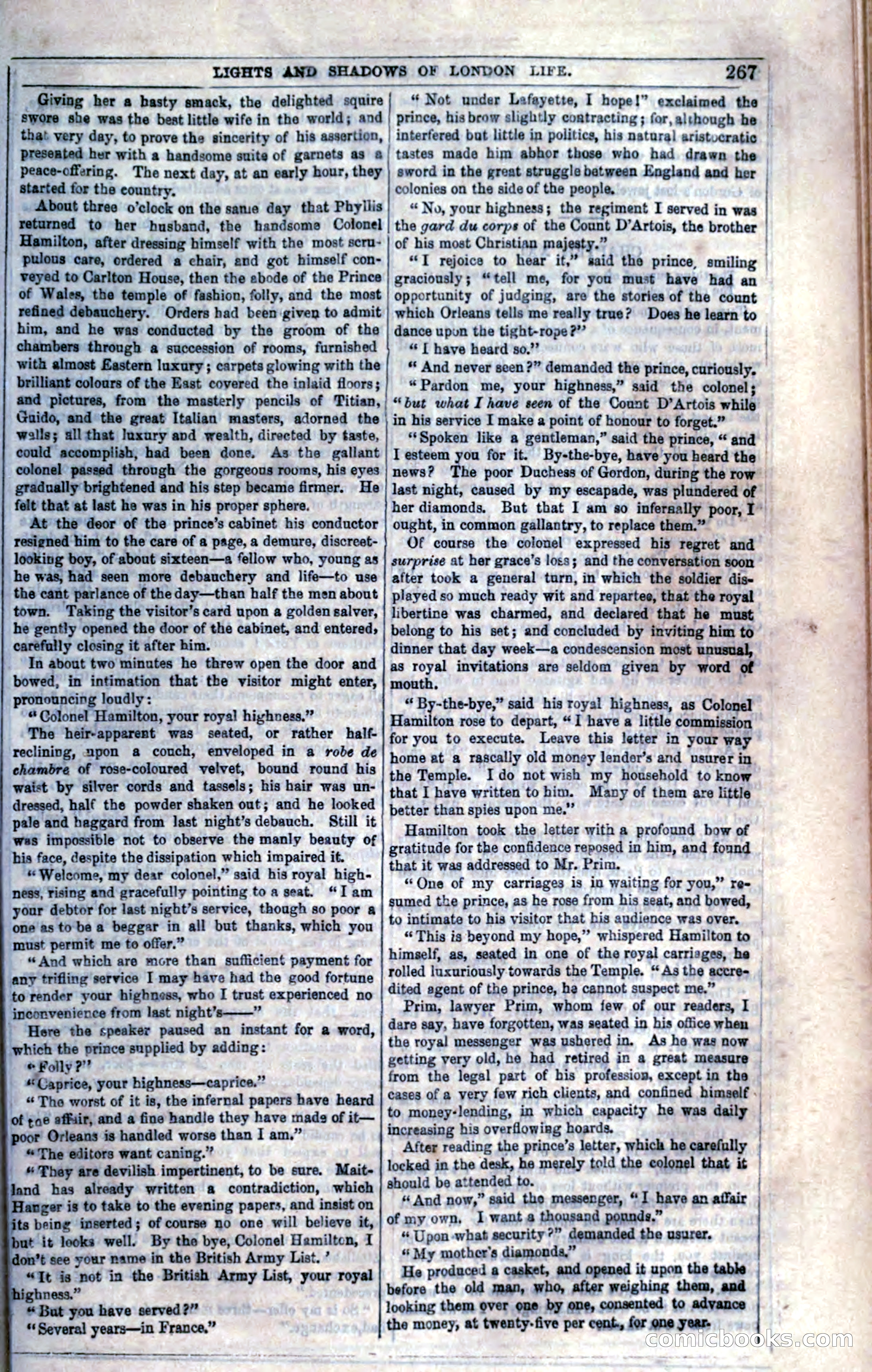
A restored page from Penny Dreadfuls, 1850. Page through the whole issue in the reader above.
📄 Transcribed text from this page (OCR, searchable)
Machine-transcribed from the original scan — historical spelling and the odd misread are preserved.
. _ Giving her a basty smack, the delighted squire ‘ie ‘ _ that very day, to prove the sincerity of his assertion, _ presented her with a handsome suite of garnets as a | peace-offering. The next day, at an early hour, they started for the country. . About three o’clock on the same day that Phyllis _ returned to her husband, the handsome Colonel after dressing himself with the most scru- pulous care, ordered a chair, and got himself con- — to Carlton House, then the ebode of the Prince of Wales, the temple of fashion, folly, and the most . Orders had been given to admit him, and he was conducted by the groom of the chambers through a succession of rooms, furnished with almost Eastern luxury ; carpets glowing with the brilliant colours of the East covered the inlaid floors; and pictures, from the masterly pencils of Titian, Guido, and the great Italian masters, adorned the walls; all that luxury and wealth, directed by taste, could _had been done. As the gallant colonel passed through the gorgeous rooms, his eyes and his step became firmer. He felt that at last he was in his proper sphere. At the deor of the prince’s cabinet his conductor ov ren hog otha a demure, discreet- ‘of about sixteen—a fellow who, young as \ had seen more debauchery and life—to use th pore Boel of the day—than half the men about town. ‘Taking the visitor’s card upon a golden salver, he gently opened the door of the cabinet, and entered, closing it after him. _ In about two minutes he threw open the door and bowed, in intimation that the visitor might enter, Pra Colonel Hlomilton, your royal highness.” The heir-apparent was seated, or rather half- reclining, mpon a couch, enveloped in a robe de chambre of rose-coloured velvet, bound round his waist by silver cords and tassels; his hair was un- dressed, half the powder shaken out; and he looked pale and haggard from last night’s debauch. Still it was impossible not to observe the manly beauty of his face, despite the dissipation which impaired it. «Welcome, my dear colonel,” said his royal high- ness, rising and gracefully pointing toa seat. “Tam your debtor for last night’s service, though so poor a one as tobe a beggar in all but thanks, which you ‘must permit me to offer.” “ And which are more than sufficient payment for any trifling service I may have had the good fortune to render your highness, who I tenst experienced no jneonvenience from last night’s—— ‘Here the speaker paused an instant for a word, ; ich the prince supplied by adding: © Folly ?” _ Caprice, your highness—caprice.” “ The worst of it is, the infernal papers have heard of ¢oe affuir, and a fine handle they have madg of it— Orleans is handled \ ers than I am.” _ The editors want caning.” _ They are devilish impertinent, to be sure. Mait- nd has already written a contradiction, which is to take to the evening papers, and insist on its being inserted; of course no one will believe it, ‘it leoks well. By the bye, Colonel Hamilton, I don’t see your name in the British Army List. ’ “Tt is not in the British Army List, your royal But you have served?” “Several years—in France,” Sle eietetie ee ae LIGHTS AND SHADOWS OF LONDON LIFE. Sp 267 | “* Not under Lafayette, I hope!” exclaimed the - swore she was the best little wife in the world; and | prince, his brow slightly contracting; for, although be | interfered but little in politics, his natura! aristucratic tastes made him abhor those who had drawn the > sword in the great struggle between England and her | colonies on the side of the people, “No, your highness; the regiment I served in was the gard du corps of the Count D’Artois, the brother of his most Christian majesty.” | “T rejoice to hear it,” said the prince, smiling graciously; “tell me, for you must have had an opportunity of judging, are the stories of the count which Orleans tells me really true? Does he learn to dance upon the tight-rope ?”’ “ [ have heard so.” | “ And never seen?” demanded the prince, curiously, “Pardon me, your highness,” said the colonel; “but what I have seen of the Count D’ Artois while in his service I make a point of honour to forget.” **Spoken like a gentleman,” said the prince, “ and I esteem Pi for it. By-the-bye, have you heard the ~ news? e poor Duchess of Gordon, during the row last night, caused by my escapade, was plundered of her diamonds. But that I am so inferaally poor, I ought, in common gallantry, to replace them.” See course the colonel expressed his regret and ise at her grace’s loss; and the conversation soon ite took a general turn in which the soldier dis- played so much ready wit and repartee, that the royal libertine was charmed, and declared that he must belong to his set; and concluded by inviting him to dinner that day week—a condescension most as royal invitations are seldom given by word of mouth, ad B -the-bye,” said his royal highness, as Colonel Hamilton rose to depart, “I have a little commission for you to execute. Leave this letter in your way home at a rascally old money lender’s and usurer in the Temple. Ido not wish my household to know that I have written to him. Many of them are little better than spies upon me.’ Hamilton took the letter with a profound bow of gratitude for the confidence reposed in him, and found that it was addressed to Mr. Prim. “One of my carriages is in waiting for you,” re- sumed the prince, as he rose from his seat, and bowed, to intimate to his visitor that his audience was over. “‘ This is beyond my hope,” whispered Hamilton to | himself, as, seated in one of the royal carriages, he rolled luxuriously towards the Temple. “As the accre- dited agent of the prince, he cannot suspect me,” Prim, lawyer Prim, whom few of our readers, I _ dare say, have forgotten, was seated in his office when | the royal messenger was ushered in. As he was now getting very old, he had retired in a great measure — from the legal part of his profession, except in the cases of a very few rich clients, and confined himself . to money-lending, in which capacity he was daily | increasing his overflowing hoards. After reading the prince’s letter, which he carefully | locked in the desk, he merely told the colonel that it — should be attended to. * And now,” said the messenger, “I have an affair of my own, I wants thousand pounds.” “ Upon what security?” demanded the usurer. “ My mother's diamonda,” He produced a casket, Saas xo before the old man, who, after weighing them, and looking them over one by one, consented to advance the money, at twenty- ixave ta cul dr gegen CCCOMNMUC S (CO) mM