
Penny Dreadfuls, 1850 · page 266 of 394
The Mysteries of London; or, Lights and Shadows of London Life — page 266: what you’re looking at
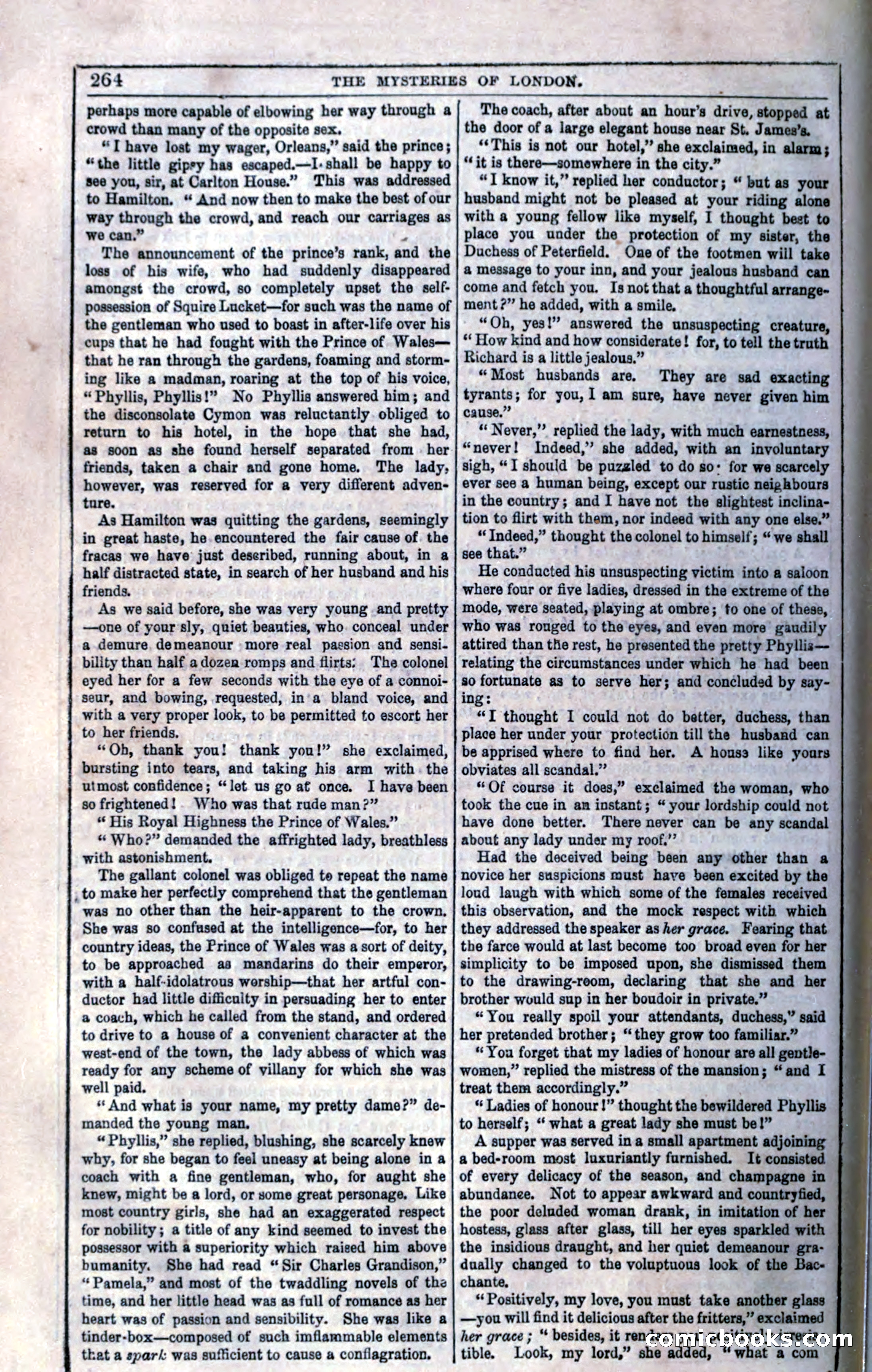
A restored page from Penny Dreadfuls, 1850. Page through the whole issue in the reader above.
📄 Transcribed text from this page (OCR, searchable)
Machine-transcribed from the original scan — historical spelling and the odd misread are preserved.
— ee a dl 264 perhaps more capable of elbowing her way through a crowd than many of the opposite sex. “TIT have lost my wager, Orleans,” said the prince; “the little gipry has escaped.—I-shall be happy to see you, sir, at Carlton House.” This was addressed to Hamilton. “ And now then to make the best of our way through the crowd, and reach our carriages as we can,” , The announcement of the prince’s rank, and the loss of his wife, who had suddenly disappeared amongst the crowd, so completely upset the self- possession of Squire Lucket—for such was the name of the gentleman who used to boast in after-life over his cups that he had fought with the Prince of Wales— that he ran through the gardens, foaming and storm- ing like a madman, roaring at the top of his voice, “Phyllis, Phyllis!” No Phyllis answered him; and the disconsolate Cymon was reluctantly. obliged to return to his hotel, in the hope that she had, as soon as she found herself separated from . her friends, taken a chair and gone home. The lady, however, was reserved for a very different adven- ture. As Hamilton was quitting the gardens, seemingly in great haste, he encountered the fair cause of. the fracas we have just described, running about, in a half distracted state, in search of her husband and his friends. As we said before, she was very young and pretty —one of your sly, quiet beauties, who. conceal under a demure. demeanour more real passion and sensi- bility than half a dozen romps and flirts: The colonel eyed her for a few seconds with the eye of a connoi- seur, and bowing, requested, in'a bland voice, and with a very proper look, to be permitted to escort her to her friends. “Ob, thank you! thank you!” she exclaimed, bursting into tears, and taking his arm with. the utmost confidence; “let us go af once. I have been so frightened! Who was that rude man?” “ His Royal Highness the Prince of Wales.” “ Who?” demanded the affrighted lady, breathless with astonishment, The gallant colonel was obliged te repeat the name to make her perfectly comprehend that the gentleman was no other than the heir-apparent to the crown, She was so confused at the intelligence—for, to her country ideas, the Prince of Wales was a sort of deity, to be approached as mandarins do their emperor, with a half-idolatrous worship—that her artful con- ductor had little difficuity in persuading her to enter a coach, which he called from the stand, and ordered to drive to a house of a convenient character at the west-end of the town, the lady abbess of which was ready for any scheme of yvillany for which she was well paid. * And what is your name, my pretty dame?” de- manded the young man, “ Phyllis,” she replied, blushing, she scarcely knew why, for she began to feel uneasy at being alone in a coach with a fine gentleman, who, for aught she knew, might be a lord, or some great personage, Like most country girls, she had an exaggerated respect for nobility; a title of any kind seemed to invest the possessor with a superiority which raised him above bumanity. She had read “Sir Charles Grandison,” “ Pamela,” and most of the twaddling novels of the time, and her little head was as full of romance as her heart was of passion and sensibility. She was like a tinder-box—composed of such imflammable elements that a spar/: was sufficient to cause a conflagration. THE MYSTERIES OF LONDON, The coach, after about an hour’s drive, stopped at the door of a large elegant house near St. James's, ‘This is not our hotel,” she exclaimed, in alarm; “it is there—somewhere in the city.” “I know it,” replied her conductor; “ but as your husband might not be pleased at your riding alone with a young fellow like myself, I thought best to place you under the protection of my sister, the Duchess of Peterfield. One of the footmen will take a moses? 52 your inn, and your jealous husband can come and fetch you. Is not that a th tful arrange- ment?” he added, with a smile, = “Oh, yes!” answered the unsuspecting creature, ** How kind and how considerate! for, to tell thetruth | Richard is a little jealous,” “Most husbands are. They are sad exacting tyrants; for you, 1 am sure, have never given him cause,” “ Never,” replied the lady, with much earnestness, “never! Indeed,” she added, with an involuntary sigh, “I should be puzzled to do so: for we scarcely ever see a human being, except our rustic neighbours in the country; and I have not the slightest inclina- tion to flirt with them, nor indeed with any one else.” | “Indeed,” thought the colonel to himself; “we shall | © see that.” | He conducted his unsuspecting victim into a saloon where four or five ladies, dressed in the extreme of the mode, were seated, playing at ombre; to one of these, who was rouged to the eyes, and even more’ gaudily attired than the rest, he presented the pretty Phyllia— relating the circumstances under which he had been so fortunate as to serve her; and concluded by say- ing: “T thought I could not do better, duchess, than place her under your protection till the husband can be apprised where to find her. A housa like yours obviates all scandal.” “Of course it does,” exclaimed the woman, who took the cue in an instant; “ your lordship could not — have done better. There never can be any scandal about any lady under my roof,’’ Had the deceived being been any other than a novice her suspicions must have been excited by the loud laugh with which some of the females received this observation, and the mock respect with which they addressed the speaker as her grace. Fearing that | the farce would at last become too broad even for her | simplicity to be imposed upon, she dismissed them to the drawing-reom, declaring that she and her brother would sup in her boudoir in private.” “You really spoil your attendants, duchess,” said her pretended brother; “they grow too familiar.” “You forget that my ladies of honour are all gentle- women,” replied the mistress of the mansion; “and I — treat them accordingly.” | | * Ladies of honour!” thought the bewildered Phyllis — to herself; “‘ what a great lady she must be!” is A supper was served in a small apartment adjoining a bed-room most luxuriantly furnished. It consisted of every delicacy of the season, and champagne in abundanee. Not to appear awkward and countryfied, — the poor deluded woman drank, in imitation of her hostess, glass after glass, till her eyes sparkled with — the insidious draught, and her quiet demeanour gra- dually changed to the voluptuous look of the Bac- chante, j * Positively, my love, you must take another glass | —you will find it delicious after the fritters,” exclaimed her grace ; “ besides, it rena.) at oie) = CO tible. Look, my lord,” COMUICDO hat a com “fk SR IR ET ee tig ee