
Penny Dreadfuls, 1850 · page 26 of 394
The Mysteries of London; or, Lights and Shadows of London Life — page 26: what you’re looking at
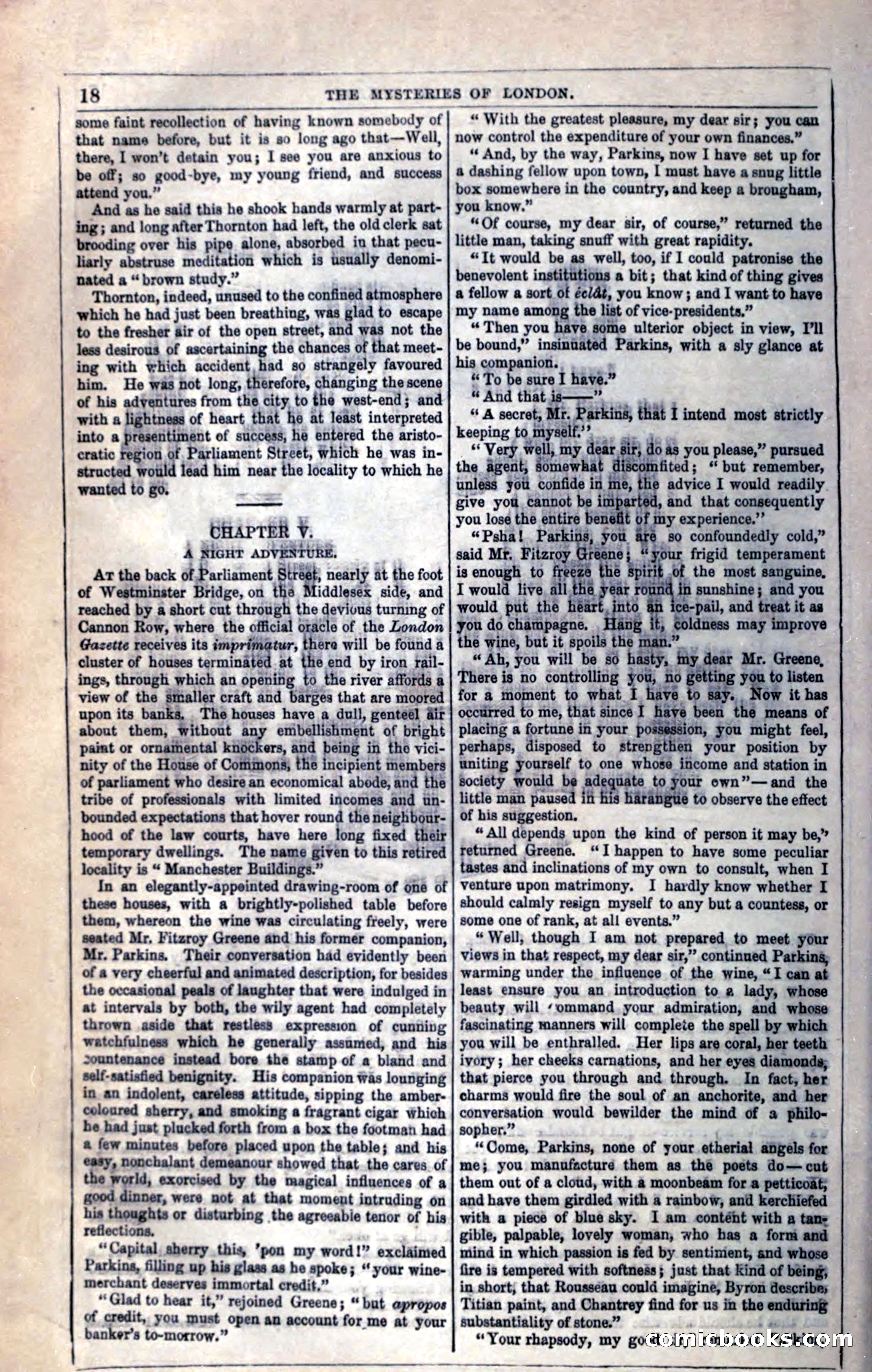
A restored page from Penny Dreadfuls, 1850. Page through the whole issue in the reader above.
📄 Transcribed text from this page (OCR, searchable)
Machine-transcribed from the original scan — historical spelling and the odd misread are preserved.
| ' ’ 18 _—_— LE TS A th some faint recollection of having known somebody of that name before, but it is so long ago that—Well, there, I won’t detain you; I see you are anxious to be off; so good-bye, my young friend, and success attend you.” And as he said this he shook hands warmly at part- ing ; and long after Thornton had left, the old clerk sat brooding over his pipe alone, absorbed in that pecu- liarly abstruse meditation which is usually denomi- nated a “ brown study.” Thornton, indeed, unused to the confined atmosphere which he had just been breathing, was glad to escape to the fresher air of the open street, and was not the less desirous of ascertaining the chances of that meet- ing with which accident had so strangely favoured him. He was not long, therefore, changing thescene of his adventures from the city. to the west-end; and with a ghtness of heart that he at least interpreted coh eet of success, he entered the aristo- io Ergon Parliament Street, Which he was in- wanted 16 #8 CHAPTER ¥. A NIGHT ADVENTURE, Ar the back of Parliament ti nearly at the foot | i 1 of Westminster Bridge, on iddlesex side, and reached by a short cut through the ey turning of Cannon Row, where the official oracle of the London Gazette receives its a ie ie cluster of houses terminat , ings, ree which an opanitig view of the ller craft and barges that are aoe upon its The houses ag weihs vee gen about them, ithout nt of b Ant paint or craainetal knock in the er nity of the House of Comm fraintaht me of parliament who desire an potty abode, an tribe of professionals with limited incomes an bounded expectations that hover round the ae hood of the law courts, have here long fixed th tem dwellings. The name given to this locality is “ Manchester Buildings.” In an elegantly-appeinted drawing-room of one of these houses, with a brightly-polished table before them, whereon the wine was circulating freely, were seated Mr, Fitzroy Greene and his former companion, Mr. Parkins. Their conversation had evidently been of a very cheerful and animated description, for besides the occasional peals of laughter that were indulged in at intervals by both, the wily agent had completely thrown aside that restless expression of cuniing watchfulness which he generally assumed, and his Sountenance instead bore the stamp of a bland and self-satisfied ity. His companion was lounging in an indolent, careless attitude, sipping the amber- coloured sherry, and smoking a fragrant cigar which be had just plucked forth from a box the footman had a few minutes before placed upon the table; and his easy, nonchalant demeanour showed that the cares of the Ferd x exorcised by the magical influences of a » Were not at that moment intruding on his tia thoaghts or disturbing the agreeabie tenor of his reflections, “Capital, sherry this, ‘pon my word!” exclaimed Parkins, filling up his glass as he spoke; “ your wine- merchant deserves immortal credit,” “Glad to hear it,” rejoined Greene; “ but of credit, you must open an account for me at your banker’s to-morrow.” —_= =—=————_— rh ror - -"”"——- THE MYSTERIES OF LONDON. lead him near the locality to which he | _— — “ With the greatest pleasure, my dear sir; you can now control the expenditure of your own finances.” “ And, by the way, Parkins, now I have set up for a dashing fellow upon town, I must have a snug little box somewhere in the country, and keep a brongham, you know.” “Of course, my dear sir, of course,” returned the little man, taking snuff with great rapidity. “Tt would be as well, too, if 1 could patronise the benevolent inate a bit; that kind of thing gives a fellow a sort of éclat, you know; and I want to have my name among the list of vice-presidents,” “Then you have some ulterior object in view, I'll be bound,” insinaated Parkins, with a sly glance at his companion. «To be sure I have.” “ And that is “ A secret, M intend most strictly keeping to my he of wi 0 43 you please,” pursued r my ex perience.”’ rot 80 confoundedly cold,” 3, | There is no controlling you, 0 for a moment to what air | occtirred to me, that since I hi placing a fortune in your poss pan i d to strengthen your position by rg yourself to one whose income and station in vould | acaette BA Ned ewn”—and the fate & man pa ed to observe the effect of his suggestion. “All depends upon the kind of person it may be,” returned Greene. “I happen to have some peculiar tastes and inclinations of my own to consult, when I venture upon matrimony. I hardly know whether I should calmly resign myself to any but a countess, or some one of rank, at all events.” “ Well, though I am not prepared to meet your views in that respect, my dear sir,” continued P. warming under the influence of the wine, “I can at least ensure you an introduction to a lady, whose beauty will ‘ommand your admiration, and whose fascinating manners will complete the spell by which you will be enthralled. Her lips are coral, her teeth — ivory; her cheeks carnations, and her eyes that pierce you through and through. In fact, her charms would fire the soul of an anchorite, and her conversation would bewilder the mind of a philo- sopher.” “Come, Parkins, none of your etherial angels for me; you manufacture them as thé poets do— cut them out of a cloud, with a moonbeam for a petticoat; and have them girdled with a rainbow, and kercliiefed with a piece of blue sky. I am contéht with a tans gible, palpable, lovely woman, who has a form and mind in which passion is fed by sentinient, and whose fire is tempered with softness; just that Kind of in short, that Rousseau could imagine, Byron describe; Titian paint, ont eee tal See ee substantiality of stone.” micbooks.co “Your rhapsody, my go(doye\) —_—«