
Penny Dreadfuls, 1850 · page 258 of 394
The Mysteries of London; or, Lights and Shadows of London Life — page 258: what you’re looking at
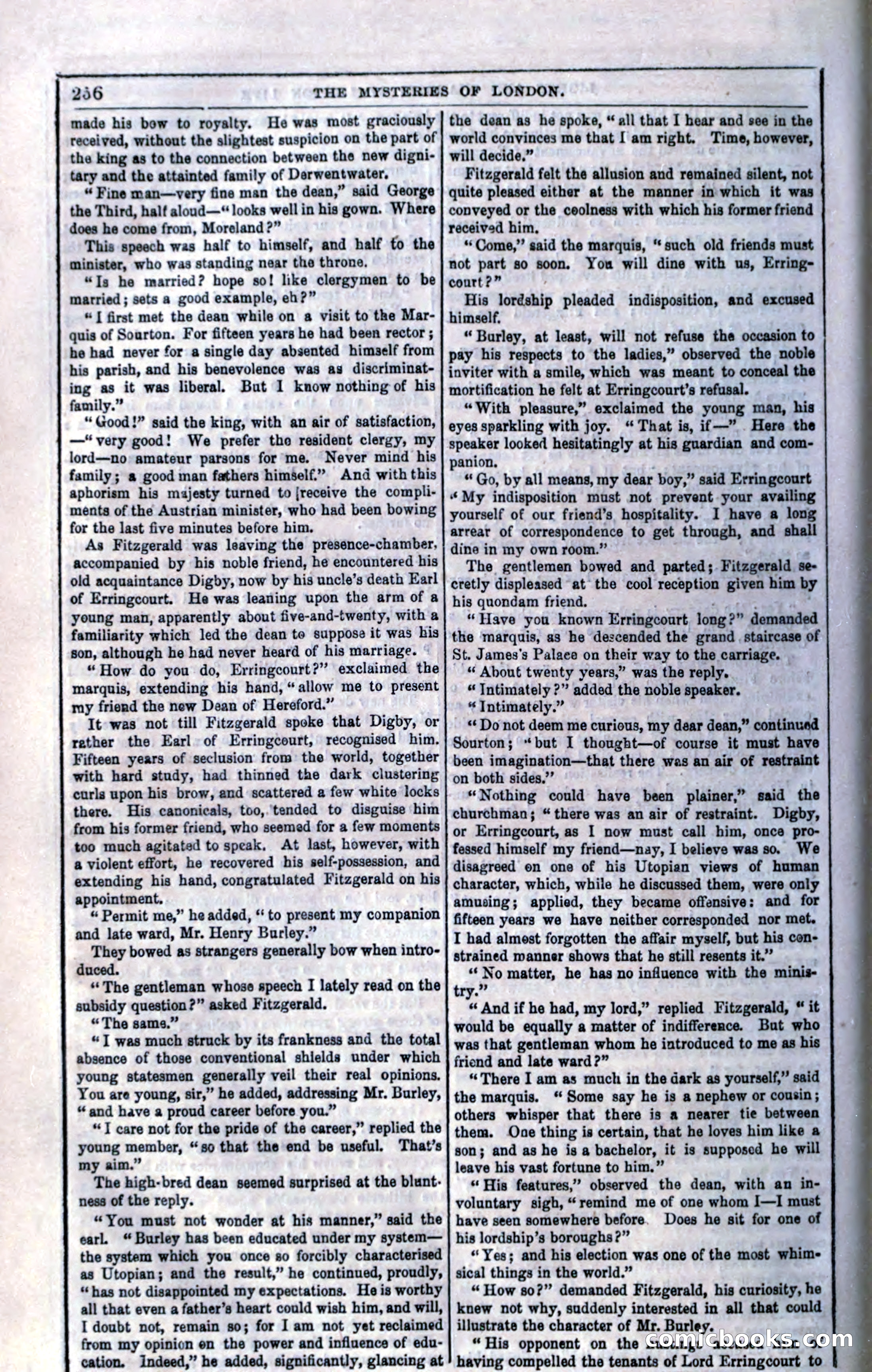
A restored page from Penny Dreadfuls, 1850. Page through the whole issue in the reader above.
📄 Transcribed text from this page (OCR, searchable)
Machine-transcribed from the original scan — historical spelling and the odd misread are preserved.
256 made his bow to royalty. He was most graciously’ received, without the slightest suspicion on the part of the king as to the connection between the new digni- tary and the attainted family of Derwentwater. “ Fine man—very fine man the dean,” said George the Third, half aloud—“ looks well in his gown. Where aan he come from, Moreland ?” This speech was half to himself, and half to the minister, who was standing near the throne. “Ts he married? hope so! like clergymen to be married; sets a good example, eh?” “J first met the dean while on a visit to the Mar- quis of Sourton. For fifteen years he had been rector ; he had never for a single day absented himself from his parish, and his benevolence was as discriminat- ing as it was liberal. But 1 know nothing of his family.” “Good!” said the king, with an air of satisfaction, —“very good! We prefer the resident clergy, my lord—no amateur parsons for me. Never mind his family; a good man fathers himself.” And with this aphorism his majesty turned to [receive the compli- ments of the Austrian minister, who had been bowing for the last five minutes before him. As Fitzgerald was leaving the presence-chamber, accompanied by his noble friend, he encountered his old acquaintance Digby, now by his uncle’s death Earl of Erringcourt. He was leaning upon the arm of a young man, apparently about five-and-twenty, with a familiarity which led the dean te suppose it was his son, although he had never heard of his marriage. “How do you do, Erringcourt?” exclaimed the | — marquis, extending his hand, “ allow me to present my friend the new Dean of Hereford.’ It was not till Fitzgerald spoke that Digby, or rether the Earl of Erringcourt, recognised him. Fifteen years of seclusion from the world, together with hard study, had thinned the dark clustering curls upon his brow, and scattered a few white locks there. His canonicals, too,.tended to disguise him from his former friend, who seemed for a few moments too much agitated to speak. At last, however, with a violent effort, he recovered his self-possession, and extending his hand, congratulated Fitzgerald on his appointment, “ Permit me,” he added, * to present my companion and late ward, Mr. Henry Burley.” They bowed as strangers generally bow when intro- duced. “The gentleman whose speech I lately read on the subsidy question?” asked Fitzgerald. “The same,” “] was much struck by its frankness and the total absence of those conventional shields under which young statesmen generally veil their real opinions. You are young, sir,” he added, addressing Mr. Burley, “and have a proud career before you.” “J care not for the pride of the career,” replied the young member, “so that the end be useful. That’s my aim.” The high-bred dean seemed surprised at the blunt- ness of the reply. “You must not wonder at his manner,” said the earl. “ Burley has been educated under my system— the system which you once so forcibly characterised as Utopian; and the result,” he continued, proudly, “has not disappointed my expectations. He is worthy all that even a father’s heart could wish him, and will, I doubt not, remain so; for Iam not yet reclaimed from my opinion en the power and influence of edu- cation. Indeed,” he added, significantly, glancing at A ee a ES THE MYSTERIES OF LONDON. the dean as he spoke, “all that I hear and see in the world convinces me that I am right. Time, however, will decide,” Fitzgerald felt the allusion and remained silent, not quite pleased either at the manner in which it was conveyed or the coolness with which his former friend received him, “Come,” said the marquis, “such old friends must not part so soon. You will dine with us, Erring- court?” } His lordship pleaded indisposition, and excused himself, “ Burley, at least, will not refuse the occasion to pay his respects to the ladies,” observed the noble inviter with a smile, which was meant to conceal the mortification he felt at Erringcourt’s refusal. “With pleasure,” exclaimed the young man, his eyes sparkling with joy. “That is, if—” . Here the speaker looked hesitatingly at his guardian and com- panion, “ Go, by all means, my dear boy,” said Erringcourt “ My indisposition must not prevent your availing yourself of our friend’s hospitality. I have a 8 arrear of correspondence to get through, and shall dine in my own room.” The gentlemen bowed and parted; Fitzgerald se cretly displeased at the cool rete? = him by his quondam friend. “Have you known Erringcourt long 2” demanded the marquis, as he descended the scl staircase of St. James's Palace on their way to the carriage. | “ About twenty years,” was the reply, “ Intimately ?” added the noble speaker. * Intimately.” “Do not deem me curious, my dear dean,” continued Sourton; “but I thought—of course it must have been imagination—that there was an air of restraint on both sides.’’ “Nothing could have been plainer,” said the churchman; “ there was an air of restraint. Digby, or Erringeonrt, as I now must call him, once pro- fessed himself my friend—nay, I believe was so. We disagreed on one of his Utopian views of human character, which, while he discussed them, were only amusing; applied, they became offensive: and for fifteen years we have neither corresponded nor met. I had almost forgotten the affair myself, but his con- strained manner shows that he still resents it.” ss No matter, he has no influence with the minis- «“ And if he had, my lord,” replied Fitzgerald, “ it would be equally a matter ‘of indifference. But who was that gentleman whom he introduced to me as his friond and late ward?” “There I am as much in the dark as yourself,” said the marquis. “Some say he is a nephew or cousin; others whisper that there is a nearer tie between them. One thing is certain, that he loves him like a son; and as he is a bachelor, it is supposed he will leave his vast fortune to him.” “ His features,” observed the dean, with an in- voluntary sigh, “remind me of one whom I—I must have seen somewhere before. Does he sit for one of his lordship’s boroughs?” “Yes; and his election was one of the most whim- sical things i in the world.” “ How so?” demanded Fitzgerald, his curiosity, he knew not why, suddenly interested in all that could illustrate the character of we pan “His opponent on the comicboo having compelled the iehanll = Livi Erringcourt to KS7cCOM