
Penny Dreadfuls, 1850 · page 254 of 394
The Mysteries of London; or, Lights and Shadows of London Life — page 254: what you’re looking at
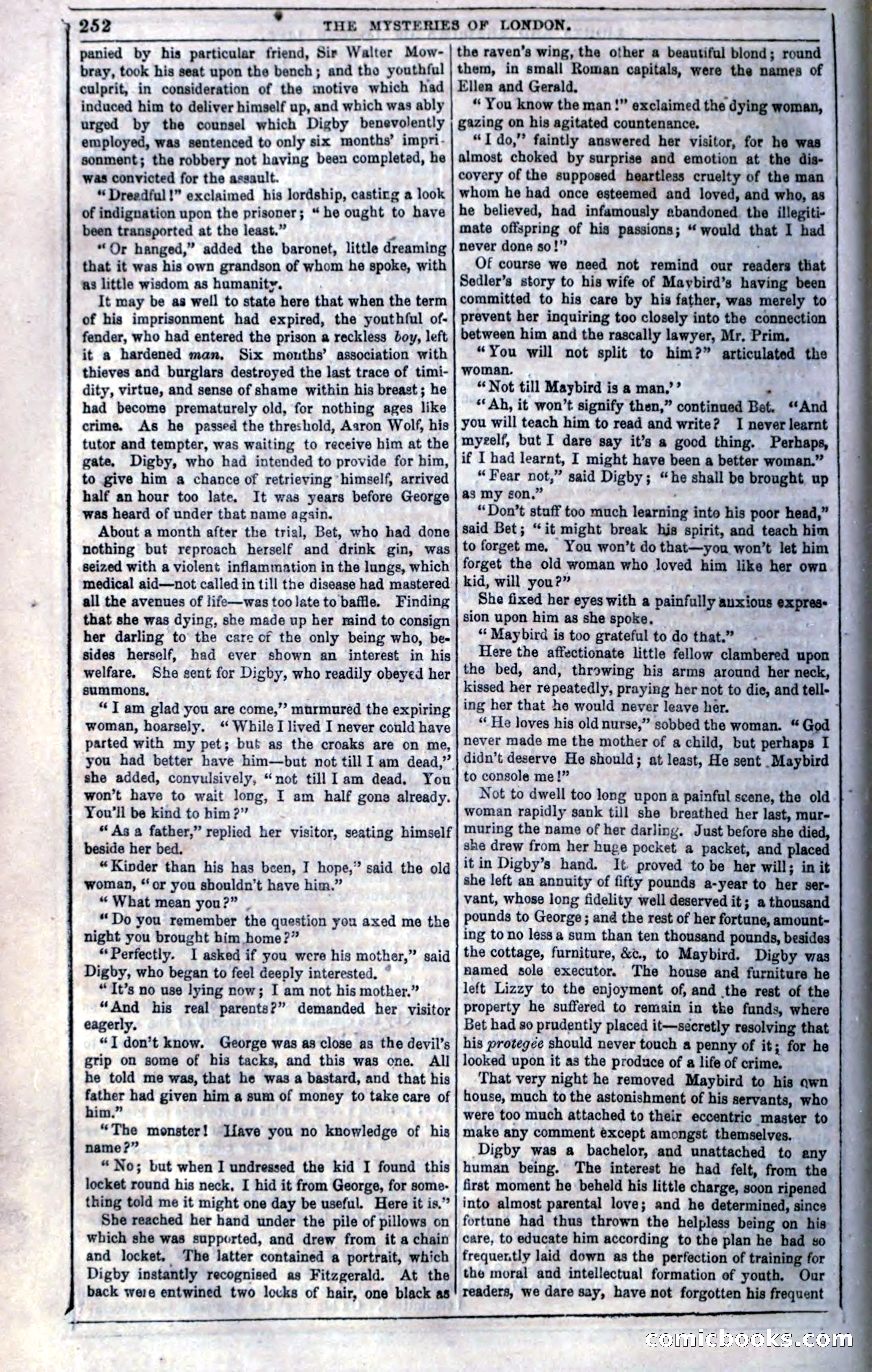
A restored page from Penny Dreadfuls, 1850. Page through the whole issue in the reader above.
📄 Transcribed text from this page (OCR, searchable)
Machine-transcribed from the original scan — historical spelling and the odd misread are preserved.
Ee. tn ee, eee Ce ee ee en eee ' THE MYSTERIES OF LONDON, 252 panied by his particular friend, Sir Walter Mow- bray, took his seat upon the bench; and tho youthful culprit, in consideration of the motive which had induced him to deliver himself up, and which was ably urged by the counsel which Digby benevolently employed, was sentenced to only six months’ impri- sonment; the robbery not having been completed, he was convicted for the assault. “ Dreadful!” exclaimed his lordship, casting a look of indignation upon the prisoner; “he ought to have been transported at the least.” : “Or hanged,” added the baronet, little dreaming that it was his own grandson of whom he spoke, with as little wisdom as humanity. It may be as well to state here that when the term of his imprisonment had expired, the youthful of- fender, who had entered the prison a reckless boy, left it a hardened man, Six mouths’ association with thieves and burglars destroyed the last trace of timi- dity, virtue, and sense of shame within his breast; he had become prematurely old, for nothing ages like crime. As he passed the threshold, Aaron Wolf, his tutor and tempter, was waiting to receive him at the gate. Digby, who had intended to provide for him, to give him a chance of retrieving ‘himself, arrived half an hour too late. It was years before George was heard of under that name again. About a month after the trial, Bet, who had done nothing but reproach herself and drink gin, was seized with a violent inflammation in the lungs, which medical aid—not called in till the disease had mastered all the avenues of life—was too late to baffle. Finding that she was dying, she made up her mind to consign her darling to the care of the only being who, be- sides herself, had ever shown an interest in his welfare, She sent for Digby, who readily obeyed her summons, “ T am glad you are come,”’ murmured the expiring woman, hoarsely. ‘“ While I lived I never could have parted with my pet; but as the croaks are on me, you had better have him—but not till I am dead,” she added, convulsively, “not till lam dead. You won’t have to wait long, I am half gona already. You'll be kind to him ?” “As a father,” replied her visitor, seating himself beside her bed. “Kinder than his has been, I hope,” said the old woman, “or you sbouldn’t have him.” “What mean you?” | “Do you remember the question you axed me the night you brought him home?” “Perfectly. I asked if you were his mother,” said Digby, who began to feel deeply interested. * “It’s no use lying now; I am not his mother.” “And his real parents?” demanded her visitor eagerly, ~ “] don’t know. George was as close as the devil’s grip on some of his tacks, and this was one. All he told me was, that he was a bastard, and that his father had given him a sum of money to take care of him.” “The monster! Liave you no knowledge of his name?” “No; but when I undressed the kid I found this locket round his neck, I hid it from George, for some- thing told me it might one day be useful. Here it is.” She reached her hand under the pile of pillows on which she was supported, and drew from it a chain and locket, The latter contained a portrait, which Digby instantly recognised as Fitzgerald. At the back were entwined two locks of hair, one black as the raven’s wing, the other a beautiful blond; round them, in small Roman capitals, were the names of Ellen and Gerald, |. “ You know the man !” exclaimed the dying woman, gazing on his agitated countenance. ; “Ido,” faintly answered her visitor, for he was almost choked by surprise and emotion at the dis- covery of the supposed heartless cruelty of the man whom he had once esteemed and loved, and who, as he believed, had infamously abandoned. the illegiti- mate offspring of his passions; “would that I had never done so!” | Of course we need not remind our readers that Sedler’s story to his wife of Maybird’s having been committed to his care by his father, was merely to prevent her inquiring too closely into the connection between him and the rascally lawyer, Mr, Prim, “You will not split to him?” articulated the woman. | : | “‘ Not till Maybird is a man,’’ . ‘Ah, it won’t signify then,” continued Bet. “And you will teach him to read and write? I never learnt myeelf, but I dare say it’s a good thing. Perhaps, if I had learnt, I might have been a better woman.” “Fear not,” said Digby; “he shall be brought up as my son,” | “Don’t stuff too much learning into his poor head,” said Bet; “it might break hjs spirit, and teach him to forget me, You won’t do that—yon won’t let him forget the old woman who loved him like her own kid, will you?” She fixed her eyes with a sion upon him as she spoke, “ Maybird is too grateful to do that.” Here the affectionate little fellow clambered upon the bed, and, throwing his arms around her neck, kissed her repeatedly, praying her not to die, and tell- ing her that he would never leave her. “ He loves his old nurse,” sobbed the woman. “ never made me the mother of a child, but perhaps I didn’t deserve He should; at least, He sent Maybird to console me!” Not to dwell too long upon a painful scene, the old woman rapidly sank till she breathed her last, mur- muring the name of her darling. Just before she died, she drew from her huge pocket a packet, and placed itin Digby’s hand. It proved to be her will; in it she left an annuity of fifty pounds a-year to her ser- vant, whose long fidelity well deserved it; a thousand pounds to George ; and the rest of her fortune, amount- ing to no less a sum than ten thousand pounds, besides the cottage, furniture, &¢., to Maybird. Digby was | named sole executor. The house and furniture he left Lizzy to the enjoyment of, and the rest of the property he suffered to remain in the funds, where Bet had so prudently placed it—secretly resolving that | his protege should never touch a penny of it; for he | — looked upon it as the produce of a life of crime. That very night he removed Maybird to his qwn | house, much to the astonishment of his servants, who were too much attached to their eccentric master to make any comment éxcept amongst themselves. | Digby was a bachelor, and unattached to any human being. The interest he had felt, from the first moment he beheld his little charge, soon ripened into almost parental love; and he determined, since fortune had thus thrown the helpless being on his care, to educate him according to the plan he had frequently laid down as the perfection hei oo the moral and intellectual formation of youth. O readers, we dare say, have not forgotten his frequent — painfully anxious express (elo) EGomichoo S