
Penny Dreadfuls, 1850 · page 238 of 394
The Mysteries of London; or, Lights and Shadows of London Life — page 238: what you’re looking at
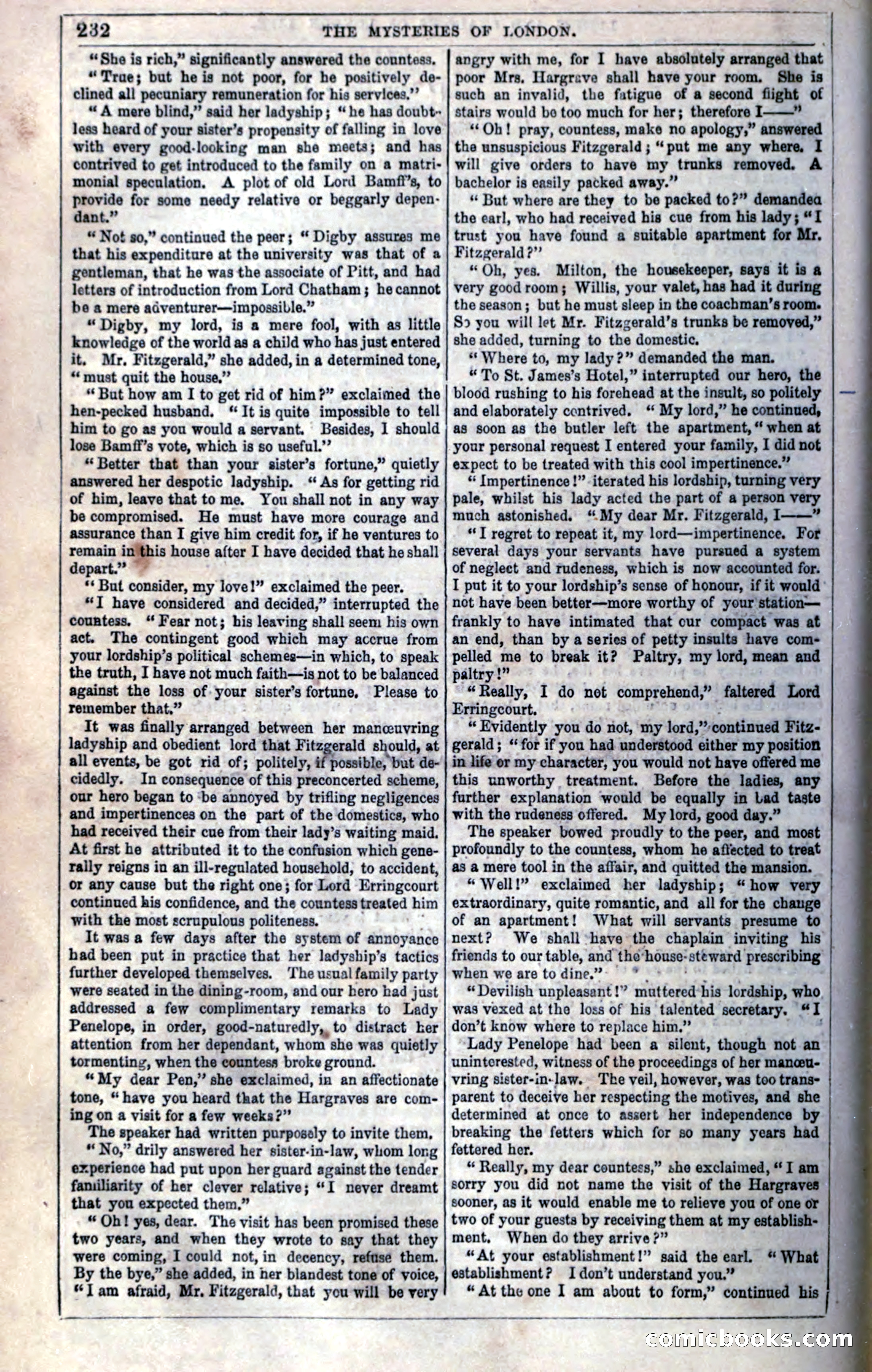
A restored page from Penny Dreadfuls, 1850. Page through the whole issue in the reader above.
📄 Transcribed text from this page (OCR, searchable)
Machine-transcribed from the original scan — historical spelling and the odd misread are preserved.
232 THE MYSTERIES ‘OF LONDON. “She is rich,” significantly answered the countess, “Trae; but he is not poor, for he positively de- clined all pecuniary remuneration for his services,”’ “A mere blind,” said her ladyship; “he has doubt- less heard of your sister’s propensity of falling in love with every good-looking man she meets; and has contrived to get introduced to the family on a matri- monial speculation. A plot of old Lord Bamft’s, to provide for some needy relative or beggarly depen- dant.” * Not so,” continued the peer; “ Digby assures me that his expenditure at the university was that of a gentleman, that he was the associate of Pitt, and had letters of introduction from Lord Chatham; he cannot be a mere adventurer—impossible.” “Digby, my lord, is a mere fool, with as little knowledge of the world as a child who has just entered it. Mr. Fitzgerald,” she added, in a determined tone, “must quit the house,” * But how am I to get rid of him?” exclaimed the hen-pecked husband. “ It is quite impossible to tell him to go as you would a servant. Besides, 1 should lose Bamff’s vote, which is so useful.”’ “ Better that than your sister’s fortune,” quietly answered her despotic ladyship. “ As for getting rid of him, leave that tome. You shall not in any way be compromised. He must have more courage and assurance than I give him credit for, if he ventures to remain inthis house after I have decided that he shall depart.” — ** But consider, my love!” exclaimed the peer. “T have considered and decided,” interrupted the countess. “ Fear not; his leaving shall seem his own act. The contingent good which may accrue from your lordship’s political schemes—in which, to speak the truth, I have not much faith—is not to be balanced against the loss of your sister’s fortune, Please to remember that,” It was finally arranged between her manceuvring ladyship and obedient lord that Fitzgerald s roulde at all events, be got rid of; colitely, a eteetbie cidedly. In consequence of this Seekncatey treo our hero began to ‘be annoyed by trifling negligences and impertinences on the part of the domestics, who had received their cue from their lady’s waiting maid. At first he attributed it to the confusion which gene- rally reigns in an ill-regulated household, to accident, or any cause but the right one; for Lord Erringcourt continued his confidence, and the countess treated him with the most scrupulous politeness. It was a few days after the system of annoyance had been put in practice that her ladyship’s tactics further developed themselves. ‘The usual family party were seated in the dining-room, and our hero had just addressed a few complimentary remarks to Lady Penelope, in order, good-naturedly, to distract her attention from her dependant, whom she was quietly tormenting, when the countess broke ground. “My dear Pen,” she exclaimed, in an affectionate tone, “have you heard that the Hargraves are com- ing on a visit for a few weeks?” The speaker had written purposely to invite them, “No,” drily answered her sister-in-law, whom long experience had put upon her guard against the tender familiarity of her clever relative; “I never dreamt that you expected them,” “ Oh! yes, dear. The visit has been promised these two years, and when they wrote to say that they were coming, I could not, in decency, reftise them. By the bye,” she added, in her blandest tone of voice, “Jam afraid, Mr. Fitzgerald, that you will be very - aa eee eee ee eee ee i ee ee ee angry with me, for I have absolutely arranged that poor Mrs, Hargreve shall have your room, She is such an invalid, the fatigue of a second flight of |. stairs would be too much for her; therefore I-——” ‘‘Oh! pray, countess, make no apology,” answered the unsuspicious Fitzgerald ; “put me any where, I will give orders to have my trunks removed. A bachelor is easily packed away.” “ But where are they to be packed to?” demandea the earl, who had received his cue from his lady; “I trust you have found a suitable apartment for Mr. Fitzgerald?” | “Oh, yes. Milton, the housekeeper, says it is a very good room; Willis, your valet, has had it during the season; but he must sleep in the coachman’s room. S> you will let Mr. Fitzgerald’s trunks be removed,” she added, turning to the domestic, “Where to, my lady ?” demanded the man. “To St. James’s Hotel,” interrupted our hero, the blood rushing to his forehead at the insult, so politely and elaborately centrived. “ My lord,” he continued, as soon as the butler left the apartment, “ when at your personal request I entered your family, I did not expect to be treated with this cool impertinence.” ‘“ Impertinence !” iterated his lordship, turning very pale, whilst his lady acted the part of a person very much astonished, “My dear Mr. Fitzgerald, I——” “T regret to repeat it, my lord—impertinence. For several days your servants have pursued a system of neglect and rudeness, which is now accounted for. I put it to your lordship’s sense of honour, if it would’ not have been better—more worthy of your station— | frankly to have intimated that our compact was at an end, than by a series of petty insults have com- pelled me to break it? Paltry, my lord, mean and paltry !” “Really, I do not comprehend,” faltered Lord Erringcourt, . o Evidently you do stot,’ my lord,” contains’ Fitz- gerald; “for if you had understood either my position de- | in life er my character, you would not have offered me this unworthy treatment. Before the ladies, any | further explanation would be equally in Lad taste | — with the rudeness offered. My lord, good day.” The speaker bowed proudly to the peer, and most profoundly to the countess, whom he affected to treat as a mere tool in the affair, and quitted the mansion. “Well!” exclaimed her ladyship; “ how very extraordinary, quite romantic, and all for the change of an apartment! What will servants presume to next? We shall have the chaplain inviting his friends to our table, and the ‘house steward prescribing when we are todine.” ” “Devilish unpleasant !” siiatteadel his lordship, who | was vexed at the loss of his talented secretary. “I Py don’t know where to replace him,” Lady Penelope had been a silent, though not an uninterested, witness of the proceedings of her manceu- vring sister-in-law. The veil, however, was too trans- {| parent to deceive her respecting the motives, and she | — determined at once to assert her independence by | breaking the fetters which for so many years had fettered her. * Really, my dear countess,” she exclaimed, “I am sorry you did not name the visit of the sooner, as it would enable me to relieve you of one or | two of your guests by receiving them at my establish- . ment, When do they arrive ?” : “At your establishment!” said the earl. “ What establishment? I don’t understand you.” * “At the one I am about to form,” continued his ee eee GOmichbooks