
Penny Dreadfuls, 1850 · page 233 of 394
The Mysteries of London; or, Lights and Shadows of London Life — page 233: what you’re looking at
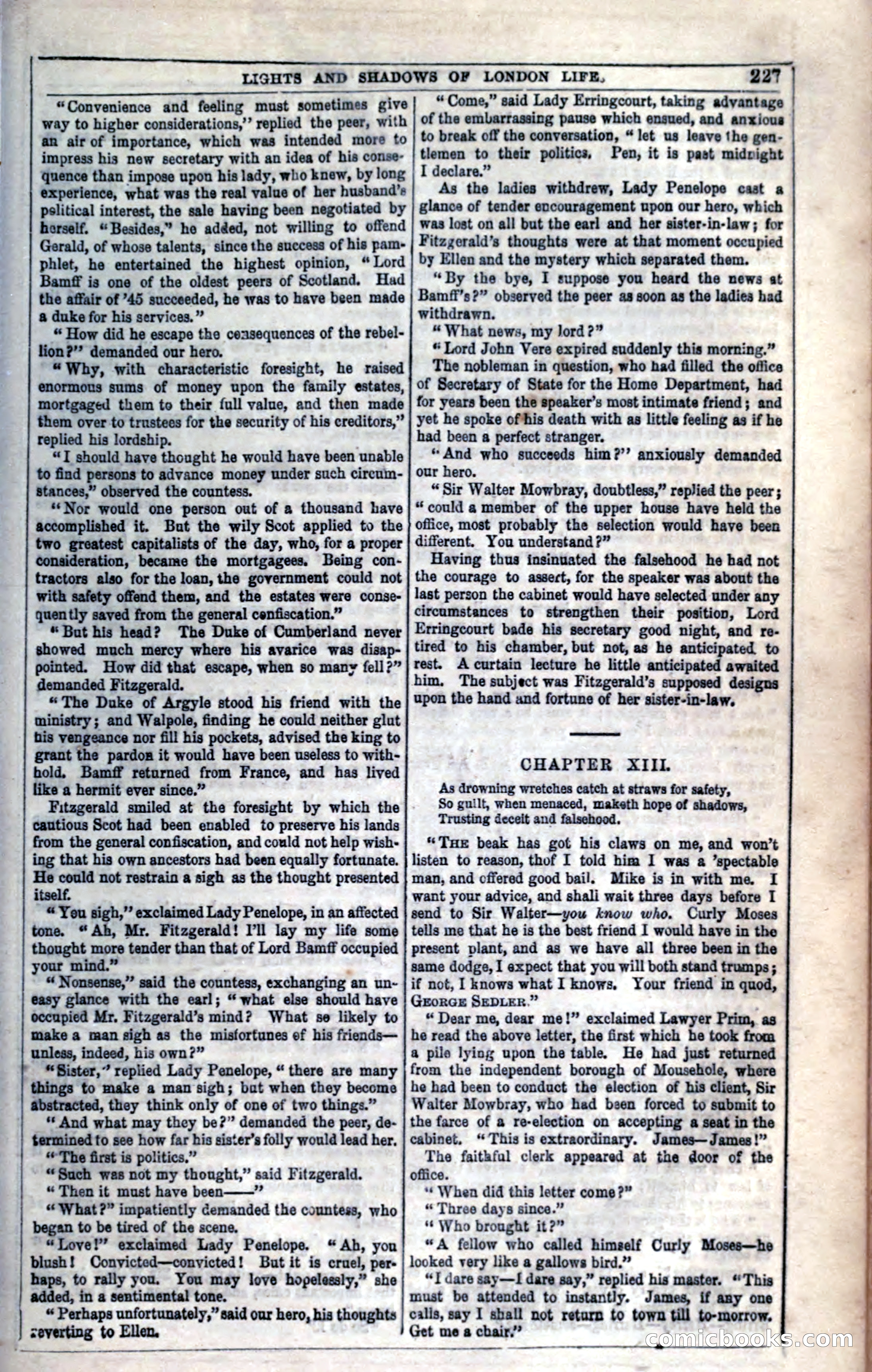
A restored page from Penny Dreadfuls, 1850. Page through the whole issue in the reader above.
📄 Transcribed text from this page (OCR, searchable)
Machine-transcribed from the original scan — historical spelling and the odd misread are preserved.
LIGHTS AND SHADOWS OF LONDON LIFE, “Convenience and must sometimes give way to higher considerations,’’ replied the peer, with an air of importance, which was intended more to impress his new secretary with an at pond quence than im upon his lady, who knew, by long experience, webat was the real value of her husband's political interest, the sale having been negotiated by horself, “Besides,” he adé@ed, not willing to offend Gerald, of whose talents, since the success of his pam- phlet, he entertained the highest opinion, “ Lord Bamff is one of the oldest peers of Scotland. Had the affair of 745 succeeded, he was to have been made a duke for his services.” “ How did he escape the ceasequences of the rebel- lion?”” demanded our hero. “Why, with characteristic foresight, he raised enormous sums of money upon the family estates, mortgaged them to their full value, and then made them over to trustees for the security of his creditors,” replied his lordship. “T should have thought he would have been unable be = a ae money under such circum- observed the countess. Nee would one person out of a thousand have accomplished it. But the wily Scot applied to the two greatest capitalists of the day, who, for a proper consideration, became the mortgagees. Being con- tractors also for the loan, the government could not with safety offend them, and the estates were conse- quently saved from the general confiscation.” “But his head? The Duke of Cumberland never showed much mercy where his avarice was disap- pointed. How did that escape, when so many fell?” demanded Fitsgerald. “The Duke of Argyle stood his friend with the boat and Walpole, finding he could neither glut phn gered cefaSaaed yeae advised the king to grant pardon it would have been useless to with- hold, Bamff returned from France, and has lived fav's ieee crer dame.” F: smiled at the foresight by which the cautious Scot had been enabled to preserve his lands from the general confiscation, and could not help wish- that his own ancestors had been equally fortunate. opps ie cman as the thought presented va a Yen ee ne in an affected Mr. Fitzgerald! I'll lay my life some thought more tender than that of Lord Bamff occupied our : : “ Nonsense,” said the countess, exchanging an un- easy glance with the earl; “what else should have occupied Mr. Fitzgerald’s mind? What se se likely to make a man sigh as the misfortunes ef his friends— | unless, indeed, his own?” “Sister,” replied Lady Penelope, “ there are many things to make a man sigh; bat when they become abstracted, they think only of one of two things.” | “And what may they be?” demanded the peer, de- termined to see how far his sister’s folly would lead her. “The first is politics.” “Such was not my thought,” said Fitzgerald. “ Then it must have been——~—” “What?” impatiently demanded the countess, who began to be tired of the scene. “Love!” exclaimed Lady Penelope. “Ah, you blush! Convyicted—convicted! But it is cruel, per- to rally you. You may love hopelessly,” she in a sentimental tone. eee —- 227 “Come,” said Lady Erringcourt, taking advantage of the embarrassing pause which ensued, and anxious to break off the conversation, “let us leave the gen- tlemen to their politics, Pen, it is past midnight I declare.” As the ladies withdrew, Lady Penelope cast a glance of tender encouragement upon our hero, which was lost on all but the earl and her sister-in-law; for Fitzgerald’s thoughts were at that moment occupied by Ellen and the mystery which separated them. “By the bye, I suppose you heard the news at Bamff’s?” observed the peer as soon as the ladies had withdrawn. “What news, my Jord?” “ Lord John Vere expired suddenly this morning.” The nobleman in question, who had filled the office of Secretary of State for the Home Department, had for years been the speaker’s most intimate friend; and yet he spoke ofthis death with as little feeling as if he had been a perfect stranger. “And who succeeds him?’’ anxiously demanded our hero. “Sir Walter Mowbray, doubtless,” replied the peer; “could a member of the upper house have held the office, most probably the selection would have been different. You understand?” Having thus insinuated the falsehood he had not the courage to assert, for the speaker was about the last person the cabinet would have selected under any circumstances to strengthen their position, Lord Erringeourt bade his secretary good night, and re- tired to his chamber, but not, as he antici to rest. A curtain lecture he little antici awaited him. The subject was Fitzgerald’s supposed upon the hand and fortune of her sister-in-law. CHAPTER XIIL As drowning wretches catch at straws for safety, So guilt, when menaced, maketh hope of shadows, Trusting deceit and falsehood. “THe beak has got his claws on me, and won’t listen to reason, thof I told him I was a ’spectable man, and offered good bail. Mike is in with me. I want your advice, and shali wait three days before I send to Sir Walter—you know who. Curly Moses tells me that he is the best friend I would have in the present plant, and as we have all three been in the same dodge, I expect that you will both stand trumps; if not, I knows what I knows. Your friend in quod, GEoRGE SEDLER.” “Dear me, dear me!” exclaimed Lawyer Prim, as he read the above letter, the first which he took from a pile lyingg upon the table. He had just returned from the independent borough of Mousehole, where he had been to conduct the election of his client, Sir Walter Mowbray, who had been forced to submit to the farce of a re-election on accepting a seat in the cabinet. “This is extraordinary. James—James!” The faitafal clerk appeared at the door of the office. “ When did this letter come?” “ Three days since.” ‘* Who brought it?” “A fellow who called himself Curly Moses—he looked very like a gallows bird.” “I dare say—lI dare say,” replied his master. “This must be attended to instantly. James, if any one calls, say I shall not return to town till to-morrow. Get me a chair,” (E(@) deste EE Ee OMTICHOO KS