
Penny Dreadfuls, 1850 · page 230 of 394
The Mysteries of London; or, Lights and Shadows of London Life — page 230: what you’re looking at
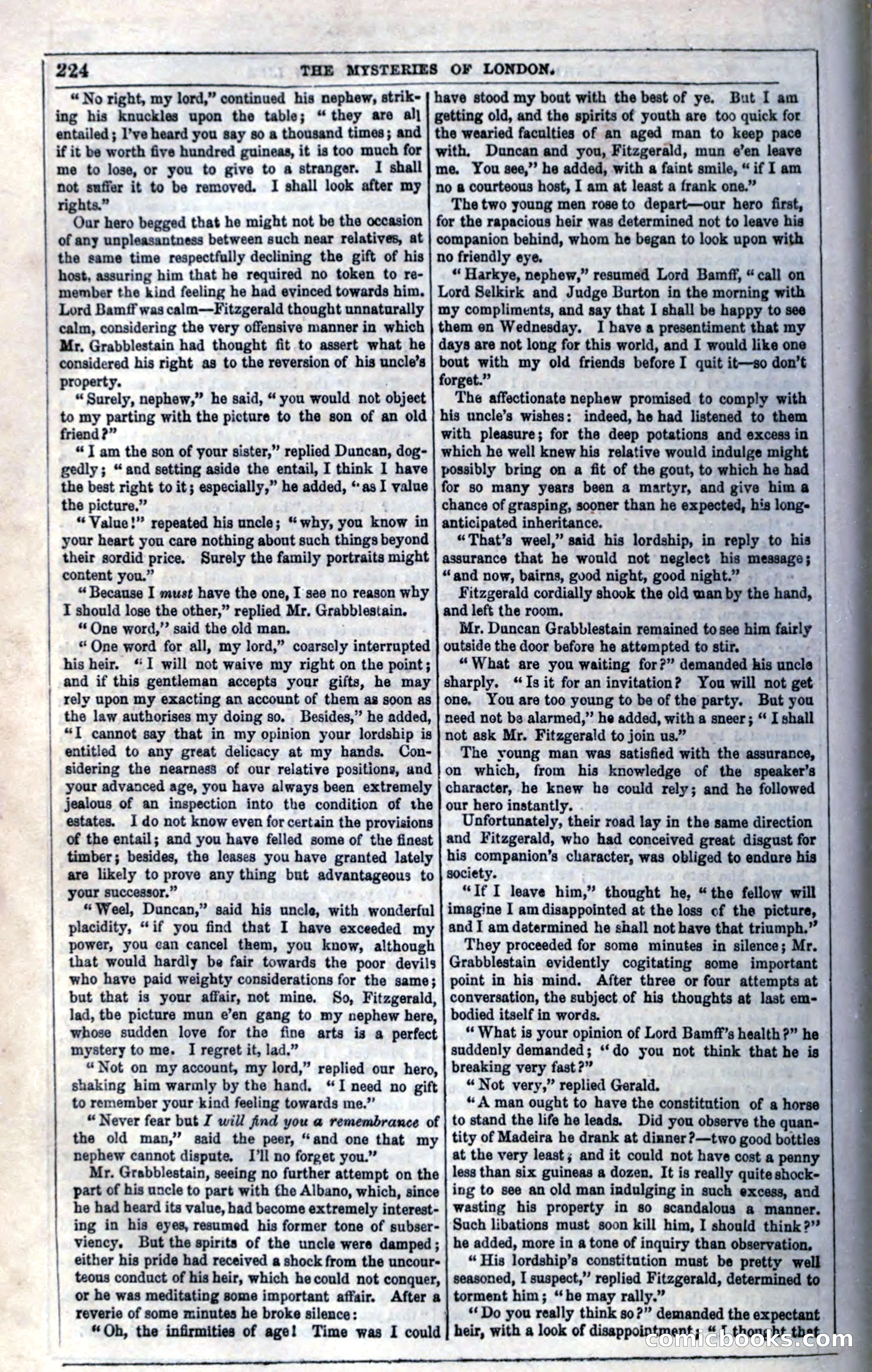
A restored page from Penny Dreadfuls, 1850. Page through the whole issue in the reader above.
📄 Transcribed text from this page (OCR, searchable)
Machine-transcribed from the original scan — historical spelling and the odd misread are preserved.
224 “ No right, my lord,” continued his nephew, strik- ing his knuckles upon the table; “they are all entailed; I’ve heard you say so a thousand times; and if it be worth five hundred guineas, it is too much for me to lose, or you to give to a stranger. I shall not suffer it to be removed. I shall look after my rights.” Our hero begged that he might not be the occasion of any unpleasantness between such near relatives, at the same time respectfully declining the gift of his host, assuring him that he required no token to re- member the kind feeling he had evinced towards him. Lord Bamff was calm—Fitzgerald thought unnaturally calm, considering the very offensive manner in which Mr. Grabblestain had thought fit to assert what he considered his right as to the reversion of his uncle’s property. : “ Surely, nephew,” he said, “ you would not object to my parting with the picture to the son of an old friend ?” “J am the son of your sister,” replied Duncan, dog- gedly; “and setting aside the entail, I think I have the best right to it; especially,” he added, “as I value the picture.” “Value!” repeated his uncle; “why, you know in your heart you care nothing about such things beyond their sordid price. Surely the family portraits might content you.” “ Because I must have the one, I see no reason why I should lose the other,” replied Mr. Grabblestain. ‘One word,” said the old man. “ One word for all, my lord,” coarsely interrupted his heir. “I will not waive my right on the point; and if this gentleman accepts your gifts, he may rely upon my exacting an account of them as soon as the law authorises my doing so. Besides,” he added, “IT cannot say that in my opinion your lordship is entitled to any great delicacy at my hands. Con- sidering the nearness of our relative positions, and your advanced age, you have always been extremely jealous of an inspection into the condition of the estates. Ido not know even for certain the provisions of the entail; and you have felled some of the finest timber; besides, the leases you have granted lately are likely to prove any thing but advantageous to your successor.” *“ Weel, Duncan,” said his uncle, with wonderful placidity, “if you find that I have exceeded my power, you can cancel them, you know, although that would hardly be fair towards the poor devils who have paid weighty considerations for the same; but that is your affair, not mine. So, Fitzgerald, lad, the picture mun e’en gang to my nephew here, whose sudden love for the fine arts is a perfect mystery to me. I regret it, lad.” “Not on my account, my lord,” replied our hero, shaking him warmly by the hand, “I need no gift to remember your kind feeling towards me.”’ “ Never fear but J will find you a remembrance of the old man,” said the peer, “and one that my nephew cannot dispute, I'll no forget you.” Mr. Grabblestain, seeing no further attempt on the part of his uncle to part with fhe Albano, which, since he had heard its value, had become extremely interest- ing in his eyes, resumed his former tone of subser- viency, But the spirits of the uncle were damped ; either his pride had received a shock from the uncour- | teous conduct of his heir, which he could not conquer, _ or he was meditating some important affair. After a | reverie of some minutes he broke silence: “Oh, the infirmities of age! Time was I could ee ceca te EL CCC LLL LL LL! THE MYSTERIES OF LONDON, have stood my bout with the best of ye. But I am getting old, and the spirits of youth are too quick for the wearied faculties of an aged man to keep pace with. Duncan and you, Fitzgerald, mun e’en leave me. You see,’”’ he added, with a faint smile, “if I am no a courteous host, I am at least a frank one.” The two young men rose to depart—our hero first, for the rapacious heir was determined not to leave his companion behind, whom he began to look upon with no friendly eye. “ Harkye, nephew,” resumed Lord Bamff, “call on Lord Selkirk and Judge Burton in the morning with my compliments, and say that I shall be happy to see them en Wednesday. I have a presentiment that my days are not long for this world, and I would like one bout with my old friends before I quit it—so don’t forget.” The affectionate nephew promised to comply with his uncle’s wishes: indeed, he had listened to them with pleasure; for the deep potations and excess in which he well knew his relative would indulge might possibly bring on a fit of the gout, to which he had for so many years been a martyr, and give hima chance of grasping, sooner than he expected, his long- anticipated inheritance. “That’s weel,” said his lordship, in reply to his assurance that he would not neglect his message; “and now, bairns, good night, good night.” - “ Fitzgerald cordially shook the old man by the hand, and left the room, Mr. Duncan Grabblestain remained tosee him fairly outside the door before he attempted to stir. “What are you waiting for?” demanded his gible . sharply. “Is it for an invitation? You will not get one, You are too young to be of the party. But you need not be alarmed,’ he added, with a sneer; “ I shall not ask Mr. Fitzgerald to join us.” . The voung man was satisfied with ‘the assurance, on which, from his knowledge of the speaker’s character, he knew he could rely; and he followed our hero instantly. Unfortunately, their road lay in the same direction and Fitegerald, who had conceived great disgust for his companion’s character, was obliged to endare his society. “If I leave him,” thought he, “the fellow will imagine I am disappointed at the loss of the picture, and I am determined he shall not have that triumph.” They proceeded for some minutes in silence; Mr. Grabblestain evidently cogitating some important point in his mind. After three or four attempts at conversation, the subject of his thoughts at last em- bodied itself in words. ** What is your opinion of Lord Bamff’s health ?” he suddenly demanded; “‘do you not think that he is breaking very fast?” “ Not very,” replied Gerald. “ A man ought to have the constitution of a horse to stand the life he leads. Did you observe the quan- tity of Madeira he drank at dinner ?—two good bottles at the very least ; and it could not have cost a less than six guineas a dozen, It is really quite shock- ing to see an old man indulging in such excess, and wasting his property in so scandalous a manner. Such libations must soon kill him, I should think?” he added, more in a tone of inquiry than observation, “ His lordship’s constitution must be pretty well — seasoned, I suspect,” replied Fitzgerald, determined to torment him; ; “he may rally.” ** Do you really think so?” cpneene yes ss ys hes, with look of diosppoletrsents 8 EAP) Metod a hada 5, PED iin ns SIO COMMER OOKS COT