
Penny Dreadfuls, 1850 · page 227 of 394
The Mysteries of London; or, Lights and Shadows of London Life — page 227: what you’re looking at
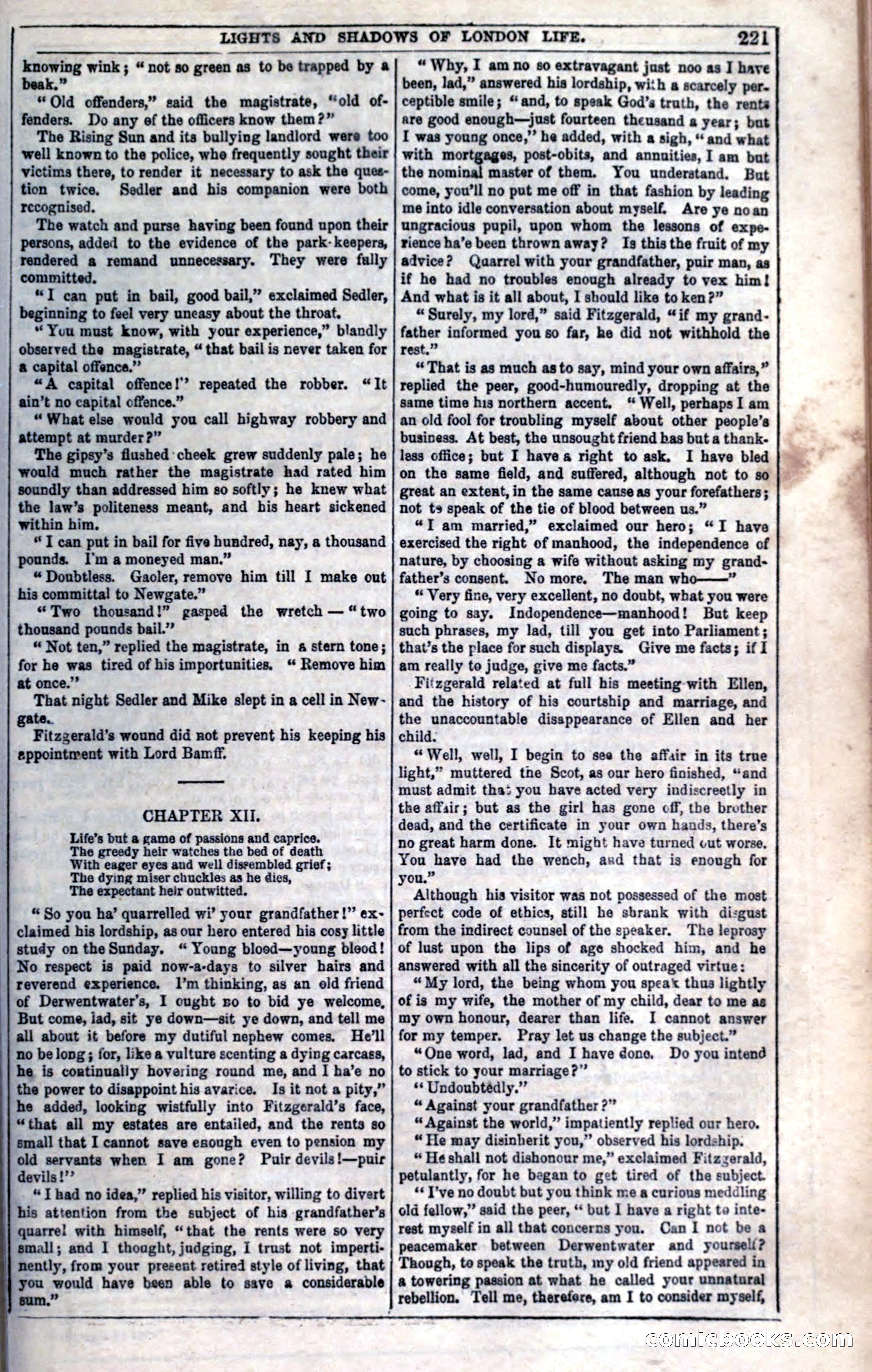
A restored page from Penny Dreadfuls, 1850. Page through the whole issue in the reader above.
📄 Transcribed text from this page (OCR, searchable)
Machine-transcribed from the original scan — historical spelling and the odd misread are preserved.
LIGHTS AND SHADOWS OF LONDON LIFE. knowing wink ; “ not so green as to be trapped by a beak.” “Old offenders,” said the magistrate, “old of- fenders. Do any of the officers know them?” The Rising Sun and its bullying landlord were too well known to the police, whe frequently sought their recognised. The watch and purse having been found upon their persons, added to the evidence of the park- keepers, rendered a remand unnecessary. They were fully “TI can put in bail, good bail,” exclaimed Sedler, to feel very uneasy about the throat. “Youu must know, with your experience,” blandly observed the magistrate, “that bail is never taken for & capital offence.” “A capital offence!’ repeated the robber. “It ain’t no capital offence.” “What else would you call highway robbery and attempt at murder?” The gipsy’s flushed cheek grew suddenly pale; he would much rather the magistrate had rated him soundly than addressed him so softly; he knew what the law’s politeness meant, and his heart sickened within him. *“T can put in bail for five hundred, nay, a thousand pounds. I'm a moneyed man.” “Doubtless. Gaoler, remove him till I make out his committal! to Newgate.” “Two thousand!” gasped the wretch — “two thousand bail.” “ Not ten,” replied the magistrate, in a stern tone; for he was tired of his importunities. “ Remove him at once.” That night Sedler and Mike slept in a cell in New- | Fitzgerald’s wound did not prevent his keeping his appointment with Lord Bamff. ease ; Life’s but a game of passions and caprice. * So you ha’ quarrelled wi’ your grandfather!” ex~- f claimed his lordship, as our hero entered his cosy little | study onthe Sunday. “ Young blood—young bleod! No respect is paid now-a-days to silver hairs and reverend experience. I’m thinking, as an old friend of Derwentwater’s, I ought no to bid ye welcome, But come, iad, sit ye down—sit ye down, and tell me all about it before my dutiful nephew comes. He'll no belong; for, like a vulture scenting a dying carcass, he is continually hovering round me, and I ha’e no the power to disappoint his avarice. Is it not a pity,’ ‘he added, looking wistfully into Fitzgerald’s face, “that all my estates are entailed, and the rents so ‘small that I cannot save esough even to pension my old servants wher I am gone? Puir devils!—puir ‘devils!’ “J had no idea,” replied his visitor, willing to divert his attention from the subject of his grandfather’s 21 with himself, “that the rents were so very , ; and I thought, judging, I trust not imperti- ‘nently, from your present retired style of living, that you would have been able to save a considerable eS SE 221 “Why, I am no so extravagant just noo as I have been, lad,” answered his lordship, with a scarcely per- sepals smile; “and, to speak God’s truth, the rents are good enough—just fourteen theusand a year; but I was young once,”’ he added, with a sigh, “and what with ages, post-obits, and annuities, I am but the nom master of them. You understand, But come, owt no put me off in that fashion by leading me into idle conversation about myself. Are ye noan ungracious pupil, upon whom the lessons of expe- rience ha’e been thrown away? Is this the fruit of my advice? Qaarrel with your grandfather, puir man, as if he had no troubles enough already to vex him! And what is it all about, I should like to ken?” “ Surely, my lord,” said Fitzgerald, “if my grand- father informed you so far, he did not withhold the rest,” “That is as much as to say, mind your own affairs,” replied the peer, good-humouredly, dropping at the same time his northern accent, “ Well, perhaps I am an old fool for troubling myself about other people’s business. At best, the unsought friend bas but a thank- less office; but I havea right to ask. I have bled on the same field, and suffered, although not to so great an extent, in the same cause as your forefathers; not ts speak of the tie of blood between us.” “T am married,” exclaimed our hero; “I have exercised the right of manhood, the independence of nature, by choosing a wife without asking my grand- father’s consent. No more, The man who——” “ Very fine, very excellent, no doubt, what you were going to say. Indopendence—manhood! But keep such phrases, my lad, till you get into Parliament; that’s the place for such displays. Give me facts; if I am really to judge, give me facts.” Fitzgerald related at full his meeting-with Ellen, and the history of his courtship and marriage, and the unaccountable disappearance of Ellen and her child. “Well, well, I begin to see the affair in its trne light,” muttered the Scot, as our hero finished, “and must admit tha: you have acted very indiscreetly in the affair; but as the girl has gone off, the brother dead, and the certificate in your own hands, there’s no great harm done. It might have turned vut worse, You have had the wench, asd that is enough for you,” Although his visitor was not possessed of the most perfect code of ethics, still he sbrank with disgust from the indirect counsel of the speaker. The leprosy of lust upon the lips of age shocked him, and he answered with all the sincerity of outraged virtue: “My lord, the being whom you speak thus lightly of is my wife, the mother of my child, dear to me as my own honour, dearer than life. I cannot answer for my temper. Pray let us change the subject.” “One word, lad, and I have done, Do you intend to stick to your marriage?” ‘* Undoubtédly.” “ Against your grandfather ?” “ Against the world,” impatiently replied our hero. “He may disinherit you,” observed his lordship. “ He shall not dishonour me,” exclaimed Fitzzerald, petulantly, for he began to get tired of the subject. ‘« T’ve no doubt but you think me a curions meddling old fellow,” said the peer, ** but 1 have a right te inte- rest myself in all that concerns you. Can I not be a peacemaker between Derwentwater and yoursel{? Though, to speak the truth, my old friend appeared in a towering passion at what he called your unnatural rebellion. Tell me, therefore, am I to consider myself, ECORNICLOO — SS (E©) mM