
Penny Dreadfuls, 1850 · page 219 of 394
The Mysteries of London; or, Lights and Shadows of London Life — page 219: what you’re looking at
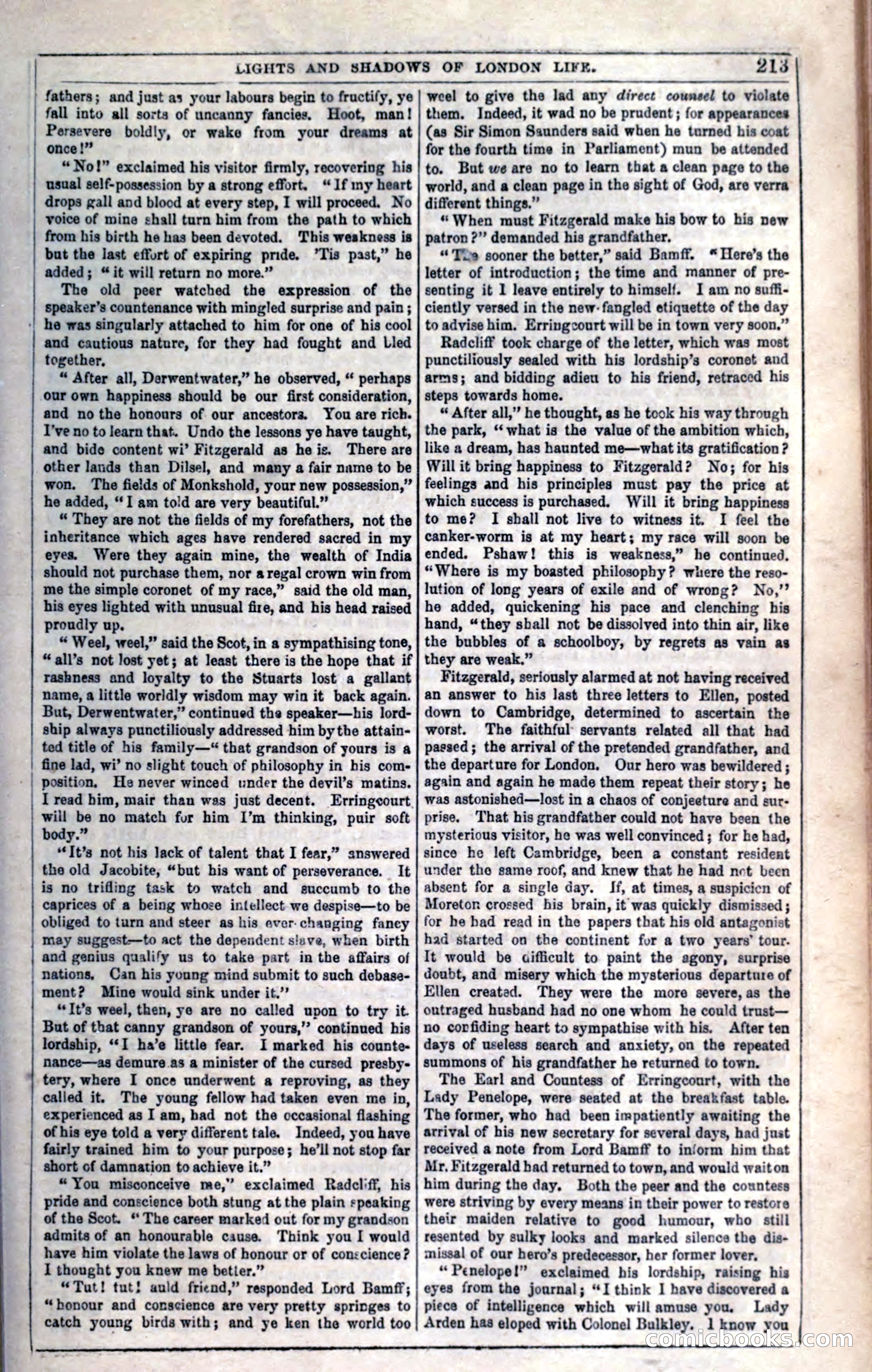
A restored page from Penny Dreadfuls, 1850. Page through the whole issue in the reader above.
📄 Transcribed text from this page (OCR, searchable)
Machine-transcribed from the original scan — historical spelling and the odd misread are preserved.
LIGHTS AND SHADOWS OF LONDON LIFE. 2138 fathers; and just as your labours begin to fructify, ye fall into all sorts of uncanny fancies, Hoot, man! Persevere boldly, or wake from your dreams at once!” “No!” exclaimed his visitor firmly, recovering his usual self-possession by a strong effort. “If my heart drops gall and blood at every step, I will proceed. No voice of mine shall turn him from the path to which from his birth he has been devoted. This weakness is but the last effort of expiring pride. ’Tis past,” he added; “ it will return no more.” The old peer watched the expression of the speaker’s countenance with mingled surprise and pain ; ' he was singularly attached to him for one of his cool and cautious nature, for they had fought and Lied together, “ After all, Derwentwater,” he observed, “ perhaps our own happiness should be our first consideration, and no the honours of our ancestors. You are rich. I’ve no to learn that. Undo the lessons ye have taught, and bide content wi’ Fitzgerald as he is. There are other lands than Dilsel, and many a fair name to be won. The fields of Monkshold, your new possession,” he added, “I am told are very beautiful.” “ They are not the fields of my forefathers, not the inheritance which ages have rendered sacred in my eyes. Were they again mine, the wealth of India should not purchase them, nor aregal crown win from me the simple coronet of my race,” said the old man, his eyes lighted with unusual fire, and his head raised proudly up. “ Weel, weel,” said the Scot, in a sympathising tone, “all’s not lost yet; at least there is the hope that if raskness and loyalty to the Stuarts lost a gallant name, a little worldly wisdom may win it back again. But, Derwentwater,” continued the speaker—his lord- ship always punctiliously addressed him by the attain- ted title of his family—“ that grandson of yours is a fine lad, wi’ no slight touch of philosophy in his com- position, He never winced under the devil’s matins. I read him, mair than was just decent. Erringcourt. will be no match for him I’m thinking, puir soft body.” **It’s not his lack of talent that I fear,” answered the old Jacobite, “but his want of perseverance. It is no trifling task to watch and succumb to the caprices of a being whose intellect we despise—to be obliged to turn and steer as his ever-changing faney May suggest—to act the dependent s!ave, when birth and genius qualify us to take part in the affairs of nations, Can his young mind submit to such debase- ment? Mine would sink under it.’’ “It’s weel, then, ye are no called upon to try it. But of that canny grandson of yours,” continued his lordship, “I ha’e little fear. I marked his counte- nance—as demure as a minister of the cursed presby- tery, where I once underwent a reproving, as they called it. The young fellow had taken even me in, experienced as I am, had not the occasional flashing of his eye told a very different tale. Indeed, you have fairly trained him to your purpose; he’ll not stop far short of damnation to achieve it.” “You misconceive me,” exclaimed Radcliff, his pride and conscience both stung at the plain speaking of the Scot. “ The career marked out for my grandson admits of an honourable cause. Think you I would have him violate the laws of honour or of conscience? I thought you knew me better.” “Tut! tut! auld friend,” responded Lord Bamff; “honour and conscience are very pretty springes to catch young birds with; and ye ken the world too weel to give the lad any direct counsel to violate them. Indeed, it wad no be prudent; for appearances (as Sir Simon Saunders said when he turned his coat for the fourth time in Parliament) mun be attended to. But we are no to learn that a clean page to the world, and a clean page in the sight of God, are verra different things,” “When must Fitzgerald make his bow to his new patron ?”’ demanded his grandfather, “Tie sooner the better,” said Bamff. “Here’s the letter of introduction; the time and manner of pre- senting it I leave entirely to himself. I am no suffi- ciently versed in the new: fangled etiquette of the day to advise him. Erringcourt will be in town very soon.” Radcliff took charge of the letter, which was most punctiliously sealed with his lordship’s coronet and arms; and bidding adieu to his friend, retraced his steps towards home. “ After all,” he thought, as he took his way through the park, “what is the value of the ambition which, like a dream, has haunted me—what its gratification ? Will it bring happiness to Fitzgerald? No; for his feelings and his principles must pay the price at which success is purchased. Will it bring happiness to me? I sball not live to witness it. I feel the canker-worm is at my heart; my race will soon be ended. Pshaw! this is weakness,” he continued, “Where is my boasted philosophy? where the reso- lution of long years of exile and of wrong? WNo,’’ he added, quickening his pace and clenching his hand, “they sball not be dissolved into thin air, like the bubbles of a schoolboy, by regrets as vain as they are weak,” Fitzgerald, seriously alarmed at not having received an answer to his last three letters to Ellen, posted down to Cambridge, determined to ascertain the worst. The faithful servants related all that had passed; the arrival of the pretended grandfather, and the departure for London, Our hero was bewildered; again and again he made them repeat their story; he was astonished—lost in a chaos of conjeeture and sur- prise. That his grandfather could not have been the mysterious visitor, he was well convinced; for he had, since he left Cambridge, been a constant resident under the same roof, and knew that he had net been absent for a single day. If, at times, a suspicicn of Moreton crossed his brain, it was quickly dismissed; for he bad read in the papers that his old antagonist had started on the continent for a two years” tour. It would be aifficult to paint the agony, surprise doubt, and misery which the mysterious departure of Ellen created. They were the more severe, as the outraged husband had no one whom he could trust— no corfiding heart to sympathise with his. After ten days of useless search and anxiety, on the repeated summons of his grandfather he returned to town. The Earl and Countess of Erringcourt, with the Lady Penelope, were seated at the breakfast table. The former, who had been impatiently awaiting the arrival of his new secretary for several days, had just received a note from Lord Bamff to inform him that Mr. Fitzgerald had returned to town, and would waiton him during the day. Both the peer and the countess were striving by every means in their power to restore their maiden relative to good humour, who still resented by sulky looks and marked silence the dis- missal of our hero’s predecessor, her former lover, “Penelope!” exclaimed his lordship, raising his eyes from the journal; “I think I have discovered a piece of intelligence which will amuse you. Lady Arden has eloped with Colonel Bulkley. _ 1 Olm (CO)