
Penny Dreadfuls, 1850 · page 212 of 394
The Mysteries of London; or, Lights and Shadows of London Life — page 212: what you’re looking at
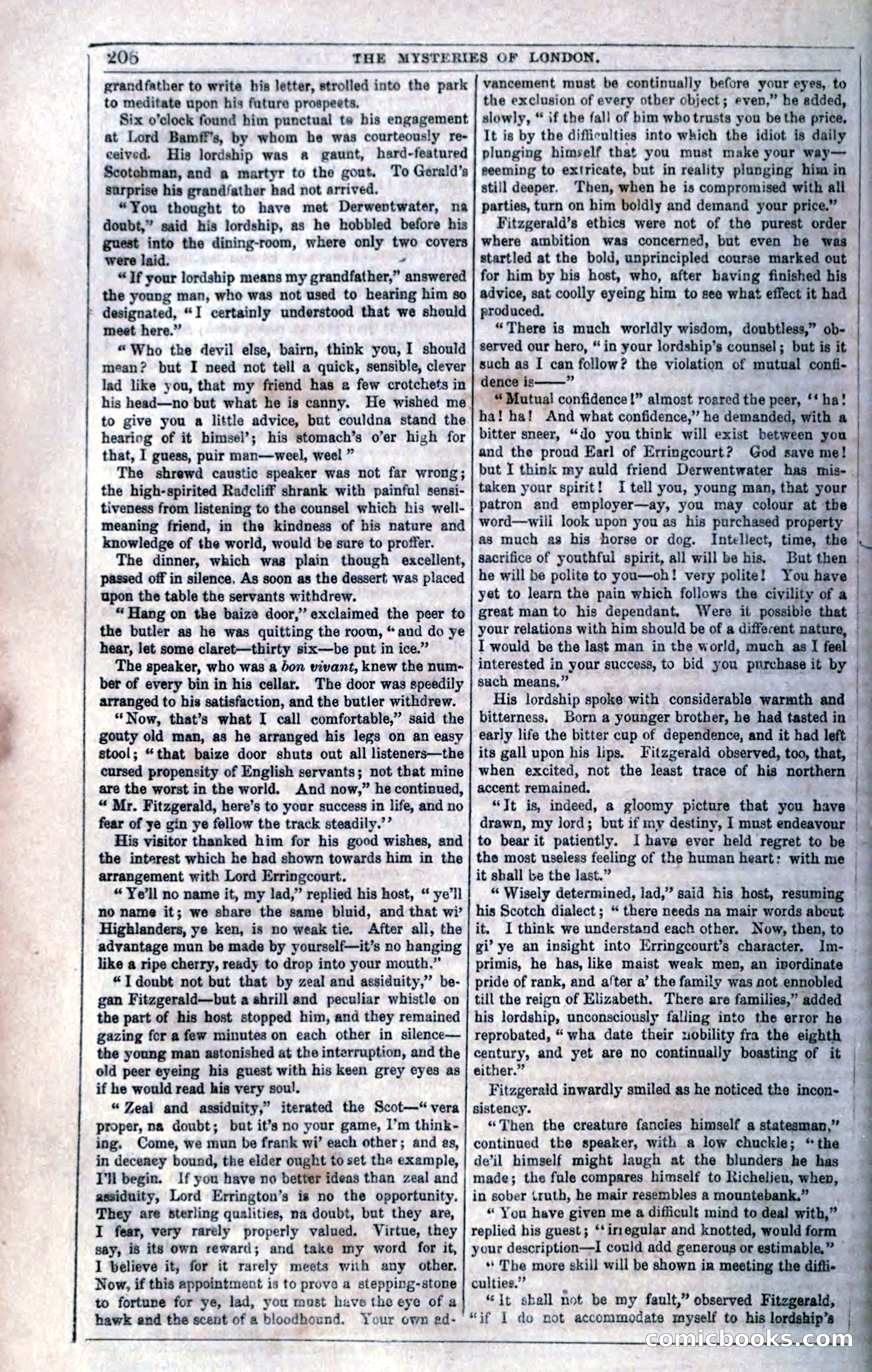
A restored page from Penny Dreadfuls, 1850. Page through the whole issue in the reader above.
📄 Transcribed text from this page (OCR, searchable)
Machine-transcribed from the original scan — historical spelling and the odd misread are preserved.
205 THE MYSTERIES OF LONDON, ae eee eee eer eee grandfather to write his letter, strolled into the park to meditate upon his future prospeets. Six o’clock found him punctual te bis engagement at Lord Bamff’s, by whom he was courteously re- ceived. His lordship was a gaunt, hard-featured Scotehman, and a martyr to the gout. To Gerald’s surprise his grandfather had not arrived. “You thought to have met Derwentwater, na doubt,” said his lordship, as he hobbled before his guest into the dining-room, where only ~~ covers were laid. “If your lordship means my grandfather,” aasheiaet the young man, who was not used to hearing him so ~ designated, “I certainly understood that we should meet here.” “Who the devil else, bairn, think you, I should mean? but I need not tell a quick, sensible, clever lad like you, that my friend has a few crotchets in his head—no but what he is canny. He wished me to give you a little advice, but couldna stand the heariog of it himsel’; his stomach’s o’er high for that, I guess, puir man—weel, weel ” The shrewd caustic speaker was not far wrong; the high-spirited Radcliff shrank with painful sensi- tiveness from listening to the counsel which his well- meaning friend, in the kindness of his nature and knowledge of the world, would be sure to proffer. The dinner, which was plain though excellent, passed off in silence, As soon as the dessert was placed upon the table the servants withdrew. “ Hang on the baize door,” exclaimed the peer to the butler as he was quitting the room, “and do ye hear, let some claret—thirty six—be put in ice.” The speaker, who was a don vivant, knew the num- ber of every bin in his cellar. The door was speedily arranged to his satisfaction, and the butler withdrew. ‘Now, that’s what I call comfortable,” said the gouty old man, as he arranged his legs on an easy stool; “that baize door shuts out all listeners—the cursed propensity of English servants; not that mine are the worst in the world. And now,” he continued, “ Mr. Fitzgerald, here’s to your success in life, and no fear of ye gin ye fellow the track steadily.’’ His visitor thanked him for his good wishes, and the interest which he had shown towards him in the arrangement with Lord Erringcourt. “ Ye’ll no name it, my lad,” replied his host, “ ye’ll no name it; we share the same bluid, and that wi’ Highlanders, ye ken, is no weak tie. After all, the advantage mun be made by yourself—it’s no hanging like a ripe cherry, ready to drop into your mouth.” “T doubt not but that by zeal and assiduity,” be- gan Fitzgerald—but a shrill and peculiar whistle on the part of his host stopped him, and they remained gazing for a few minutes on each other in silence— the young man astonished at the interruption, and the old peer eyeing his guest with his keen grey eyes as if he would read his very soul. “ Zeal and assiduity,” iterated the Scot—*“ vera proper, na doubt; but it’s no your game, I’m think- ing. Come, we mun be frank wi’ each other; and as, in deceney bound, the elder ought to set the example, I'll begin. If you have no better ideas than zeal and assiduity, Lord Errington’s is no the opportunity. They are sterling qualities, na doubt, but they are, I fear, very rarely properly valued. Virtue, they say, is its own reward; and take my word for it, 1 believe it, for it rarely meets with any other, Now, if this appointment is to prove a stepping-stone to fortune for ye, lad, you must have the eye of a hawk and the scent of a bloodhound. Your own ed- itegerald, “if I do not accommodate myself to ot ren vancement must be continually before your eyes, to the exclusion of every other object; even,” he added, slowly, “ if the fall of him who trusts you be the price, It is by the difficulties into which the idiot is daily plunging himself that you must make your way— . seeming to extricate, but in reality plunging him in still deeper. ‘Then, when he is compromised with all parties, turn on him boldly and demand your price.” | Fitzgerald’s ethics were not of the purest order | where ambition was concerned, but even he was | startled at the bold, unprincipled course marked out | ~ for him by his host, who, after having finished his | advice, sat coolly eyeing him to see what effect it had | produced. | “There is much worldly wisdom, doubtless,” ob- served our hero, “in your lordship’s counsel; but is it such as I can follow? the violation of mutual confi- dence is——” 1 “ Mutual confidence!” almost roared the peer, ‘* H . ha! ha! And what confidence,” he demanded, . bitter sneer, “do you think will exist between oes and the proud Earl of Erringcourt? God save me! but I think my auld friend Derwentwater has mis- taken your spirit! I tell you, young man, that your patron and employer—ay, you may colour at the word—wili look upon you as his purchased property as much as his horse or dog. Intellect, time, the sacrifice of youthful spirit, all will be his. But then he will be polite to you—oh! very polite! You have yet to learn the pain which follows the civility of a great man to his dependant. Were it possible that your relations with him should be of a different I would be the last man in the world, much as I { interested in your success, to bid you purchase it by such means,” His lordship spoke with considerable warmth and bitterness, Born a younger brother, he had tasted in early life the bitter cup of dependence, and it had left | its gall upon his lips. Fitzgerald observed, too, that, | when excited, not the least trace of his northern accent remained. “Jt is, indeed, a gloomy picture that you have drawn, my lord; but if my destiny, I must endeavour | to bear it patiently. 1 have ever held regret to be — the most useless feeling of the human heart; with me | it shall be the last.” “ Wisely determined, lad,” said his host, | his Scotch dialect; “ there needs na mair words about it. I think we understand each other. Now, then, to — gi’ ye an insight into Erringcourt’s character, Im- _ primis, he has, like maist weak men, an pride of rank, and after a’ the family was aot ennobled till the reign of Elizabeth. There are families,” oo his lordship, unconsciously falling into the | error reprobated, “ wha date their uobility fra the i century, and yet are no continually boasting ¢ ma either.” Fitzgerald inwardly smiled as he noticed the incon sistency. | “Then the creature fancies himself a sta “< continued the speaker, with a low chuckle; * de’il himself might laugh at the blunders he has made; the fule compares himself to Richelien, when, in sober truth, he mair resembles a mountebank.” __ “ You have given me a difficult mind wo om replied his guest; ‘*inegular and knotted, w | your description—I could add generous or esti ‘The more skill will be shown ia meeting the d culties.” “Jt shall not be my fault,” observed F