
Penny Dreadfuls, 1850 · page 205 of 394
The Mysteries of London; or, Lights and Shadows of London Life — page 205: what you’re looking at
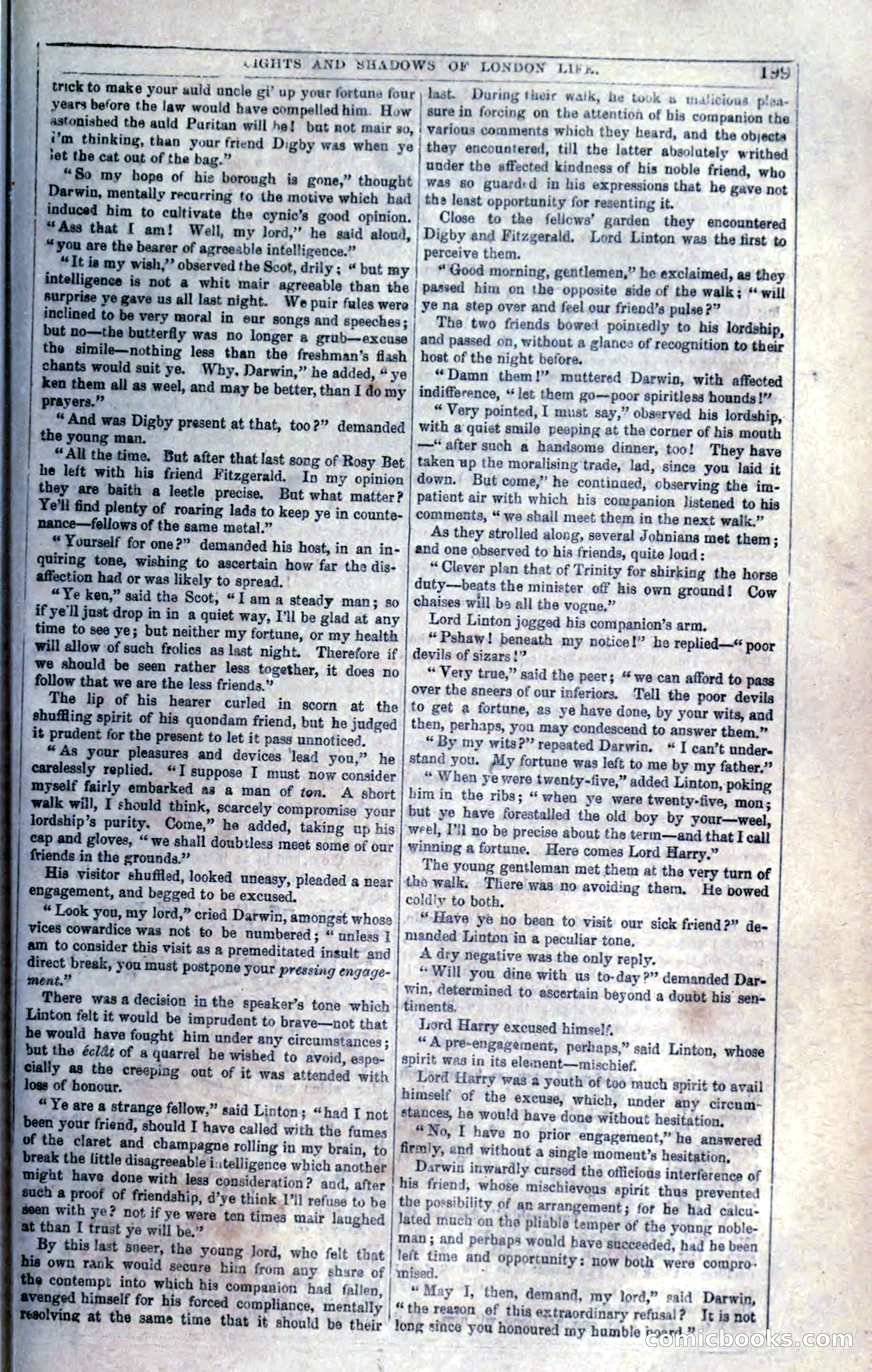
A restored page from Penny Dreadfuls, 1850. Page through the whole issue in the reader above.
📄 Transcribed text from this page (OCR, searchable)
Machine-transcribed from the original scan — historical spelling and the odd misread are preserved.
Se eee et arattinemeeemmensenasinentiie mesons 2 Fe \ i a 4 | Jet the cat out of the bag.” y Soda | years before the law would have compelled him. How | sure in forcing on the attention of bis companion the | '| astonished the auld Paritan will he! bat not mair $0, | various comments which they heard, and the objects | i’m thinking, than your friend Digby was when ye | they encountered, till the latter absolutely writhed ; “IGHTS AND SHADOWS OF LONDON Lin. ly | — ee i a trick to make your auld uncle gi’ up your fortune four; last. During their Walk, he tovuk w mutlicigua piea- | under the affected kindness of his noble friend, who my hope of his borough is gone,” thought | was so guarded in his expressions that he gave not 1, mentally recurring to the motive which had the least opportunity for resenting it. _tnduced him to cultivate the cynic’s good opinion. | Close to the fellows’ garden they encountered s, 109 that { am! Well, my lord,” he said aloud, are the bearer of agreeable intelligence.” | “Itiss wish,” observed the Scot, drily ; “ but my : intellig. eigen a whit mair agreeable than the | passed him on the opposite side of the walk; * will Digby and Fitzgerald. Lord Linton was the first to perceive them. “Good morning, gentlemen,” he exclaimed, as they “surprise ye gave us all last night. We puir fules were | ye na step over and feel our friend’s pulse 2” ‘butterfly was no longer a grub—excuse the simile—nothing less than the freshman’s flash chants would suit ye. Why, Darwin,” he added aye ther all as weel, and may be better, than I do my ; « And was Digby present at that, too?” demanded Ui But after that last song of Rosy Bet left with his friend Fitzgerald, Ip my opinion fs ee ¥ , eo “ * nance—fellows of the same metal.” tone, wishing to ascertain how far the dis- had or was likely to spread. ; ‘it pradent for the present to let it pass unnoticed. _ “As your pleasures and devices ‘lead you,” he carelessly replied. “I suppose I must now consider myself fairly emb ed as a man of ton. A short walk will, id should think, scarcely compromise your lordship’s purity. Come,” he added, taking up his cap and gloves, “we shall doubtless meot some of our iriends in the grounds.” His visitor shuffled, looked uneasy, pleaded a near engagement, and begged to be excused. __“ Look you, my lord,” cried Darwin, amongst whose Vices cx e was not to be numbered ; “ unless } am to consider this visit as a premeditated insult and direc breaks, you must postpone your pressing engage- _ There was a decision in the speaker’s tone which Aanton felt it would be imprudent to brave—not that le would have fought him under any circumstances ; ut the éclét of a quarrel he wished to avoid, espe- cially as the creeping out of it was attended with “Ye area strange fellow,” said Linton; “had I not een your friend, should I have called with the fumes f the claret and champagne rolling in my brain, to reak the little disagreeable i.telligence which another ugot have done with | es3 consideration? and, after uch a proo! ¥ ship, d’ye think.1’!l refuse to be mn with Not if ye 1 ten times mair laughed than I ye will bay 3 By this last sneer, the young Jord, whe felt that own rank would secure hiin from any shure of contempt into which his companion had fallen, enged for his forced compliance, mentally ot *, + ; they are bait a leetle precise. But what matter? ; i plenty of roaring lads to keep ye in counte- | “Yourself for one?” demanded his host, in an in- ken,” said the Scot; “I am a steady man; so ‘if ye'll just drop in in a quiet way, I'll be glad at any _ time to see ye; but neither my fortune, or my health will allow of such frolies as last night. Therefore if we should be seen rather less together, it does no The lip of his hearer curled in scorn at the Spirit of his quondam friend, but he judged The two friends bowed pointedly to his lordship, and passed on, without a glance of recognition to their host of the night before. “Damn them!” muttered Darwin, with affected indifference, * let them go—poor spiritless hounds!” “ Very pointed, I must say,” observed his lordship, with a quiet smile peeping at the corner of his mouth —“ after such a handsome dinner, tuo! They have taken up the moralising trade, lad, since you laid it down. But come,” he continued, observing the im- patient air with which his companion listened to his comments, “ we shall meet them in the next walk.” As they strolled along, several Johnians met them ; and one observed to his friends, quite loud: “ Clever plan that of Trinity for shirking the horse duty—beats the minister off his own ground! Cow chaises will bs all the vogue,” Lord Linton jogged his companion’s arm. “Pshaw! beneath my notice!” ‘he replied—“ poor devils of sizars!” “ Very true,” said the peer; “we can afford to pass over the sneers of our inferiors. ‘Tell the poor devils to get a fortune, as ye have done, by your wits, and then, perhaps, you may condescend to answer them.” “By my wits?” repeated Darwin. “I can’t under- stand you. My fortune was left to me by my father,” “ When ye were twenty-five,” added Linton, poking him in the ribs; “ when ye were twenty-five, mon; but ye have forestalled the old boy by your—weel, weel, Pil no be precise about the term—and that I call winning a fortune. Here comes Lord Harry.” The young gentleman met them at the very turn of the walk. There was no avoiding them. He powed coldly to both. “Have ye no been to visit our sick friend?” de- manded Linton in a peculiar tone, A dry negative was the only reply. “Will you dine with us to- day ?” demanded Dar- win, determined to ascertain beyond a doubt his’ sen- timents, Juord Harry excused himsel!, “A pre-engagement, perhaps,” said Linton, whose spirit was in its element—mischief. Lord Harry was'a youth of too much spirit to avail himself of the excuse, which, under any circam- stances, he would have done without hesitation, “No, I have no prior engagement,” he answered firmly, and without a single moment’s hesitation, Darwin inwardly cursed the officious interference of his friend, whose mischievous spirit thus prevented the possibility of an arrangement; for he had calcu- lated much on the pliablé temper of the young noble- man; and perbaps wonld have Succeeded, had he been left time and opportunity: now both were compro- rnised. : “May I, then, demand, my lord,” eaid Darwin, — ee ed | “the reason of this extraordinary refusal? It is not olving at the same time that it should be their long since you honoured my hamble Gbooks (E@)