
Penny Dreadfuls, 1850 · page 192 of 394
The Mysteries of London; or, Lights and Shadows of London Life — page 192: what you’re looking at
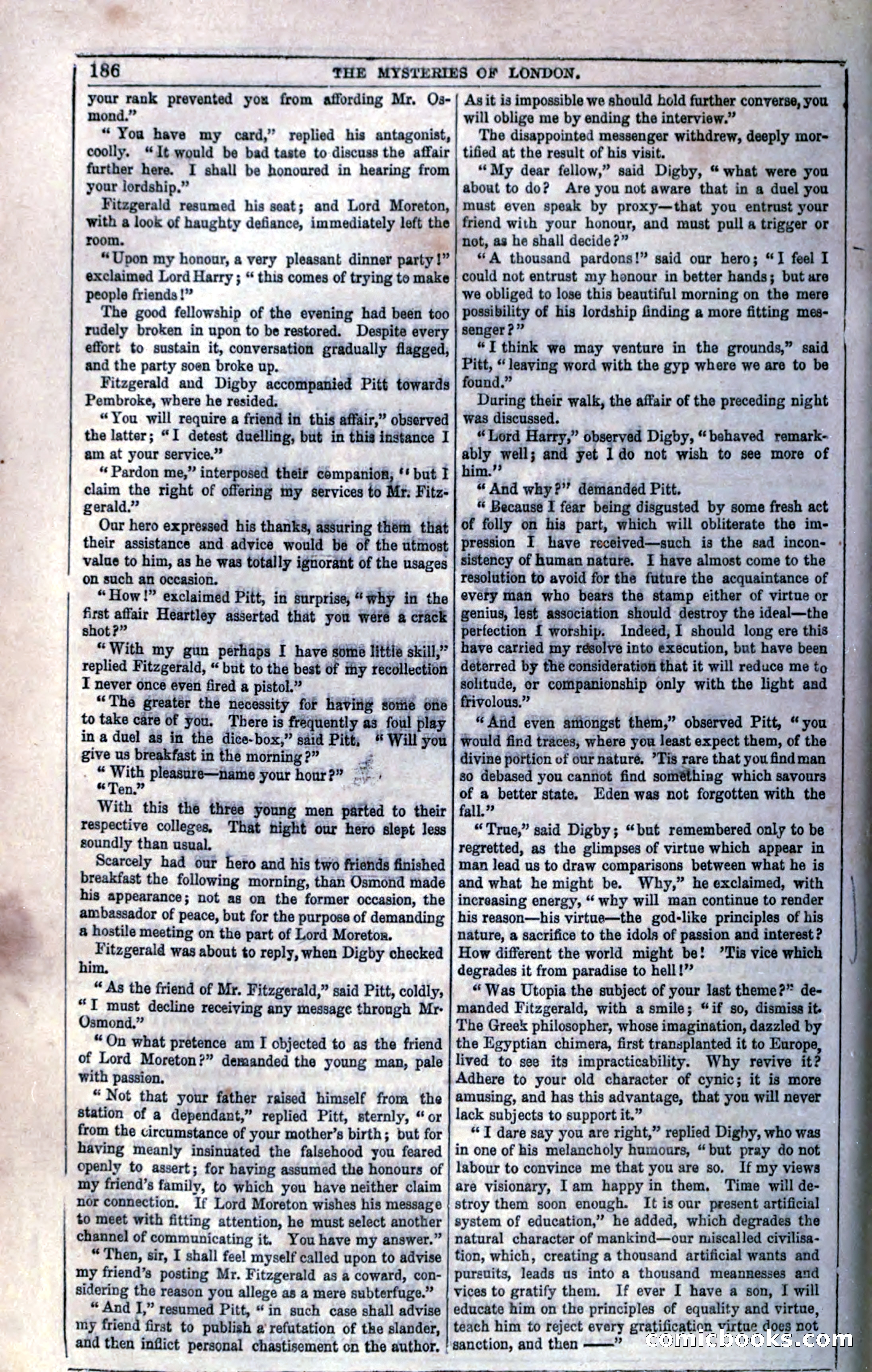
A restored page from Penny Dreadfuls, 1850. Page through the whole issue in the reader above.
📄 Transcribed text from this page (OCR, searchable)
Machine-transcribed from the original scan — historical spelling and the odd misread are preserved.
186 THE MYSTERIES OF LONDON, your rank prevented you from affording Mr. Os- mond.” “ You have my card,” replied his antagonist, coolly. “I¢ would be bad taste to discuss the affair further here. I shall be honoured in hearing from your lordship.” Fitzgerald resumed his seat; and Lord Moreton, with a look of haughty defiance, immediately left the room. “Upon my honour, a very pleasant dinner party!” exclaimed Lord Harry ; “ this comes of trying to make people friends!” The good fellowship of the evening had been too rudely broken in upon to be restored. Despite every effort to sustain it, conversation gradually flagged, and the party soen broke up. 7 Fitzgerald and Digby accompanied Pitt towards Pembroke, where he resided; “You will require a friend in this affair,” observed the latter; “I detest duelling, but in this instance I am at your service.” “ Pardon me,” inte theif companion; ** but I claim the right of offering my services to Mr: Fitz- gerald.” Our hero expressed his thanks, assuring théth that their assistance and advice would be of the utinost value to him, as he was totally ignorant of the usages on such an occasion. “How!” exclaimed Pitt, in surprise, “Why ifi the es aoe Heartley asserted that you were a@ crack oO “With my gun perhaps I have some little skill,” replied Fitzgerald, “ but to the best of ihy recollection I never once even fired a pistol.” “The greater the necessity for haviig sotiie ¢ to take care of You. There is frequently as foul play in a duel as in the dice-box,” said Pitt; * Will you give us breakfast in the morning ?” : _ “ With pleasure—name your hour?” x ; “Ten,” With this the three young men patted to their respective colleges, That night our hero slept Jess soundly than usual. Scarcely had our hero and his two friends finished breakfast the following morning, than Osmond made his appearance; not as on the former occasion, the ambassador of peace, but for the purpose of demanding & hostile meeting on the part of Lord Moreton. ~ Fitzgerald was about to reply, when Digby checked m. “As the friend of Mr. Fitzgerald,” said Pitt, coldly, “I must decline receiving any message through Mr- Osmond,” “On what pretence am I objected to as the friend of Lord Moreton?” demanded the young man, pale with passion. “Not that your father raised himself from the station of a dependant,” replied Pitt, sternly, “ or from the circumstance of your mother’s birth; but for having meanly insinuated the falsehood you feared openly to assert; for haying assumed the honours of my friend’s family, to which you have neither claim _ nor connection. If Lord Moreton wishes his message to meet with fitting attention, he must select another channel of communicating it. You have my answer.” “Then, sir, I shall fee! myself called upon to advise my friend’s posting Mr. Fitzgerald as @ coward, con- sidering the reason you allege as a mere subterfuge.” “ And I,” resumed Pitt, “in such case shall advise my friend first to publish e refutation of the slander, and then inflict personal chastisement on the author. | eee d = a ~ he As it is impossible we should hold further converse, you will oblige me by ending the interview.” The disappointed messenger withdrew, deeply mor- tified at the result of his visit. “My dear fellow,” said Digby, “ what were you about to do? Are you not aware that in a duel you must even speak by proxy—that you entrust your friend with your honour, and mast pull a trigger or not, as he shall decide?” “A thousand pardons!” said our hero; “JI feel I could not entrust my honour in better hands; but are we obliged to lose this beautiful morning on the mere possibility of his lordship finding a more fitting mes- senger ?” “TIT think we may venture in the grounds,” said Pbk leaving word with the gyp where we are to be found.” During their walk, the affair of the preceding night “Lord Harry,” observed Digby, “behaved remark- ably well; and yet 1do not wish to see more of him. “ And why?” déimandéd Pitt. _% Because I féar being disgusted by some fresh act of folly on his part, which will obliterate the im- pression I have rec : sistency of human nature. I have almost come to the resolution to avoid for the future the acquaintance of every man who bears the stamp either of virtue or genius, lest association should destroy the ideal—the perfection { wotship. Indeed, I should long ere this have carried my resolve into execution, but have been deterred by the consideration that it will reduce me to solitude, or companionship only with the light and frivolous.” “ And even ationgst them,” observed Pitt, “you. divine portion of our naturé. ’Tis rare that youfindman | — so debased you cannot find som@thing which sayours | of a better state. Eden was not forgotten with the fall.” “True,” said Digby; “but remembered only to be | regretted, as the glimpses of virtue which appear in man lead us to draw comparisons between what he is and what he might be. Why,” he exclaimed, with increasing energy, “ why will man continue to render his reason—his virtue—the god-like principles of his nature, a sacrifice to the idols of passion and interest ? How different the world might be! *Tis vice which degrades it from paradise to hell!” “Was Utopia the subject of your last theme?” de- manded Fitzgerald, with a smile; “if so, dismiss it The Greek philosopher, whose imagination, dazzled by the Egyptian chimera, first transplanted it to Europe lived to see its impracticability. Why revive Adhere to your old character of cynic; it is more amusing, and has this advantage, that you will never lack subjects to support it.” “IT dare say you are right,” replied Dighy, who was in one of his melancholy humours, “but pray do not labour to convince me that you are so. If my views are visionary, Iam happy in them, Time will de- stroy them soon enough. It is our present artificii system of education,” he added, which degrades the natural character of mankind—our miscalled civilisa- tion, which, creating a thousand artificial wants and pursuits, leads us into a thousand meannesses and vices to gratify them. If ever I have a son, I will educate him on the principles of equality and virtue, teach him to reject every gratification ere rtue does not | sanction, and then 22 PICO MIGOOOKS com =