
Penny Dreadfuls, 1850 · page 189 of 394
The Mysteries of London; or, Lights and Shadows of London Life — page 189: what you’re looking at
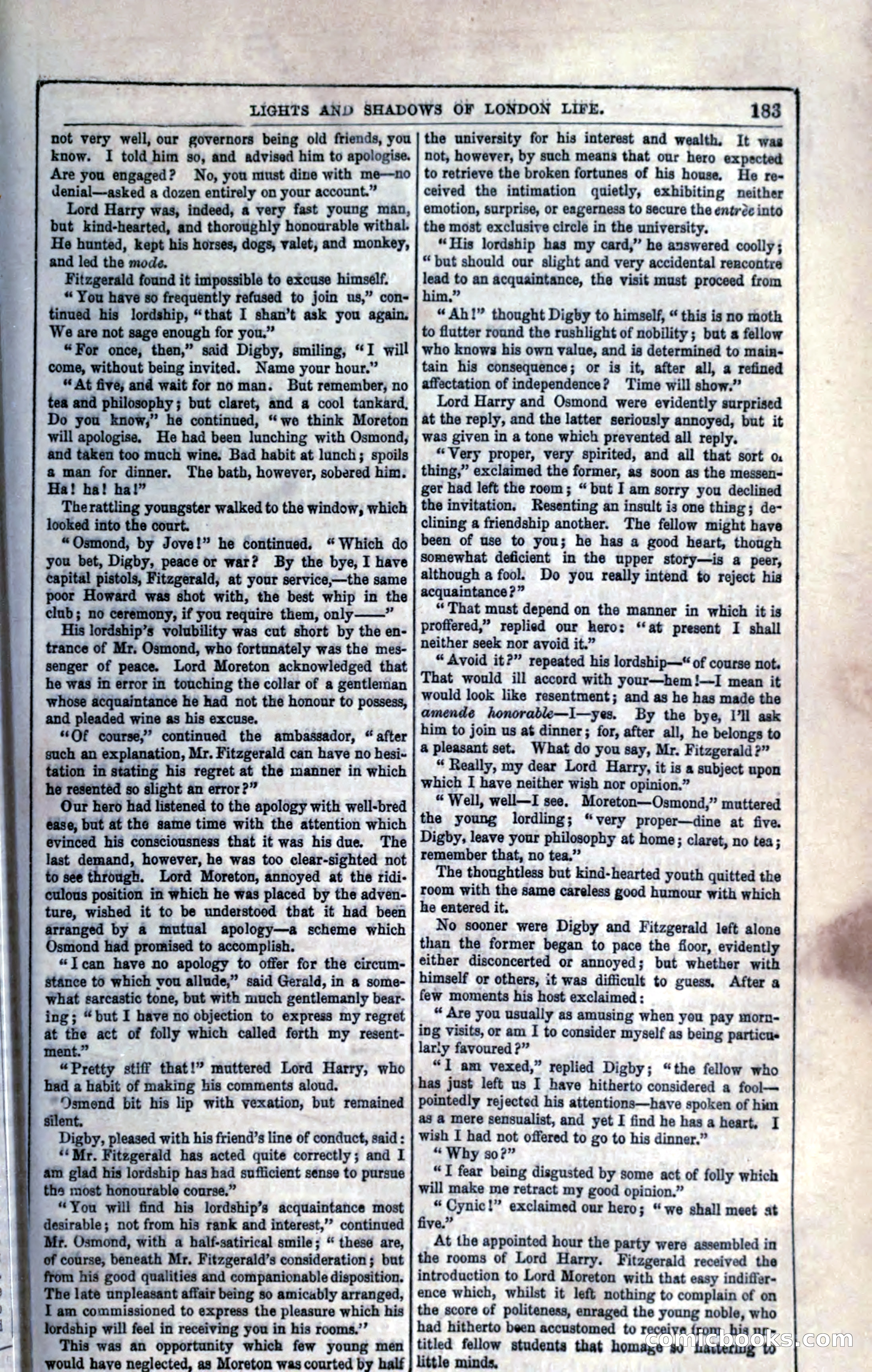
A restored page from Penny Dreadfuls, 1850. Page through the whole issue in the reader above.
📄 Transcribed text from this page (OCR, searchable)
Machine-transcribed from the original scan — historical spelling and the odd misread are preserved.
— ——e ae ee —_— aS SS - ~~ a " — ~ 7 oie” ole 7 Fs LIGHTS AND SHADOWS OF LONDON LIFE. not very well, our governors being old friends, you know. I told him so, and advised him to apologise. Are you engaged? No, you must dine with me—no oeet ees a dozen entirely on de account.” Harry was, indeed, a ast young man, but htiedheatted, and choselighif binotrable withal. He hunted, kept his horses, dogs, valet, and monkey, and led the mode. Fitzgerald found it impossible to excuse himself. 183 the university for his interest and wealth, It wag not, however, by such means that our hero expected to retrieve the broken fortunes of his house. He re- ceived the intimation quietly, exhibiting neither emotion, surprise, or eagerness to secure the entr2e into the most exclusive circle in the university. “His lordship has my card,” he answered coolly; “but should our slight and very accidental rencontre lead to an acquaintance, the visit must proceed from ; »”? “ You have so frequently refused to join us,” con- | him. tinued his lordship, “that I shan’t ask you again. We are not sage enough for you.” “For once, then,” said Digby, smiling, “I will come, without being invited. Name your hour.” “ At five; and wait for no man. But remember, no tea and philosophy; but claret, and a cool tankard, Do you know,” he continued, “we think Moreton will apologise. He had been lunching with Osmond, and taken too much wine. Bad habit at lunch; spoils a@ man for dinner. The bath, however, sobered him. Ha! ha! hal” The rattling youngster walked to the window, which “Osmond; by Jove!” he continued, “Which do you bet, Digby, peace or war? By the bye, I have capital pistols, Fitzgerald, at your service—the same poor Howard was shot with, the best whip in the | #°4 club; no cerémony, if you require them, only -——” His lordship’s volubility was cut short by the en- trance of Mr, Osmond, who fortunately was the mes- senger of peace. Lord Moreton acknowledged that he was in error in touching the collar of a gentleman whose acquaintance he had not the honour to possess, and pleaded wine as his excuse. “OF course,’ continued the ambassador, “ after such an explanation, Mr. Fitzgerald can have no hesi- tation in stating his regret at the manner in which he resentéd so slight an error?” Our hero had listened to the apology with well-bred ease; but at the same time with the attention which évinced his consciousness that it was his due. The last , however, he was too clear-sighted not to see through. Lord Moreton, annoyed at the ridi- culous position in which he was placed by the adven- ture, wished it to be understood that it had been arranged by a mutual apology—a scheme which Osmond had promised to accomplish. *JTcan have no apology to offer for the circum- stance to which vou allude,” said Gerald, in a some- what sarcastic tone, but with much gentlemanly bear- ing; “but I have no objection to express my regret at the act of folly which called forth my resent- ment.” “Pretty stiff that!” muttered Lord Harry, who had a habit of making his comments aloud. *Osmend bit his lip with vexation, but remained Digby, pleased with his friend’s line of conduct, said : ‘‘Mr. Fitzgerald has acted quite correctly; and I am glad his lordship has had sufficient sense to pursue “You will find his lordship’s acquaintance most desirable; not from his rank and interest,’”’ continued Mf. Osmond, with a half-satirical smile; “ these are, of course, beneath Mr. Fitzgerald’s consideration; but _ ffom his good qualities and companionable disposition. The late unpleasant affair being so amicably arranged, Iam commissioned to express the pleasure which his Tordship will feel in receiving you in his rooms.” This was an opportunity which few young men ‘would have neglected, as Moreton was courted by half “Ah!” thought Digby to himself, “ this is no moth to flutter round the rushlight of nobility; but a fellow who knows his own value, and is determined to main- tain his consequence; or is it, after all, a refined affectation of independence? ‘Time will show.’ Lord Harry and Osmond were evidently surprised at the reply, and the latter seriously annoyed, but it was given in a tone which prevented all reply, “Very proper, very spirited, and all that sort o: thing,” exclaimed the former, as soon as the messen- ger had left the room; “but I am sorry you declined the invitation. Resenting an insult is one thing; de- clining a friendship another. The fellow might have been of use to you; he has a good heart, though Somewhat deficient in the upper story—is a peer, although a fool. Do you really intend to reject his uaintance ?” “ That must depend on the manner in which it is proffered,” replied our hero: “‘at present I shall neither seek nor ayoid it.” “ Avoid it?” repeated his lordship—*“ of course not. That would ill accord with your—hem!—I mean it would look like resentment; and as he has made the amende honorable—I—yes. By the bye, I'll ask him to join us at dinner; for, after all, he belongs to & pleasant set. What do you say, Mr. Fitzgerald?” “ Really, my dear Lord Harry, it is a subject upon which I have neither wish nor opinion.” “Well, well—I see. Moreton—Osmond,” muttered the young lordling; “very proper—dine at five. Digby, leave your philosophy at home; claret, no tea; remember that, no tea,” The thoughtless but kind-hearted youth quitted the room with the same careless good humour with which he entered it. No sooner were Digby and Fitzgerald left alone than the former began to pace the floor, evidently either disconcerted or annoyed; but whether with himself or others, it was difficult to guess, After a few moments his host exclaimed : “ Are you usually as amusing when you pay morn- ing visits, or am I to consider myself as being particus larly favoured ?” “I am vexed,” replied Digby; “the fellow who has just left us I have hitherto considered a fool— pointedly rejected his attentions—have spoken of him as @ mere sensualist, and yet I find he has a heart, I wish I had not offered to go to his dinner.” “ Why so?” “I fear being disgusted by some act of folly which will make me retract my good opinion.” “ Cynic!” exclaimed our hero; “we shall meet at five.” At the appointed hour the party were assembled in the rooms of Lord Harry. Fitzgerald received the introduction to Lord Moreton with that easy indiffer- ence which, whilst it left nothing to complain of on the score of politeness, enraged the young noble, who titled fellow students that homaxt little minds,