
Penny Dreadfuls, 1850 · page 184 of 394
The Mysteries of London; or, Lights and Shadows of London Life — page 184: what you’re looking at
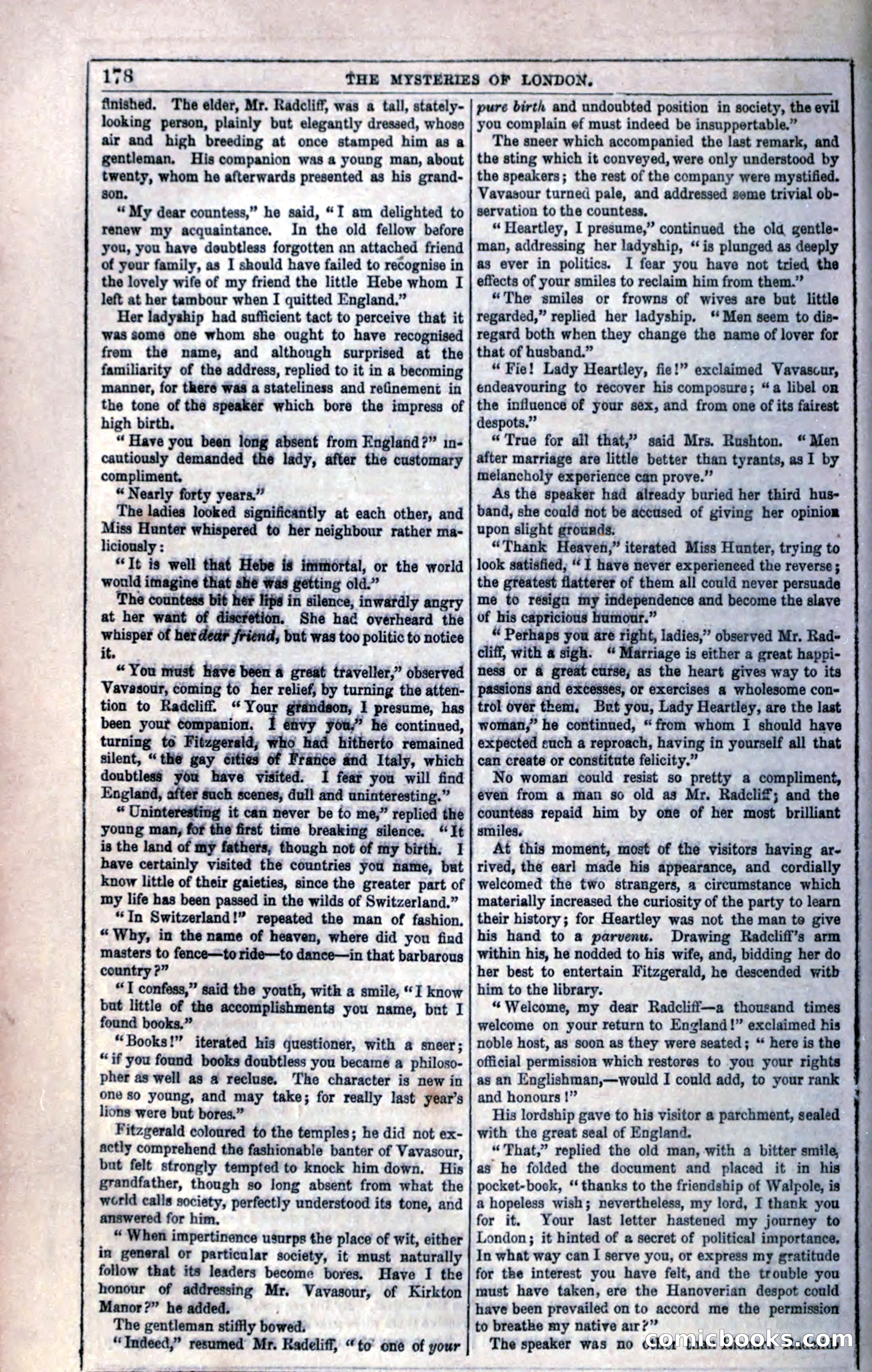
A restored page from Penny Dreadfuls, 1850. Page through the whole issue in the reader above.
📄 Transcribed text from this page (OCR, searchable)
Machine-transcribed from the original scan — historical spelling and the odd misread are preserved.
178 finished. The elder, Mr. Radcliff, was a tall, stately- looking person, plainly but elegantly dressed, whose air and high breeding at once stamped him as a gentleman. His companion was a young man, about twenty, whom he afterwards presented as his grand- son. “‘ My dear countess,” he said, “I am delighted to renew my acquaintance. In the old fellow before you, you have doubtless forgotten an attached friend of your family, as I should have failed to recognise in the lovely wife of my friend the little Hebe whom I left at her tambour when I quitted England,” Her ladyship had sufficient tact to perceive that it was some one whom she ought to have recognised from the name, and although surprised at the familiarity of the address, replied to it in a becoming manner, for theré was a stateliness and refinement in the tone of the speaker which bore the impress of high birth. “ Have you been s absent from England?” in- cautiously demanded the lady, after the customary compliment, “ Nearly forty years,” The ladies looked significatitly at each other, and Miss Hunter whispered to her neighbour rather ma- liciously : “It is well that Hebe id inimiortal, or the world The countess bit her lips in silence, inwardly angry at her want of disefétion. She had ovérheard the hisper of her dea# friend, but was too politic to notice t. “You must have been a great traveller,” observed Vavasour, coming to her relief, by turning the atten- tion to Radcliff. “Your gtdndson, I presume, has been yout companion. I éfivy you’ he continued, silent, “the gay éities of Fratice and Italy, which age Po have visited. I feat you will find England, such scenes, dull and uninteresting.” “ Uninteresting it can never be to me,” replied the young man, for the first time breaking silence. “It is the land of my fathers, though not of my birth: I have certainly visited the countries yoti name, but know little of their gaieties, since the greater part of my life has been passed in the wilds of Switzerland.” “In Switzerland!” repeated the man of fashion. “Why, in the name of heaven, where did you find masters to fence—to ride—to dance—in that barbarous country ?” dik ea See youth, with a smile, “I know tle accomplishments you name, bnt I found books.” : “Books!” iterated his questioner, with a sneer; “if you found books doubtless you becamé a philoso- pher as well as a recluse. The character is new in one so young, and may take; for really last year’s lions were but bores.” Fitzgerald coloured to the temples; he did not ex- actly comprehend the fashionable banter of Vavasour, but felt strongly tempted to knock him down. His grandfather, though so Jong absent from what the world calls society, perfectly understood its tone, and answered for him. “When impertinence usurps the place of wit, either in general or particular society, it must naturally follow that its leaders become bores. Have I the honour of addressing Mr. Vavasour, of Kirkton Manor?” he added. The gentleman stiffly bowed. “Indeed,” resumed Mr. Radeliff, “to oné of your 1 THE MYSTERIES OF LONDON, pure birth and undoubted position in society, the evil you complain ef must indeed be insuppertable.” The sneer which accompanied the last remark, and the sting which it conveyed, were only understood by the speakers; the rest of the company were mystified. Vavasour turned pale, and addressed some trivial ob- servation to the countess, “ Heartley, I presume,” continued the old gentle- man, addressing her ladyship, “is plunged as deeply as ever in politics. I fear you have not tried the effects of your smiles to reclaim him from them.” “The smiles or frowns of wives are but little regarded,” replied her ladyship. Men seem to dis- regard both when they change the name of lover for that of husband.” “ Fie! Lady Heartley, fie!” exclaimed Vavascur, endeavouring to recover his composure; “a libel on the influence of your sex, and from one of its fairest despots.” “True for all thaty’ said Mrs. Rushton. “Men after marriage are little better than tyrants, as I by melancholy experience can prove.” As the cer had already buried her third hus- band, she could not be accused of giving her opinion upon slight grounds, : “Thank Heaven,” iterated Miss Hunter, trying to look satisfied, “I have never experieneed the reverse; the greatest flatterer of them all could never persuade “ Pethaps you aré right, ladies,” observed Mr. Rad- cliff, with a sigh: “ lage is either a great happi- ness or @ great curse; as the heart gives way to its trol over them, But you, Lady Heartley, are the last woman,” he continued, “from whom I should have expected such a reproach, having in yourself all that can create or constitute felicity.” No woman could resist so pretty a compliment, éven from a man so old as Mr. Radcliff; and the countess repaid him by one of her most brilliant smiles. At this moment, most of the visitors having ar- rived, the earl made his appearance, and cordially welcomed the two strangers, a circumstance which materially increased the curiosity of the party to learn their history; for Heartley was not the man te give his hand to a parvenw. Drawing Radcliff’s arm within his, he nodded to his wife, and, bidding her do her best to entertain Fitzgerald, he descended witb him to the library. “ Welcome, my dear Radcliff—a thousand times welcome on your return to England!” exclaimed his noble host, as soon as they were seated; “ here is the official permission which restores to you your rights as an Englishman,—would I could add, to your rank and honours !” His lordship gave to his visitor a parchment, sealed with the great seal of England. “That,” replied the old man, with a bitter smile as he folded the document and placed it in his pocket-bock, ‘ thanks to the friendship of Walpole, is a hopeless wish; nevertheless, my lord, I thank you for it. Your last letter hastened my journey to London; it hinted of a secret of political importance, In what way can I serve you, or express my gratitude for the interest you have felt, and the trouble you must have taken, ere the Hanoverian despot could have been prevailec on to accord me the permission to breathe my native air?” —_— ee The speaker was no (9.21 $145 SAS Shad |