
Penny Dreadfuls, 1850 · page 173 of 394
The Mysteries of London; or, Lights and Shadows of London Life — page 173: what you’re looking at
A restored page from Penny Dreadfuls, 1850. Page through the whole issue in the reader above.
📄 Transcribed text from this page (OCR, searchable)
Machine-transcribed from the original scan — historical spelling and the odd misread are preserved.
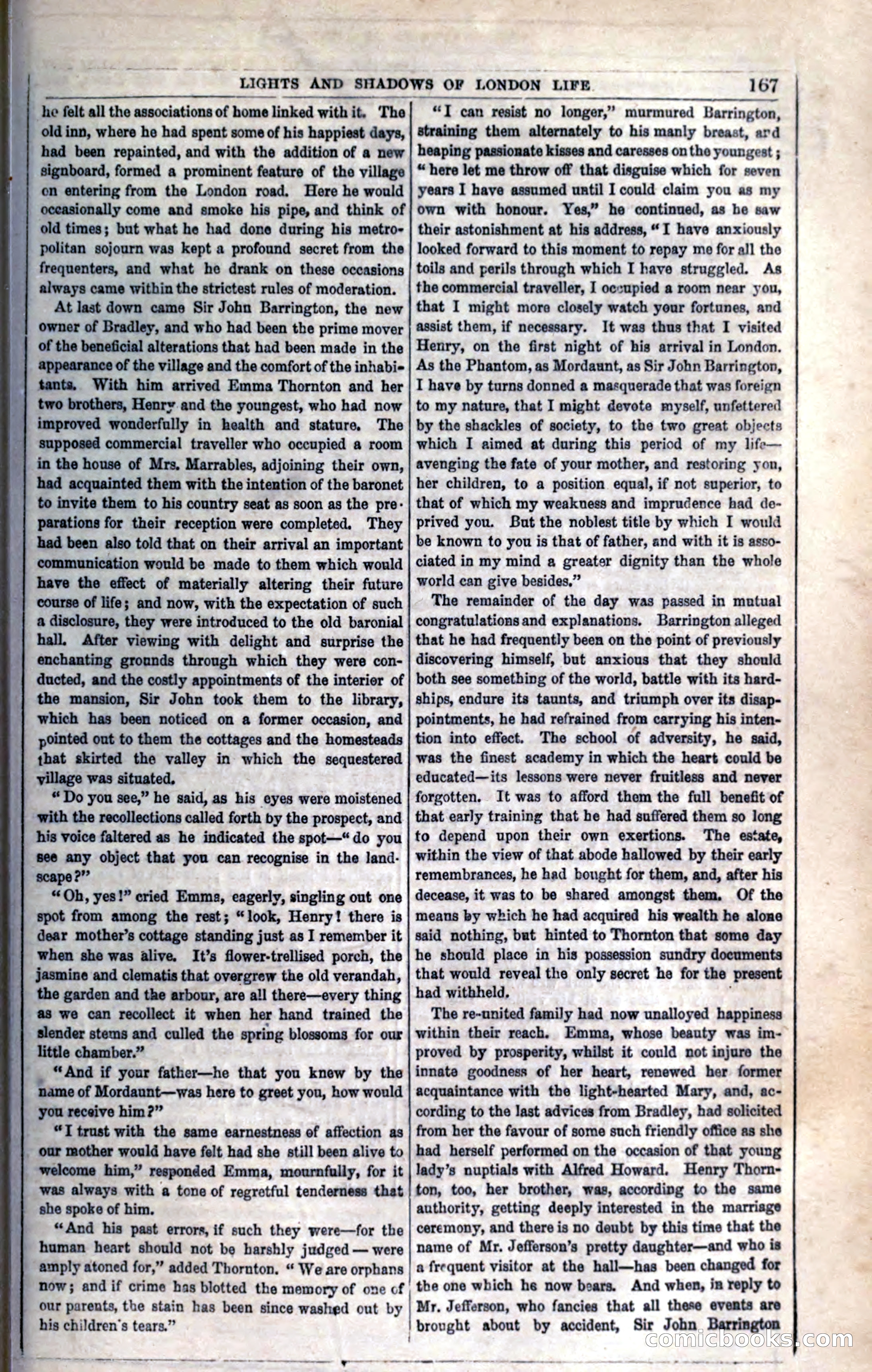
LIGHTS AND SHADOWS OF LONDON LIFE 167 : he felt all the associations of home linked with it, The | _ old inn, where he had spent some of his happiest days, _ had been repainted, and with the addition of a new _ signboard, formed a prominent feature of the village on entering from the London road. Here he would _ oceasionally come and smoke his pipe, and think of old times; but what he had done during his metro- politan sojourn was kept a profound secret from the frequenters, and what he drank on these occasions always came within the strictest rules of moderation. | At last down came Sir John Barrington, the new owner of Bradley, and who had been the prime mover of the beneficial alterations that had been made in the _ appearance of the village and the comfort of the inhabi- tants. With him arrived Emma Thornton and her two brothers, Henry and the youngest, who had now improved wonderfully in health and stature. The supposed commercial traveller who occupied a room in the house of Mrs, Marrables, adjoining their own, had acquainted them with the intention of the baronet to invite them to his country seat as soon as the pre- _ parations for their reception were completed. They had been also told that on their arrival an important communication would be made to them which would have the effect of materially altering their future course of life; and now, with the expectation of such | a disclosure, they were introduced to the old baronial hall, After viewing with delight and surprise the | enchanting grounds through which they were con- | ducted, and the costly appointments of the interior of the mansion, Sir John took them to the library, which has been noticed on a former occasion, and | pointed ont to them the cottages and the homesteads | that skirted the valley in which the sequestered | “Do you see,” he said, as his eyes were moistened | with the recollections called forth by the prospect, and } his voice faltered as he indicated the spot—“do you ‘see any object that you can recognise in the land- | “Oh, yes!” cried Emma, eagerly, singling out one spot from among the rest; “look, Henry! there is dear mother’s cottage standing just as I remember it when she was alive. It’s flower-trellised porch, the | jasmine and clematis that overgrew the old verandah, | the garden and the arbour, are all there—every thing a8 we can recollect it when her hand trained the _ slender stems and culled the spring blossoms for our | little chamber.” , _ “And if your father—he that you knew by the name of Mordaunt—was here to greet you, how would you receive him?” “T trust with the same earnestness of affection as | our mother would have felt had she still been alive to | welcome him,” responded Emma, mournfully, for it _ was always with a tone of regretful tenderness that she spoke of him. “And his past errors, if such they were—for the ‘| human heart should not be harshly judged — were |} amply atoned for,” added Thornton. “ We are orphans |} now; andif crime has blotted the memory of one cf “T can resist no longer,” murmured Barrington, straining them alternately to his manly breast, ard heaping passionate kisses and caresses on the youngest ; “here let me throw off that disguise which for seven years I have assumed uatil I could claim you as my own with honour. Yes,” he continued, as be saw their astonishment at his address, “I have anxiously looked forward to this moment to repay me for all the toils and perils through which I have struggled. As the commercial traveller, I occupied a room near you, that I might more closely watch your fortunes, and assist them, if necessary. It was thus that I visited Henry, on the first night of his arrival in London. As the Phantom, as Mordaunt, as Sir John Barrington, I have by turns donned a masquerade that was foreign to my nature, that I might devote myself, unfettered by the shackles of society, to the two great objects which I aimed at during this period of my life— avenging the fate of your mother, and restoring yon, her children, to a position equal, if not superior, to that of which my weakness and imprudence had de- prived you. But the noblest title by which I would be known to you is that of father, and with it is asso- ciated in my mind a greater dignity than the whole world can give besides,” The remainder of the day was passed in mntual congratulations and explanations. Barrington alleged that he had frequently been on the point of previously discovering himself, but anxious that they should both see something of the world, battle with its hard- ships, endure its taunts, and triumph over its disap- pointments, he had refrained from carrying his inten- tion into effect. The school of adversity, he said, was the finest academy in which the heart could be educated—its lessons were never fruitless and never forgotten. It was to afford them the full benefit of that early training that he had suffered them so long to depend upon their own exertions. The estate, within the view of that abode hallowed by their early remembrances, he had bought for them, and, after his decease, it was to be shared amongst them, Of the means by which he had acquired his wealth he alone said nothing, bat hinted to Thornton that some day he should place in his possession sundry documents that would reveal the only secret he for the ‘present had withheld, The re-united family had now unalloyed happiness within their reach. Emma, whose beauty was im- proved by prosperity, whilst it could not injure the innate goodness of her heart, renewed her former acquaintance with the light-hearted Mary, and, ac- cording to the last advices from Bradley, had solicited from her the favour of some such friendly office as she had herself performed on the occasion of that young lady’s nuptials with Alfred Howard. Henry Thorn- ton, too, her brother, was, according to the same authority, getting deeply interested in the marriage ceremony, and there is no deubt by this time that the name of Mr. Jefferson’s pretty daughter—and who is a frequent visitor at the hall—has been changed for the one which he now bears. And when, in reply to our parents, the stain has been since washed out by | Mr. Jefferson, who fancies that all these events are his children’s tears.” brought about by accident, Sir John. Barringtor | COMMICOOOKSECO m er re _>—_l eS | = — - - = ™ -