
Penny Dreadfuls, 1850 · page 171 of 394
The Mysteries of London; or, Lights and Shadows of London Life — page 171: what you’re looking at
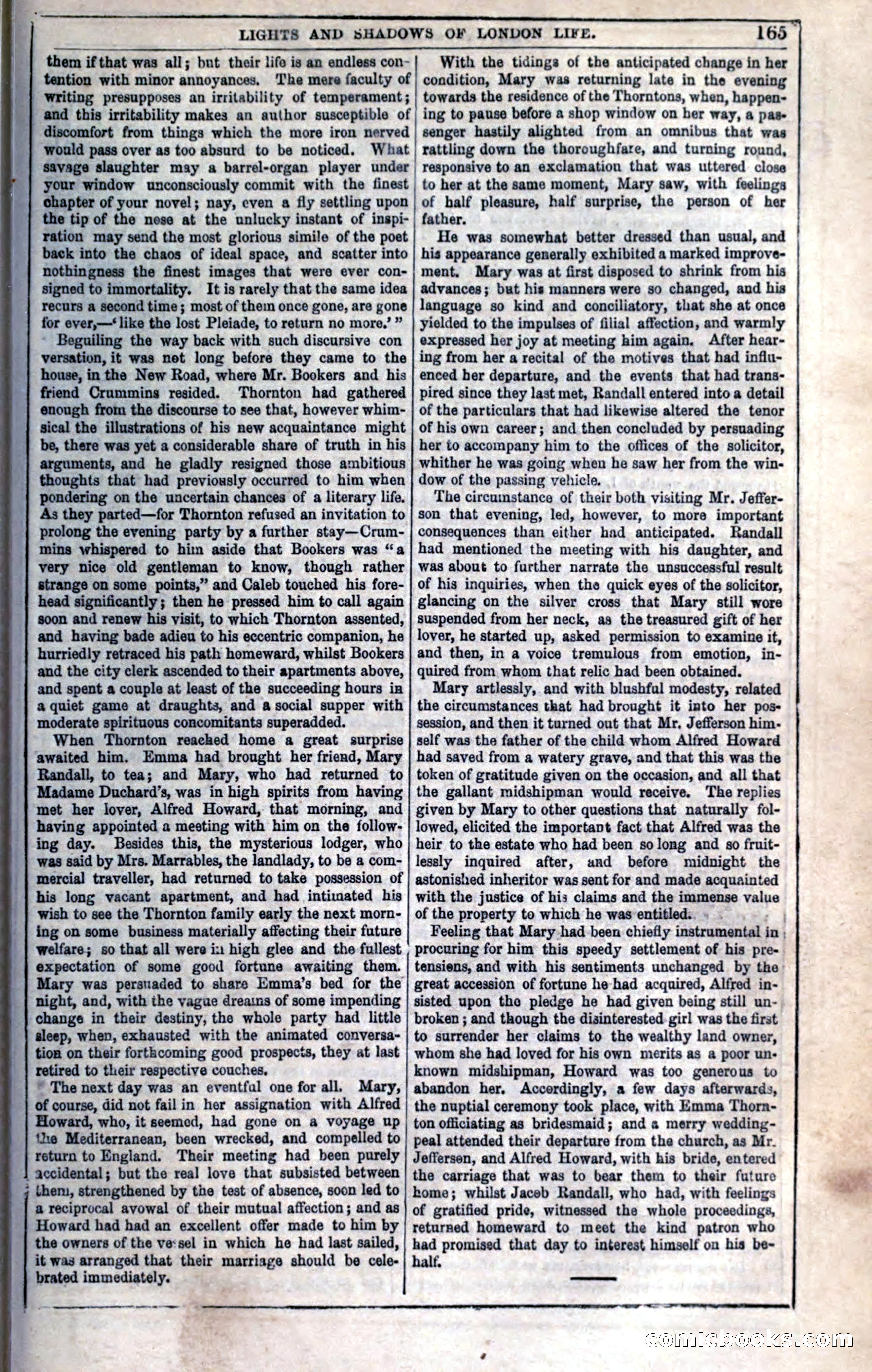
A restored page from Penny Dreadfuls, 1850. Page through the whole issue in the reader above.
📄 Transcribed text from this page (OCR, searchable)
Machine-transcribed from the original scan — historical spelling and the odd misread are preserved.
them ifthat was all; but their life is an endless con- | tention with minor annoyances, The mere faculty of 4 presupposes an irritability of temperament; and this irritability makes an author susceptible of | discomfort from things which the more iron nerved would pass over as too absurd to be noticed. What savage slaughter may a barrel-organ player under your window unconsciously commit with the finest chapter of your novel; nay, even a fly settling upon the tip of the nose at the unlucky instant of inspi- ration may send the most glorious simile of the poet back into the chaos of ideal space, and scatter into nothingness the finest images that were ever con- signed to immortality. It is rarely that the same idea recurs a second time; most of them once gone, are gone for ever,—‘ like the lost Pleiade, to return no more,’ ” - Beguiling the way back with such discursive con versation, it was not long before they came to the house, in the New Road, where Mr. Bookers and his friend Crummins resided. Thornton had gathered enough from the discourse to see that, however whim- sical the illustrations of his new acquaintance might be, there was yet a considerable share of truth in his arguments, and he gladly resigned those ambitious thoughts that had previously occurred to him when pondering on the uncertain chances of a literary life. As they parted—for Thornton refused an invitation to prolong the evening party by a further stay—Crum- mins whispered to him aside that Bookers was “a very nice old gentleman to know, though rather strange on some points,” and Caleb touched his fore- head significantly; then he pressed him to call again soon and renew his visit, to which Thornton assented, and having bade adieu to his eccentric companion, he hurriedly retraced his path homeward, whilst Bookers and the city clerk ascended to their apartments above, and spent a couple at least of the succeeding hours ia a quiet game at draughts, and a social supper with moderate spirituous concomitants superadded. When Thornton reached home a great surprise awaited him. Emma had brought her friend, Mary Randall, to tea; and Mary, who had returned to Madame Duchard’s, was in high spirits from having met her lover, Alfred Howard, that morning, and having appointed a meeting with him on the follow- ing day. Besides this, the mysterious lodger, who was said by Mrs. Marrables, the landlady, to be a com- mercial traveller, had returned to take possession of his long vacant apartment, and had intimated his wish to see the Thornton family early the next morn- ing on some business materially affecting their future welfare; so that all were i: high glee and the fullest expectation of some good fortune awaiting them. Mary was persuaded to share Emma’s bed for the night, and, with the vague dreains of some impending change in their destiny, the whole party had little sleep, when, exhausted with the animated conversa- tion on their forthcoming good prospects, they at last retired to their respective couches, * The next day was an eventfal one for all. Mary, of course, did not failin her assignation with Alfred Howard, who, it seemed, had gone on a voyage up the Mediterranean, been wrecked, and compelled to return to England. Their meeting had been purely accidental; but the real love that subsisted between ; them, strengthened by the test of absence, soon led to a reciprocal avowal of their mutual affection; and as Howard had had an excellent offer made to him by the owners of the ve:sel in which he had last sailed, it was arranged that their marriage should be cele- brated immediately. —— LIGHTS AND sHADOWS OF LONDON LIFE. With the tidings of the anticipated change in her condition, Mary was returning late in the evening towards the residence of the Thorntons, when, happen- ing to pause before a shop window on her way, a pas- senger hastily alighted from an omnibus that was rattling down the thoroughfare, and turning round, responsive to an exclamation that was uttered close to her at the same moment, Mary saw, with feelings of half pleasure, half surprise, the person of her father. He was somewhat better dressed than usual, and his appearance generally exhibited a marked improve- ment. Mary was at first disposed to shrink from his advances; but his manners were so changed, and his language so kind and conciliatory, that she at once yielded to the impulses of filial affection, and warmly expressed her joy at meeting him again. After hear- ing from her a recital of the motives that had influ- enced her departure, and the events that had trans- pired since they last met, Randall entered into a detail of the particulars that had likewise altered the tenor of his own career; and then concluded by persuading her to accompany him to the offices of the solicitor, whither he was going when he saw her from the win- dow of the passing vehicle. The circumstance of their both visiting Mr. Jeffer- son that evening, led, however, to more important consequences than either had anticipated. Randall had mentioned the meeting with his daughter, and was about to further narrate the unsuccessful result of his inquiries, when the quick eyes of the solicitor, glancing on the silver cross that Mary still wore suspended from her neck, as the treasured gift of her lover, he started up, asked permission to examine it, and then, in a voice tremulous from emotion, in- quired from whom that relic had been obtained. Mary artlessly, and with blushfal modesty, related the circumstances that had brought it into her pos- session, and then it turned out that Mr. Jefferson him- self was the father of the child whom Alfred Howard had saved from a watery grave, and that this was the token of gratitude given on the occasion, and all that the gallant midshipman would receive. The replies given by Mary to other questions that naturally fol- lowed, elicited the important fact that Alfred was the heir to the estate who had been solong and so fruit- lessly inquired after, und before midnight the astonished inheritor was sent for and made acquainted with the justice of his claims and the immense value of the property to which he was-entitled.. . . Feeling that Mary had been chiefly instrumental in. procuring for him this speedy settlement of his pre- tensiens, and with his sentiments unchanged by the great accession of fortune he had acquired, Alfred in- sisted upon the pledge he had given being still un- broken ; and though the disinterested girl was the first to surrender her claims to the wealthy land owner, whom she had loved for his own merits as a poor un- known midshipman, Howard was too generous to abandon her, Accordingly, a few days afterwards, the nuptial ceremony took place, with Emma Thorn- ton officiating as bridesmaid; and a merry wedding- peal attended their departure from the church, as Mr. Jefferson, and Alfred Howard, with his bride, entered the carriage that was to bear them to their future home; whilst Jaceb Randall, who had, with feelings of gratified pride, witnessed the whole proceedings, returned homeward to meet the kind patron who had promised that day to interest himself on his be- half. <= 165 CORNICLOO S (E)