
Penny Dreadfuls, 1850 · page 169 of 394
The Mysteries of London; or, Lights and Shadows of London Life — page 169: what you’re looking at
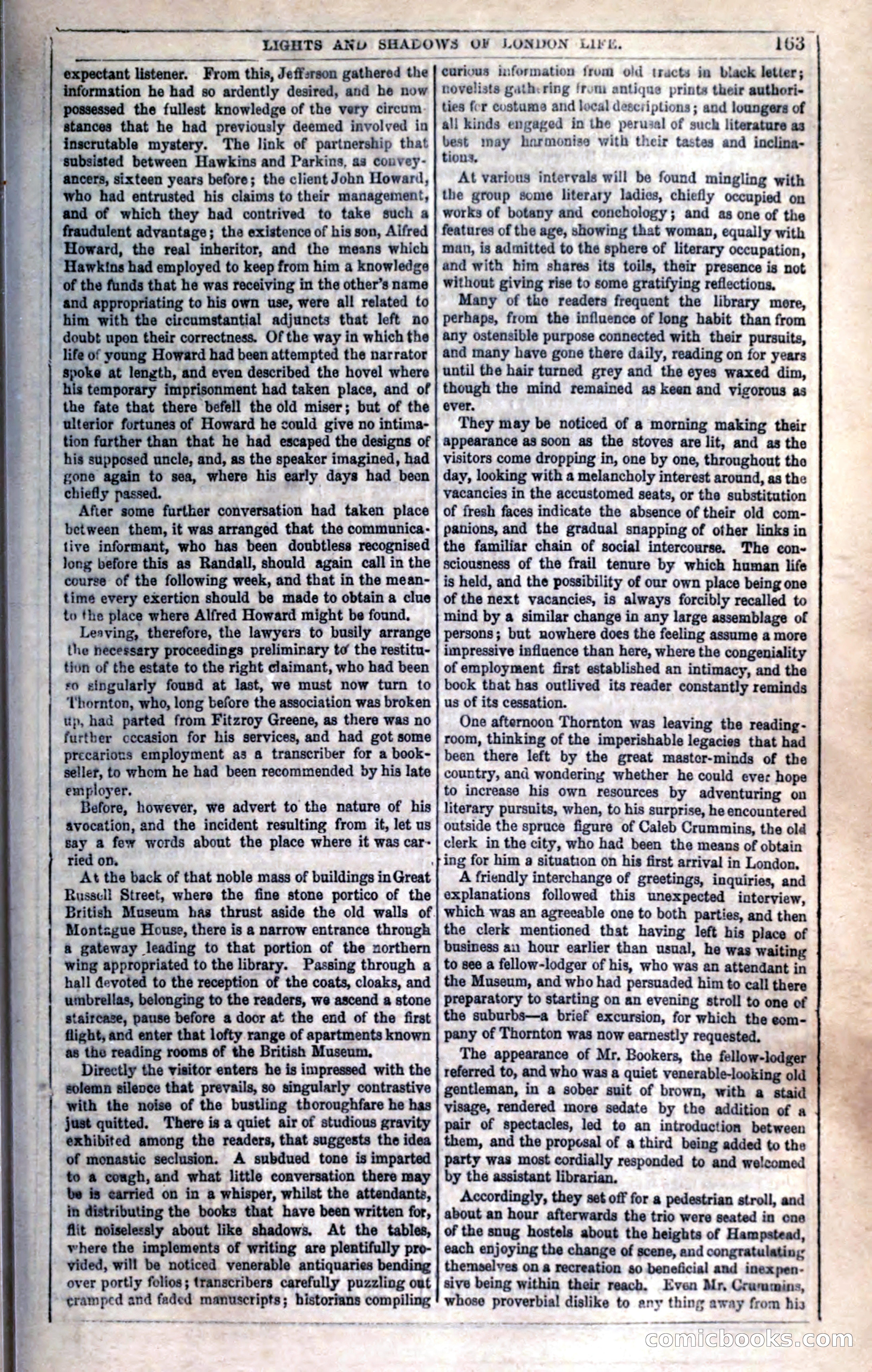
A restored page from Penny Dreadfuls, 1850. Page through the whole issue in the reader above.
📄 Transcribed text from this page (OCR, searchable)
Machine-transcribed from the original scan — historical spelling and the odd misread are preserved.
rr expectant listener. From this, Jefferson gathered the information he had so ardently desired, and he now ‘possessed the fullest knowledge of the very circum. stances that he had previously deemed involved in inscrutable mystery. The link of partnership that subsisted between Hawkins and Parkins, as convey- ancers, sixteen years before; the client John Howard, who had entrusted his claims to their management, and of which they had contrived to take such a fraudulent advantage; the existence of his son, Alfred Howard, the real inheritor, and the means which Hawkins had employed to keep from him a knowledge of the funds that he was receiving in the other’s name and appropriating to his own use, were all related to him with the circumstantial adjuncts that left no doubt upon their correctness. Of the way in which the | life of young Howard had been attempted the narrator spoke at length, and even described the hovel where his temporary imprisonment had taken place, and of the fate that there befell the old miser; but of the ulterior fortunes of Howard he could give no intima- tion farther than that he had escaped the designs of his supposed uncle, and, as the speaker imagined, had are again to sea, where his early days had been chiely After some further conversation had taken place between them, it was arranged that the communica- tive informant, who has been doubtless recognised long before this as Randall, should again call in the course of the following week, and that in the mean- time every exertion should be made to obtain a clue to the place where Alfred Howard might be found. Leaving, therefore, the lawyers to busily arrange the hecessary proceedings preliminary to the restitu- tiun of the estate to the right claimant, who had been fo singularly found at last, we must now turn to ‘Thornton, who, long before the association was broken itp, had parted from Fitzroy Greene, as there was no further cecasion for his services, and had got some precarions employment as a transcriber for a book- seller, to whom he had been recommended by his late employer. Before, however, we advert to the nature of his avocation, and the incident resulting from it, let us say a few words about the place where it was car- ried on, At the back of that noble mass of buildings in Great Russell Street, where the fine stone portico of the British Museum has thrust aside the old walls of. Montague House, there is a narrow entrance through a gateway leading to that portion of the northern wing appropriated to the library. Passing through a hall devoted to the reception of the coats, cloaks, and umbrellas, belonging to the readers, we ascend a stone staircase, pause before a door at the end of the first flight, and enter that lofty range of apartments known as the reading rooms of the British Museum. Directly the visitor enters he is impressed with the solemn silence that prevails, so singularly contrastive with the noise of the bustling thoroughfare he has just quitted. There is a quiet air of studious gravity exhibited among the readers, that suggests the idea of monastic seclusion. A subdued tone is imparted to a cough, and what little conversation there may be is carried on in a whisper, whilst the attendants, in distributing the books that have been written for, flit noiselessly about like shadows. At the tables, where the implements of writing are plentifully pro- vided, will be noticed venerable antiquaries bending over portly folios; transcribers carefully puzzling out cramped and faded manuscripts; historians compiling LIGHTS ANU SHADOWS OF LUNDON LIFE. —— curivus information from old tracts in black letter; novelists gathcring from: antique prints their authori- ties for costume and local descriptions; and loungers of all kinds engaged in the perusal of such literature as best may harmonise with their tastes and inclina- tions, At various intervals will be found mingling with the group some literary ladies, chiefly occupied on works of botany and conchology; and as one of the features of the age, showing that woman, equally with man, is admitted to the sphere of literary occupation, and with him shares its toils, their presence is not without giving rise to some gratifying reflections. Many of the readers frequent the library more, perhaps, from the influence of long habit than from any ostensible purpose connected with their pursuits, and many have gone there daily, reading on for years until the hair turned grey and the eyes waxed dim, though the mind remained as keen and vigorous as ever. They may be noticed of a morning making their appearance as soon as the stoves are lit, and as the visitors come dropping in, one by one, throughout the day, looking with a melancholy interest around, as the vacancies in the accustomed seats, or the substitution of fresh faces indicate the absence of their old com- panions, and the gradual snapping of other links in the familiar chain of social intercourse. The con- sciousness of the frail tenure by which human life is held, and the possibility of our own place being one of the next vacancies, is always forcibly recalled to mind by a similar change in any large assemblage of persons; but nowhere does the feeling assume a more impressive influence than here, where the congeniality of employment first established an intimacy, and the book that has outlived its reader constantly reminds us of its cessation. One afternoon Thornton was leaving the reading- room, thinking of the imperishable legacies that had been there left by the great mastor-minds of the country, and wondering whether he could ever hope to increase his own resources by adventuring on literary pursuits, when, to his surprise, he encountered outside the spruce figure of Caleb Crummins, the old clerk in the city, who had been the means of obtain fing for him a situation on his first arrival in London. A friendly interchange of greetings, inquiries, and explanations followed this unexpected interview, which was an agreeable one to both parties, and then the clerk mentioned that having left his place of business ai hour earlier than usual, he was waiting to see a fellow-lodger of his, who was an attendant in the Museum, and who had persuaded him to call there preparatory to starting on an evening stroll to one of the suburbs—a brief excursion, for which the eom- pany of Thornton was now earnestly requested. The appearance of Mr, Bookers, the fellow-lodger | referred to, and who was a quiet venerable-looking old gentleman, in a sober suit of brown, with a staid visage, rendered more sedate by the addition of a pair of spectacles, led te an introduction between them, and the propesal of a third being added to the party was most cordially responded to and welcomed by the assistant librarian. Accordingly, they set off for a pedestrian stroll, and about an hour afterwards the trio were seated in cne of the snug hostels about the heights of Hampstead, each enjoying the change of scene, and congratulating themselves on a recreation so beneficial and inexpen- sive being within their reach. Even Mr, Grammins, whose proverbial dislike to any thing away from his -_ ee C—O - 163. CORNICLOO <S (CO) im