
Penny Dreadfuls, 1850 · page 14 of 394
The Mysteries of London; or, Lights and Shadows of London Life — page 14: what you’re looking at
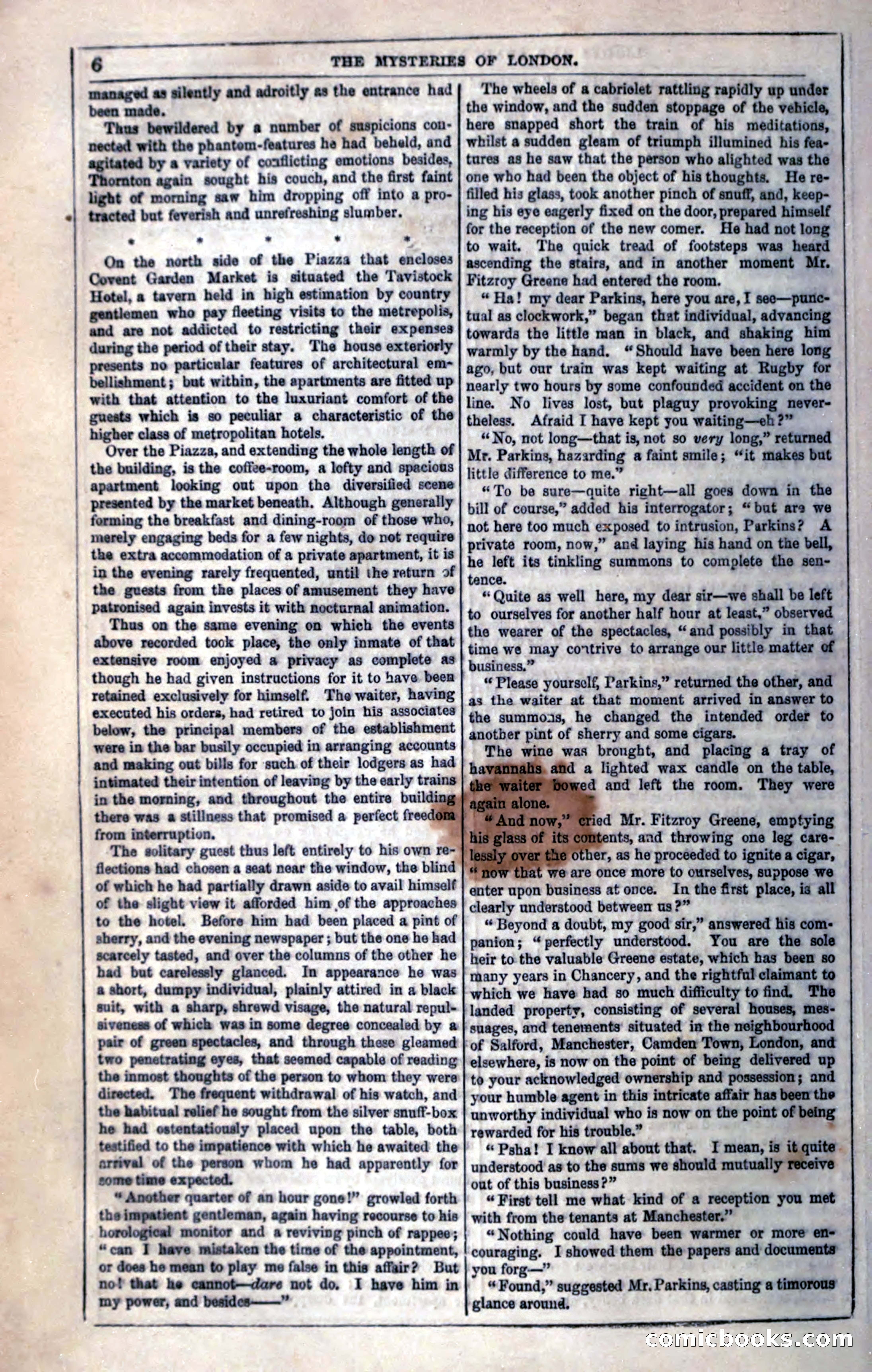
A restored page from Penny Dreadfuls, 1850. Page through the whole issue in the reader above.
📄 Transcribed text from this page (OCR, searchable)
Machine-transcribed from the original scan — historical spelling and the odd misread are preserved.
—— — ee ee managed as silently and adroitly as the entrance had been made. Thus bewildered by a number of suspicions con- nected with the phantom-features he had beheld, and agitated by a variety of coxflicting emotions besides, Thornton again sought his couch, and the first faint light of morning saw him dropping off into a pro- tracted but feverish and unrefreshing slumber. . . . . * On the north side of the Piazza that encloses Covent Garden Market is situated the Tavistock Hotel, a tavern held in high estimation by country gentlemen who pay fleeting visits to the metrepolis, and are not addicted to restricting their expenses during the period of their stay. The house exteriorly presents no particular features of architectural em- bellishment; but within, the apartments are fitted up with that attention to the luxuriant comfort of the guests which is so peculiar a characteristic of the _ higher class of metropolitan hotels. Over the Piazza, and extending the whole length of the building, is the coffee-room, a lofty and spacious apartment looking out upon the diversified scene presented by the market beneath. Although generally forming the breakfast and dining-room of those who, merely engaging beds for a few nights, do net require the extra accommodation of a private apartment, it is in the evening rarely frequented, until the return of the guests from the places of amusement they have patronised again invests it with nocturnal animation. Thus on the same evening on which the events above recorded took place, the only inmate of that extensive room enjoyed a privacy as complete as though he had given instructions for it to have been retained exclusively for himself. The waiter, having executed his orders, had retired to join his associates below, the principal members of the establishment were in the bar busily occupied in arranging accounts and making out bills for such of their lodgers as had intimated their intention of leaving by the early trains } aa in the morning, and throughout the entire buildiz there was a stillness that promised a perfect freedol from interruption. | The solitary guest thus left entirely to his own re-" , flections had chosen a seat near the window, the blind of which he had partially drawn aside to avail himself of the slight view it afforded him of the approaches to the hotel. Before him had been placed a pint of sherry, and the evening newspaper ; but the one he had scarcely tasted, and over the columus of the other he bad but carelessly glanced. In appearance he was a short, dumpy individual, plainly attired in a black suit, with a sharp, shrewd visage, the natural repul- siveness of which was in some degree concealed by a pair of green spectacles, and through these gleamed two penetrating eyes, that seemed capable of reading the inmost thoughts of the person to whom they were directed. The frequent withdrawal of his watch, and the habitual relief he sought from the silver snuff-box he had ostentatiously placed upon the table, both testified to the impatience with which he awaited the arrival of the person whom he had apparently for some time expected. “ Another quarter of an hour gone!” growled forth the impatient gentleman, again having recourse to his horological monitor and a reviving pinch of rappee; “can I have mistaken the time of the appointment, or does he mean to play me false in this affair? But not that he cannot—dare not do. I have him in my power, and besides——” RAR I EE THE MYSTERIES OF LONDON. | The wheels of a cabriolet rattling rapidly up under the window, and the sudden stoppage of the vehicle, here snapped short the train of his meditations, whilst a sudden gleam of triumph illumined his fea- tures as he saw that the person who alighted was the one who had been the object of his thoughts. He re- filled his glass, took another pinch of snuff, and, keep- ing his eye eagerly fixed on the door, prepared himself for the reception of the new comer. He had not long to wait. The quick tread of footsteps was heard ascending the stairs, and in another moment Mr. Fitzroy Greene had entered the room. “Ha! my dear Parkins, here you are, I see—puric- tual as clockwork,” began that individual, advancing towards the little man in black, and shaking him warmly by the hand. “Should have been here long ago, but our train was kept waiting at Rugby for nearly two hours by some confounded accident on the line. No lives lost, but plaguy provoking never- theless. Afraid I have kept you waiting—eh ?” “No, not long—that is, not so very long,” returned Mr. Parkins, hazarding a faint smile; “it makes but little difference to me.” “To be sure—quite right—all goes down in the bill of course,” added his interrogator; “but are we not here too much exposed to intrusion, Parkins? A private room, now,” and laying his hand on the bell, he left its tinkling summons to complete the sen- tence. “Quite as well here, my dear sir—we shall be left to ourselves for another half hour at least,” observed the wearer of the spectacles, “and possibly in that time we may contrive to arrange our little matter of business,” | “ Please yourself, Parkins,” returned the other, and as the waiter at that moment arrived in answer to the summozs, he changed the intended order to another pint of sherry and some cigars. The wine was brought, and placing a tray of hava and a lighted wax candle on the table, ed and left the room. They were ied Mr. Fitzroy Greene, emptying ents, and throwing one leg care- other, as he proceeded to ignite a cigar, jw that we are once more to ourselves, suppose we enter upon business at once. In the first place, is all clearly understood between us?” “ Beyond a doubt, my good sir,” answered his com- panion; “perfectly understood. You are the sole heir to the valuable Greene estate, which has been so many years in Chancery, and the rightful claimant to which we have had so much difficulty to find, The landed property, consisting of several houses, mes- suages, and tenements’ situated im the neighbourhood ‘of Salford, Manchester, Camden Town, London, and elsewhere, is now on the point of being delivered up to your acknowledged ownership and possession; and your humble agent in this intricate affair has been the unworthy individual who is now on the point of being rewarded for his trouble.” “Psha! I know all about that. I mean, is ed te understood as to the sums we should yi out of this business?” | “ First tell me what kind of a reception you met with from the tenants at Manchester.” “Nothing could have been warmer or more en- couraging. I showed them the papers and documents you forg—” “ Found,” suggested Mr. Parkins, casting a timorous glance around, (ECAMNCEl eKoxe) <S7Gom