
Penny Dreadfuls, 1850 · page 123 of 394
The Mysteries of London; or, Lights and Shadows of London Life — page 123: what you’re looking at
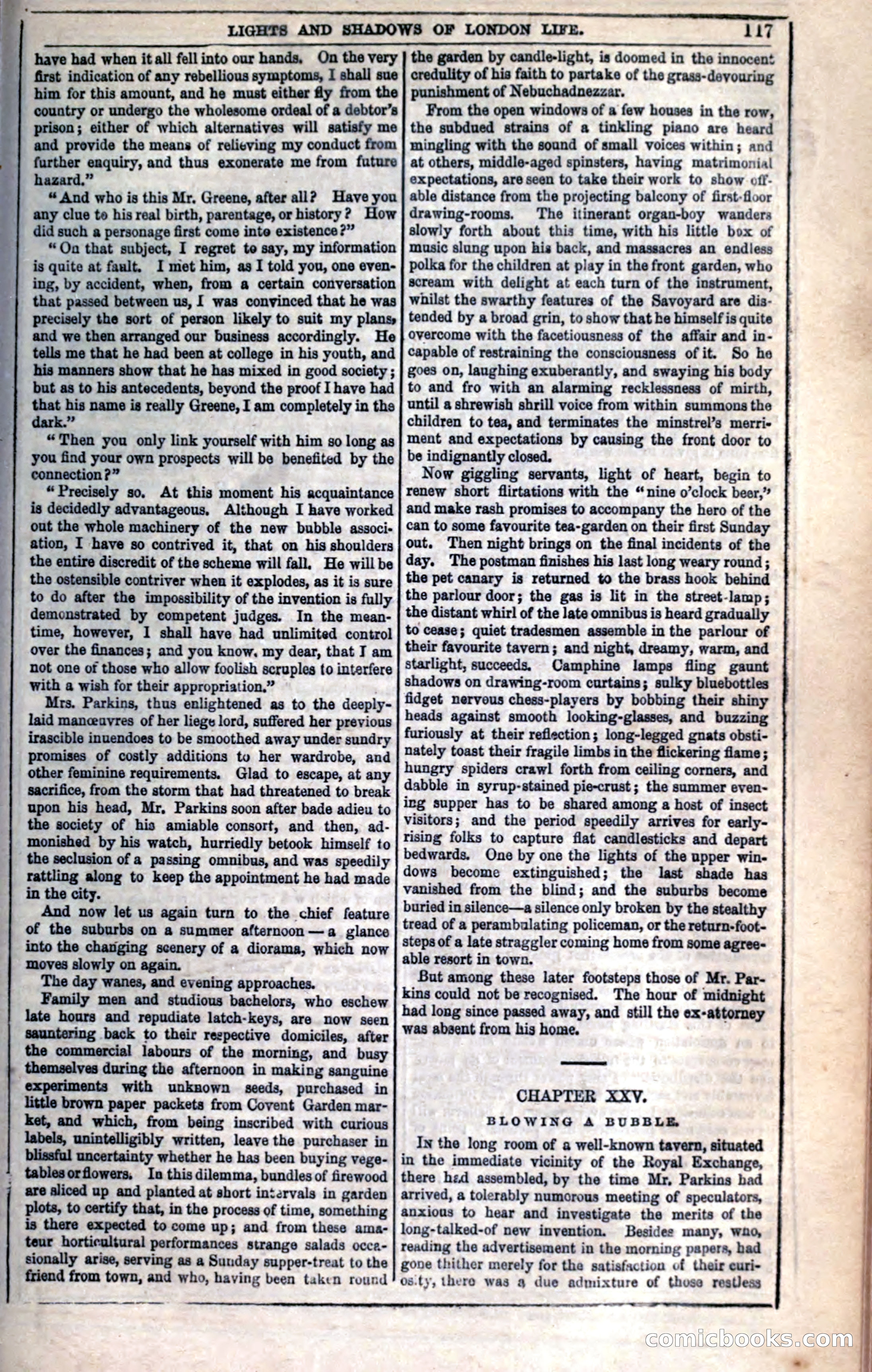
A restored page from Penny Dreadfuls, 1850. Page through the whole issue in the reader above.
📄 Transcribed text from this page (OCR, searchable)
Machine-transcribed from the original scan — historical spelling and the odd misread are preserved.
} first indication of any rebellious a and provide the means of relieving my conduct from hazard,” | did such a personage first come inte existence?” is quite at fault. I met him, as I told you, one even- and we then his manners show that he has mixed in good society ; but as to his antecedents, beyond the proof I have had that his name is really Greene, I am completely in the dar ” you find your own prospects will be benefited by the connection ?” “Precisely so. At this moment his acquaintance is decidedly advantageous, Although I have worked out the whole machinery of the new bubble associ- ation, I have so contrived it, that on his shoulders the entire discredit of the scheme will fall. He will be the ostensible contriver when it explodes, as it is sure to do after the impossibility of the invention is fully demonstrated by competent judges. In the mean- time, however, 1 shall have had unlimited control over the finances; and you know, my dear, that I am not one of those who allow foolish scruples to interfere with a wish for their appropriation.” , Mrs. Parkins, thus enlightened as to the deeply- laid manceayres of her liege lord, suffered her previous irascible inuendoes to be smoothed away under sundry promises of costly additions to her wardrobe, and other feminine requirements. Glad to escape, at any sacrifice, from the storm that had threatened to break upon his head, Mr, Parkins soon after bade adieu to the society of his amiable consort, and then, ad- monished by his watch, hurriedly betook himself to the seclusion of a passing omnibus, and was speedily rattling along to keep the appointment he had made And now let us again turn to the chief feature The day wanes, and evening approaches. Family men and studious bachelors, who eschew late hours and repudiate latch-keys, are now seen sauntering back to their regpective domiciles, after commercial labours of the morning, and busy during the afternoon in making sanguine unknown seeds, purchased in paper packets from Covent Garden mar- i are sliced up and planted at short intervals in garden plots, to certify that, in the process of time, something is there expected to come up; and from these ama- teur horticultural performances strange salads occa- sionally arise, serving as a Suuday supper-treat to the friend from town, and who, having been taken round 7 eee eel LIGHTS AND SHADOWS OF LONDON LIFE. have had when it all fell into our hands, On the very I shall sue } him for this amount, and he must either fy from the | country or undergo the wholesome ordeal of a debtor’s | prison; either of which alternatives will satisfy me further enquiry, and thus exonerate me from future “ And who is this Mr. Greene, after all? Have you any clue to his real birth, parentage, or history? How “On that subject, I regret to say, my information ing, by accident, when, from a certain conversation | that passed between us, I was convinced that he was _ precisely the sort of person likely to suit my plans, our business accordingly. He tells me that he had been at college in his youth, and “Then you only link yourself with him so long as 117 the garden by candle-light, is doomed in the innocent credulity of his faith to partake of the grass-devouring punishment of Nebuchadnezzar. From the open windows of a few houses in the row, the subdued strains of a tinkling piano are heard mingling with the sound of small voices within; and at others, middle-aged spinsters, having matrimonial expectations, are seen to take their work to show off- able distance from the projecting balcony of first-floor drawing-rooms. The itinerant organ-boy wanders slowly forth about this time, with his little box of music slung upon his back, and massacres an endless polka for the children at play in the front garden, who scream with delight at each turn of the instrument, whilst the swarthy features of the Savoyard are dis- tended by a broad grin, to show that he himself is quite overcome with the facetiousness of the affair and in- capable of restraining the consciousness of it. So he goes on, laughing exuberantly, and swaying his body to and fro with an alarming recklessness of mirth, until a shrewish shrill voice from within summons the children to tea, and terminates the minstrel’s merri- ment and expectations by causing the front door to be indignantly closed. Now giggling servants, light of heart, begin to renew short flirtations with the “nine o’clock beer,” and make rash promises to accompany the hero of the can to some favourite tea-garden on their first Sunday out. Then night brings on the final incidents of the day. The postman finishes his last long weary round; the pet canary is returned to the brass hook behind the parlour door; the gas is lit in the street-lamp; the distant whirl of the late omnibus is heard gradually to cease; quiet tradesmen assemble in the parlour of their favourite tavern; and night, dreamy, warm, and starlight, succeeds. Camphine lamps fling shadows on drawing-room curtains; sulky bluebottles fidget nervous chess-players by bobbing their shiny heads against smooth looking-glasses, and buzzing furiously at their reflection; long-legged gnats obsti- nately toast their fragile limbs in the flickering flame; hungry spiders crawl forth from ceiling corners, and dabble in syrup-stained pie-crust; the summer even- ing supper has to be shared among a host of insect visitors; and the period speedily arrives for early- rising folks to capture flat candlesticks and depart bedwards. One by one the lights of the upper win- dows become extinguished; the last shade has vanished from the blind; and the suburbs become buried in silence—a silence only broken by the stealthy tread of a perambulating policeman, or the return-foot- steps of a late straggler coming home from some agree- able resort in town. But among these later footsteps those of Mr. Par- kins could not be recognised. The hour of midnight had long since passed away, and still the ex-attorney was absent from his home. CHAPTER XXY. BLOWING A BUBBLE In the long room of a well-known tavern, situated in the immediate vicinity of the Royal Exchange, there hed assembled, by the time Mr, Parkins bad arrived, a tolerably numorous meeting of speculators, anxious to hear and investigate the merits of the long-talked-of new invention. Besides many, wno, reading the advertisement in the morning papers, had gone thither merely for the satisfaction of their curi- os.ty, there was q due admixture of those restless ———— ee ee ee SE MICLOO© (E() Ss (EO) @s